How Far Apart to Plant Apple Trees: Spacing by Rootstock
How far apart to plant apple trees depends on the rootstock more than anything else. The right gap gives each tree full sun, moving air, and room to work. The wrong one leaves crowded canopies shading each other’s fruit for years.
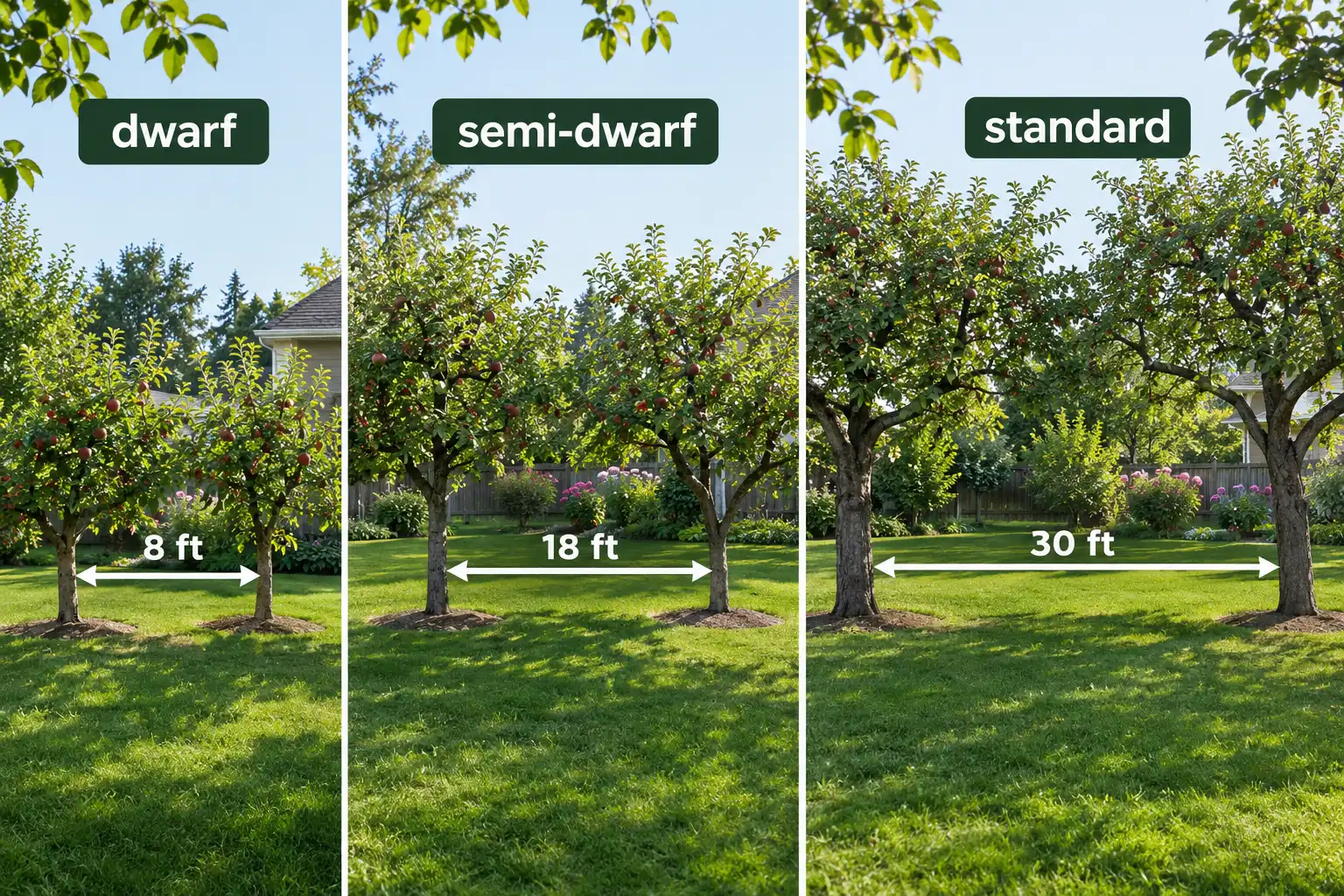
To decide how far apart to plant apple trees, start with the rootstock. Virginia Tech sets home orchard minimums of 8 feet for dwarf, 18 for semi-dwarf, and 30 for standard trees. Rows run wider.
Apple Tree Spacing Starts With the Rootstock
The rootstock sets a tree’s mature size, so it sets the spacing too. Virginia Tech Extension’s home fruit guide gives a clear example. The same variety grows 16 to 18 feet tall on MM.111 roots, but only 7 to 8 feet on M.9.
That means the variety name tells you little about spacing. A Honeycrisp on M.9 and a Honeycrisp on MM.111 need very different room.
So check the nursery tag first. Virginia Tech warns that many apple trees sold to home growers say “dwarf” without showing how dwarfing the rootstock is. Look for the rootstock name, such as B.9, M.9, G.41, M.26, M.7, or MM.111. If the tag lists none, ask the nursery before you buy.
Spacing also has two parts. In-row spacing is the distance between trunks along a row. Row spacing is the distance between rows. Home tables often give one number for a square grid, while orchard tables give both. Because the rootstock also shapes bearing age and disease risk, settle it alongside your apple variety choices.
Apple Tree Spacing Chart by Rootstock
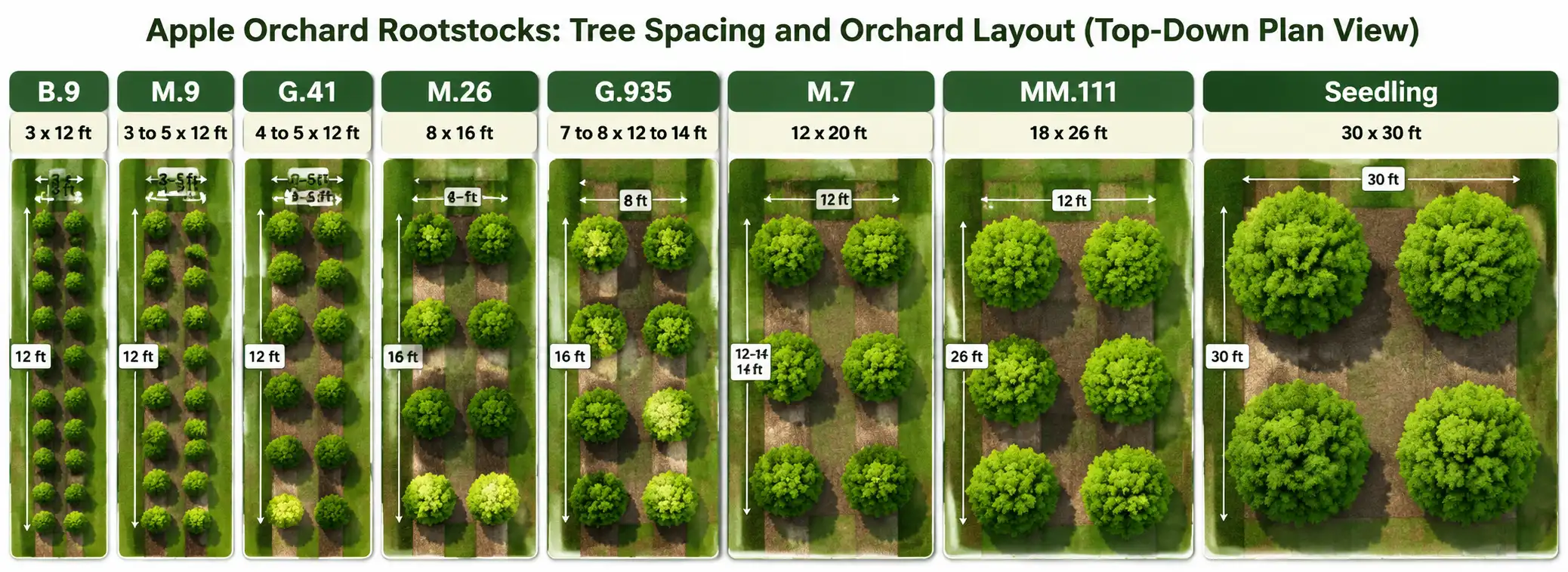
Penn State Extension’s home orchard spacing table, updated in June 2026, gives both spacings for each common apple rootstock. We added trees per acre so you can compare density at a glance.
| Rootstock | Size class | Tree size (% of seedling) | In row x between rows (feet) | Trees per acre |
|---|---|---|---|---|
| B.9 | Dwarf | 25 | 3 x 12 | 1,210 |
| M.9 | Dwarf | 35 | 3 to 5 x 12 | 726 to 1,210 |
| G.41 | Dwarf | 35 | 4 to 5 x 12 | 726 to 908 |
| M.26 | Semi-dwarf | 40 | 8 x 16 | 340 |
| B.10 | Semi-dwarf | 40 | 7 to 8 x 12 to 14 | 389 to 519 |
| G.935 | Semi-dwarf | 40 to 45 | 7 to 8 x 12 to 14 | 389 to 519 |
| M.7 or M.7A | Semi-dwarf | 60 | 12 x 20 | 182 |
| MM.111 | Semi-dwarf | 70 | 18 x 26 | 93 |
| Seedling | Standard | 100 | 30 x 30 | 48 |
Spacings for B.9 through MM.111 come from Penn State. The seedling row uses Virginia Tech’s 30-foot minimum on a square grid. Trees per acre = 43,560 ÷ (in-row spacing × row spacing), rounded. Both sources are Mid-Atlantic programs, so compare them with your own state’s extension guidance.
Smaller trees yield less each, but far more of them fit. At 10 years or older, Penn State lists 1 to 2 bushels per tree on B.9, M.9, and G.41. Trees on MM.111 average 20 to 25 bushels. Per acre, the totals land close. On paper, 1,210 B.9 trees give 1,210 to 2,420 bushels. In contrast, 93 MM.111 trees give about 1,860 to 2,325.
How Far Apart to Plant Dwarf Apple Trees
Plant dwarf apple trees 3 to 8 feet apart in the row, depending on how you train them. The two extension figures differ because they describe different setups.
Virginia Tech lists 8 feet as the minimum distance between dwarf apple trees in a home orchard. That suits free-standing trees you can walk around. Penn State packs dwarfs much tighter, all in 12-foot rows. It spaces B.9 at 3 feet, M.9 at 3 to 5 feet, and G.41 at 4 to 5 feet. Spacing that tight works only when you train trees into a narrow, supported row.
So match the number to your plan. For separate trees, use about 8 feet. For a trained row on wire, the Penn State range applies.
Either way, dwarf apples need support. Virginia Tech says trees on M.9 have brittle roots and need a post, trellis, or similar support. Set the posts and trellis wire before planting, because the support line fixes the row.
Dwarf trees also fruit soonest. Virginia Tech puts them at 2 to 3 years to bearing. Plant dwarf apples in spring 2027, and the first fruit could come in 2029 or 2030.
How Far Apart to Plant Semi-Dwarf Apple Trees
Plant semi-dwarf apple trees about 7 to 18 feet apart in the row. The range is wide because semi-dwarf rootstocks vary a lot. In Penn State’s table, they run from 40 percent of seedling size for M.26 to 70 percent for MM.111.
The smaller semi-dwarfs sit at the low end. Penn State spaces M.26 at 8 by 16 feet. B.10 and G.935 get 7 to 8 feet by 12 to 14 feet. The vigorous ones need far more: 12 by 20 feet for M.7, and 18 by 26 feet for MM.111. Virginia Tech’s home table gives a single 18-foot minimum for semi-dwarf trees, which matches the top of that range.
Because of that spread, a “semi-dwarf” tag can’t set your spacing on its own. An M.26 tree planted 18 feet apart wastes ground. An MM.111 tree planted 8 feet apart will crowd its neighbors.
Soil narrows the choice further. Penn State says MM.111 needs very well-drained soil. Keep it out of slow-draining ground and heavy clay. Virginia Tech also notes that M.7 trees may need support in their early years.
Semi-dwarf trees take longer to fruit than dwarfs. Virginia Tech puts them at 4 to 6 years to bearing. So a spring 2027 planting would first fruit between 2031 and 2033.
How Far Apart to Plant Standard Apple Trees
Plant standard apple trees at least 30 feet apart. That’s Virginia Tech’s minimum for standard trees, which grow on seedling rootstock. The same table notes that trees can go farther apart when space allows.
On a square 30-foot grid, an acre holds about 48 standard trees (43,560 ÷ 900). Each tree claims about 900 square feet, so two of them need 1,800 square feet of open, sunny ground.
Standard trees bring other trade-offs. Virginia Tech puts them at 6 to 10 years to first bearing. That means a tree planted in 2027 may not fruit until 2033 to 2037. On the plus side, they live longest, at 35 to 45 years against 30 to 35 for dwarfs.
Full-size trees also mean long ladder work for pruning and harvest, and ladder falls are a serious injury risk. For most home plantings, a smaller rootstock fits more varieties and earlier fruit into the same ground.
How Far Apart Should Apple Trees Be in Rows?
Rows should sit about 1.3 to 1.5 times the expected tree height apart. That rule comes from a Michigan State University planning method published by UMass Extension.
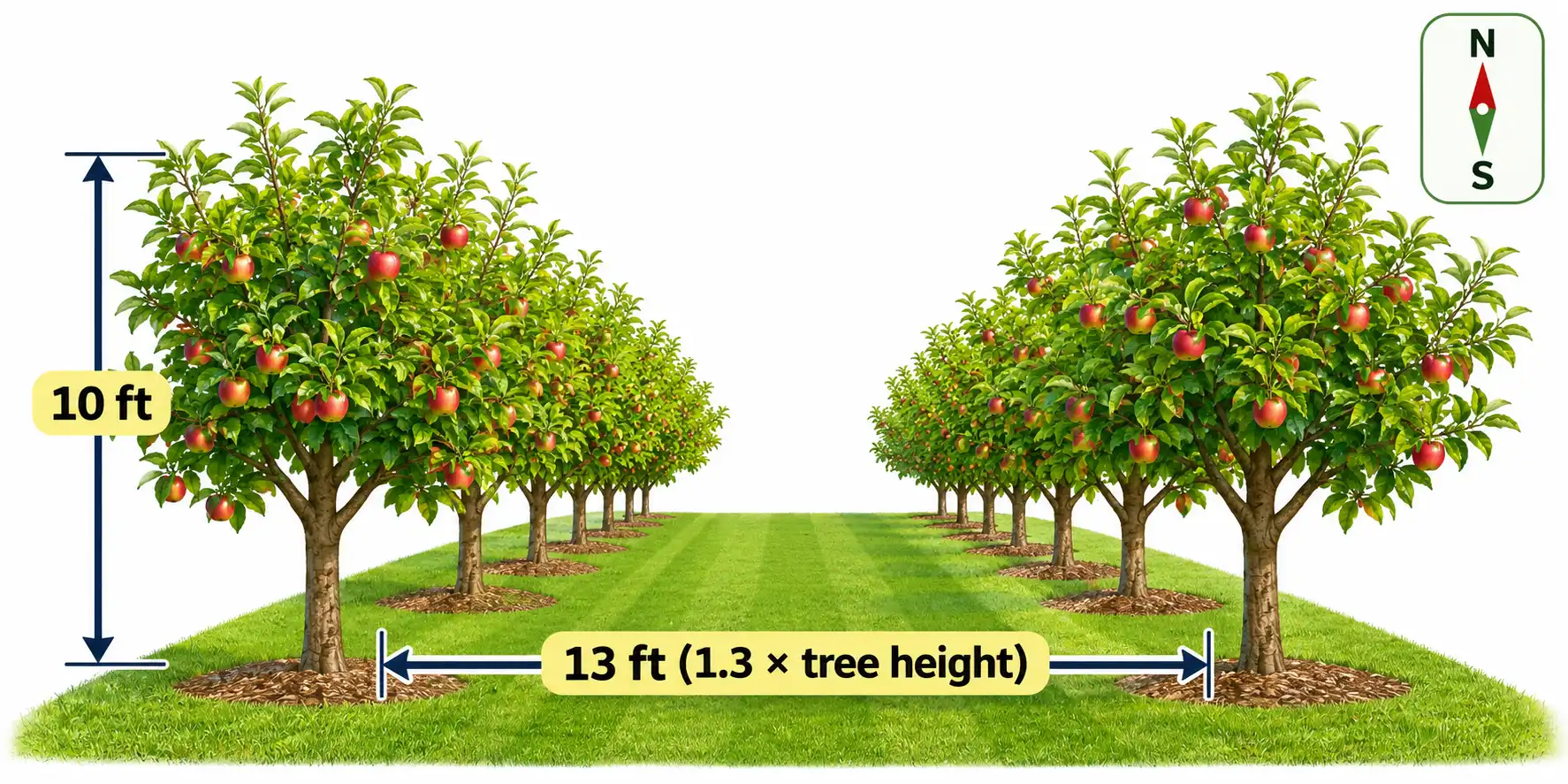
The method uses 1.3 times the tree height for rows that run north to south. For rows that run east to west, it uses 1.5 times. Michigan State built it for Michigan sites, so treat the result as a starting point elsewhere.
Run it for your own trees:
Row spacing = expected tree height × 1.3 (north-south rows) or × 1.5 (east-west rows)
For example, a 10-foot tree needs about 13 feet between north-south rows, or 15 feet between east-west rows. An 8-foot tree needs about 10.4 or 12 feet.
Next, check the lane against your equipment. The gap between canopies must fit your mower, cart, or tractor, with room to turn at row ends. If it doesn’t, widen the rows now, since a planted orchard can’t move.
Penn State’s figures follow the same pattern. Its rows widen as trees grow larger. They run 12 feet for the smallest dwarfs, 16 for M.26, 20 for M.7, and 26 for MM.111.
Apple Orchard Row Spacing in High-Density Plantings
Commercial apple orchards plant far tighter than home tables. Cornell Cooperative Extension’s tall spindle guide targets New York growers. It puts the best spacing at 3 by 11 feet for an average-vigor variety and soil. Its maximum is 4 by 12 feet.
At 3 by 11 feet, that’s about 1,320 trees per acre (43,560 ÷ 33). At 4 by 12 feet, it’s about 908. Cornell describes the system at 1,000 to 1,500 trees per acre.
The tight spacing only works as a package:
- Fully dwarfing rootstocks. Cornell names M.9 and B.9 as the most successful, with G.41, G.11, and G.16 also suited.
- A support system. Cornell lists a stake at each tree or a 4-wire trellis on 12-foot posts.
- Low-vigor matches. Cornell keeps more vigorous rootstocks for the weakest-growing varieties, such as Spur Delicious.
The Michigan State method agrees. It multiplies in-row spacing by 0.4 for tall spindle and V-trellis plantings. Each acre takes over 1,000 trees plus trellis. So run the setup budget with your county extension office before you commit.
Spacing for Apple Trees in a Backyard Orchard
In a backyard, spacing becomes a simple count of how many trees fit. That count shapes the rest of planning a home fruit planting. Divide the row length by the in-row spacing and round down. That leaves at least half a spacing at each end, so outer canopies stay off the fence.
Trees in a row = row length ÷ in-row spacing, rounded down
For a 60-foot fence line:
- Dwarf trees at Virginia Tech’s 8-foot minimum: 60 ÷ 8 = 7.5, so 7 trees
- Semi-dwarf trees on M.7 at Penn State’s 12 feet: 60 ÷ 12 = 5 trees
- Standard trees at Virginia Tech’s 30 feet: 60 ÷ 30 = 2 trees
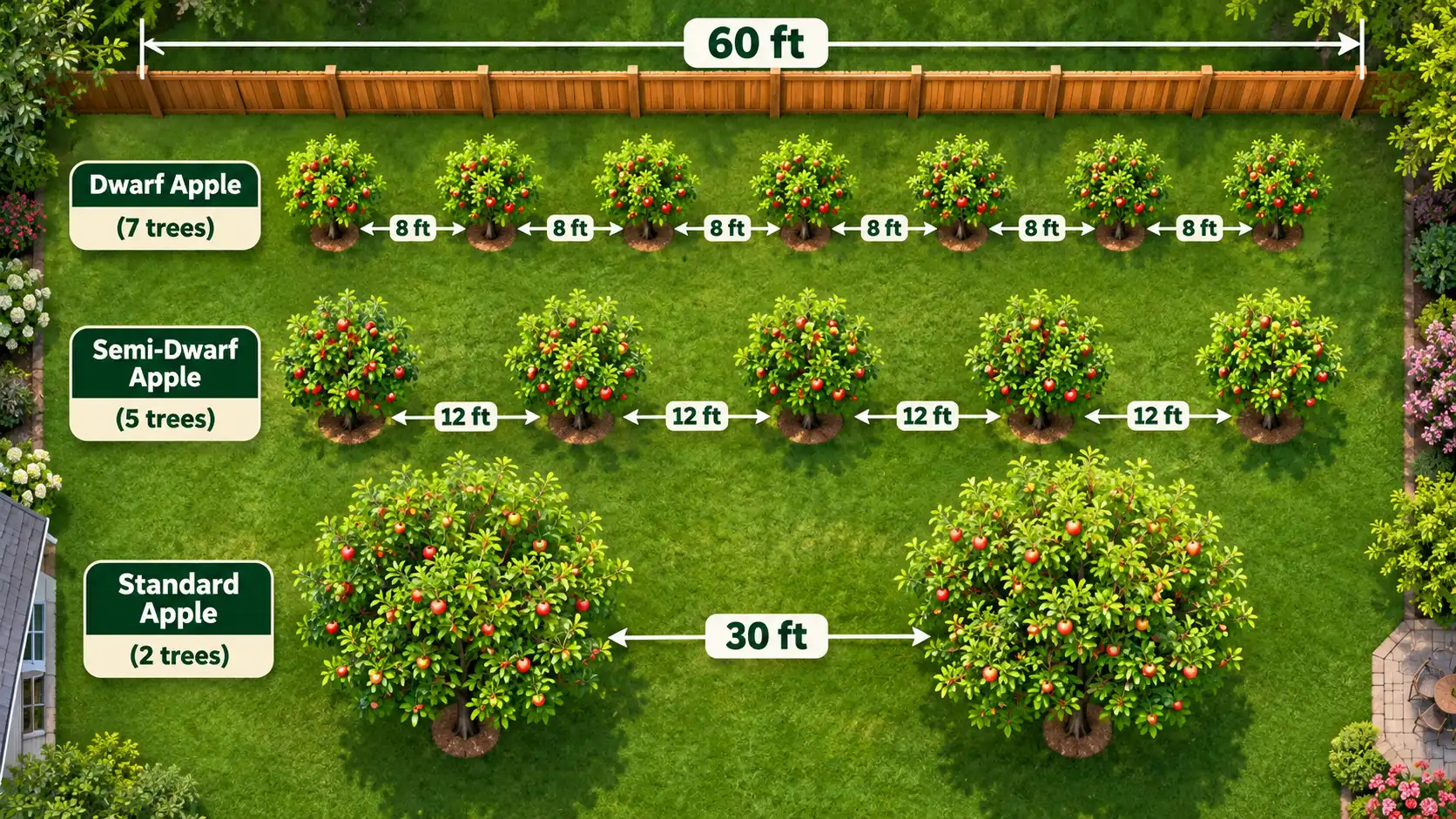
For a block of rows, use: trees = open area in square feet ÷ (in-row spacing × row spacing). Measure only the sunny, open ground, not the whole lot.
Two more checks belong in a yard plan. First, keep pollination partners close. Iowa State Extension’s pollination guidance calls for at least two apple varieties within 50 to 100 feet of each other. The pair also needs overlapping bloom times. Second, keep trees out from under power lines, and leave a walkway between canopies and the house.
How Close Can You Plant Apple Trees?
The closest spacing in these extension sources is 3 feet between trunks. Penn State lists it for B.9 and the low end of M.9. Cornell uses it for tall spindle orchards on M.9 and B.9.
That spacing comes with firm conditions. The rootstock must be fully dwarfing, and every tree needs a stake or trellis. The trees also need yearly pruning and training to stay narrow.
Close spacing on a vigorous tree fails, and the Michigan State method shows why. It adds in-row space for vigorous varieties, fertile clay loam, drip irrigation, and light pruning. Each one grows a bigger tree. Its own examples show the spread. Empire on dwarfing Mark rootstock gets 4.5 feet in the row, while McIntosh on MM.106 gets 14 feet.
Spacing Mistakes That Cost Fruit
Most spacing problems start on planting day. Once trees are in, fixing them means moving or removing trees.
Buying by the Size Label Alone
A “dwarf” or “semi-dwarf” tag can hide very different vigor, as Virginia Tech warns. Get the rootstock name before you set the spacing.
Burying the Graft Union
UMass Extension’s advice on graft union height sets the union 2 to 3 inches above the ground. If it ends up buried, the variety above it can form its own roots and grow into a standard-size tree. The same source warns that soil can settle, so recheck the height after setting the graft union at planting.
Spacing for the Nursery Tree, Not the Mature One
A young whip looks tiny next to an 8-foot gap. Space it for its mature size in the chart above, not its size on planting day.
Skipping Support on Dwarf Trees
Virginia Tech says M.9 roots are brittle and need a post or trellis. Put the support in at planting time, beside the tree.
Rows Too Narrow for Your Mower
Measure your mower or cart before you stake rows. A lane that fits a young orchard can close up once canopies fill in.
FAQs About Apple Tree Spacing
Can I plant two apple trees 10 feet apart?
Yes, if both grow on a dwarf rootstock such as M.9, B.9, or G.41. Semi-dwarf trees on M.7 or MM.111 need 12 to 18 feet in the row, according to Penn State Extension.
How many apple trees fit on a quarter acre?
About 170 dwarf, 33 semi-dwarf, or 12 standard apple trees, using Virginia Tech’s minimum spacings on a square grid. That assumes all 10,890 square feet is open, sunny ground, which few lots offer.
How close to a house can I plant an apple tree?
Plant it at least half its spacing figure from the wall. A dwarf at 8-foot spacing, for example, sits 4 or more feet out. The extension tables cited here give no fixed setback, so add room for a ladder.
Does soil change how far apart apple trees should be?
Yes. The Michigan State method adds up to 3 feet of in-row space on fertile clay loam. Deep sandy or gravelly soil adds none. Richer soil grows a bigger tree that needs more room.
Do columnar apple trees need less space?
Nurseries say so, with some catalogs listing columnar apples at 2 to 3 feet apart. That figure is the seller’s claim, though. Independent extension trial data on columnar spacing is limited, so check the rootstock and stated mature width.
Before You Plant
Find the rootstock name first, then take its spacing from the chart above. Set row width from the tree’s mature height and your mower, and keep pollination partners within 100 feet. At planting, keep the graft union above the soil and put supports in for dwarf trees. Your county extension office can check the plan against local soils and varieties.