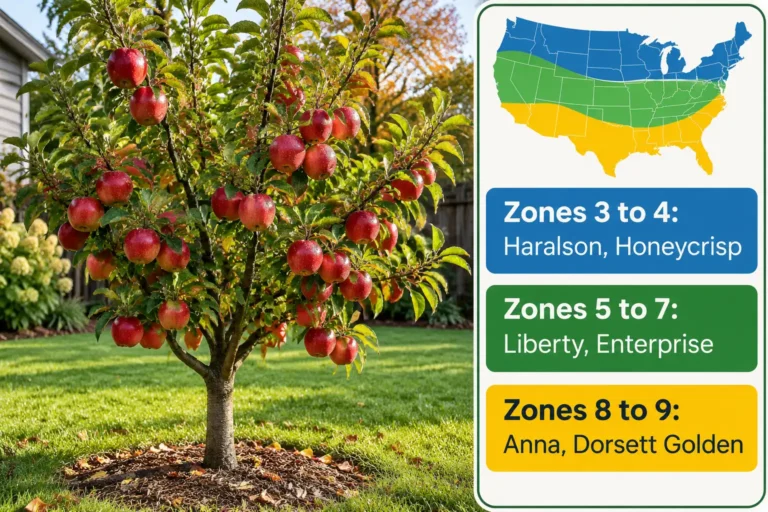
How to Plant an Apple Tree: Timing, Hole Size, and Graft Depth

Learning how to plant an apple tree comes down to four choices: when, where, how deep, and what goes in the hole. Each one shapes the tree for decades, and each changes with your region and rootstock.
To plant an apple tree, set it out while dormant: early spring up north, fall or winter where winters are mild. Dig the hole twice as wide as the roots, refill with native soil, and keep the graft union aboveground.
When to Plant Apple Trees
Plant an apple tree while it is dormant, and let your region set the window. Cold-winter areas plant in early spring. Mild-winter areas can also plant in fall or winter.
| Region | Best time to plant an apple tree | Source |
|---|---|---|
| Iowa and similar cold-winter areas | Early spring, once the soil is workable and severe freezes have passed | Iowa State Extension |
| Virginia | About a month after the first killing frost in fall, or about a month before bloom in spring | Virginia Tech |
| California | December through March, when nurseries stock bare-root trees | UC ANR Master Gardeners, Alameda County |
The spring timing comes from Iowa State Extension’s apple guide. The Virginia windows come from Virginia Tech’s Tree Fruit in the Home Garden. For California, see UC ANR’s Alameda County Master Gardeners.
Bare-root apple trees need that dormant window, because they arrive with no soil on their roots. Container trees are more flexible. Still, a potted tree set out in summer heat needs far more water.

Planting Apple Trees in Spring
In spring, plant early, as long as the ground cooperates. Iowa State Extension advises waiting only until the soil is workable and severe freezes have passed. So squeeze a handful of soil first. If it crumbles, dig. If it forms a sticky ball, wait a few days, because wet soil packs hard around new roots.
Also plant before the buds break. A tree that leafs out first must feed new leaves from roots that have not regrown yet. For that reason, order bare-root trees for early delivery and pick the site before they arrive.
Where to Plant an Apple Tree
Plant an apple tree in full sun and deep, well-drained soil, away from low spots. For an apple tree in California, UC ANR Publication 8048 calls for full sun 6 or more hours a day. In Maine, UMaine Extension asks for soil at least 18 inches deep. It also warns that apple trees are especially sensitive to waterlogging.
Next, check air drainage. Cold air pools in low ground, so a frost pocket can kill blossoms in a late spring frost. Iowa State Extension favors a slightly raised spot for that reason.
Then test the soil. UMaine Extension targets a pH of 6.0 to 7.0 for apple plantings in Maine. Iowa State Extension gives 6.5 to 7.0 for Iowa. A lab test shows where your yard falls, and testing your soil before planting also tells you whether you need lime. UMaine notes that lime goes in most easily before the tree does.
Finally, skip any spot where apples or pears recently failed. Iowa State Extension warns that soilborne disease risk runs higher there.
Pollination Partners
Plant at least two apple varieties that bloom at the same time. Iowa State Extension gives that minimum for Iowa. It also notes that most flowering crabapples will pollinate nearby apples if bloom overlaps. Virginia Tech asks for more: at least three apple varieties for good cross-pollination in Virginia. So treat two as the floor, and add a third variety or a crabapple where space allows. Before you buy, confirm the bloom overlap between apple varieties.
Spacing by Rootstock
Space apple trees by rootstock, because rootstock sets the tree’s final size. The two sources differ, so the table gives both.
| Apple rootstock class | Iowa State spacing (Iowa) | Virginia Tech minimum spacing (Virginia) |
|---|---|---|
| Dwarf | 8 to 12 feet | 8 feet |
| Semi-dwarf | 10 to 16 feet | 18 feet |
| Standard (seedling) | 18 to 24 feet | 30 feet |
Variety vigor, soil, and training push a tree toward one end of each range.
To see how many trees fit, divide your planting area by the spacing squared. For example, take a 20 by 30 foot bed, which is 600 square feet. It holds about 9 dwarf apple trees at 8 feet (600 / 64), but only 4 at 12 feet (600 / 144). On a full acre, the same math gives about 680 dwarf apple trees at 8 feet (43,560 / 64). In contrast, it fits about 48 standard apple trees at Virginia Tech’s 30 feet (43,560 / 900).
How Wide and How Deep to Dig the Hole
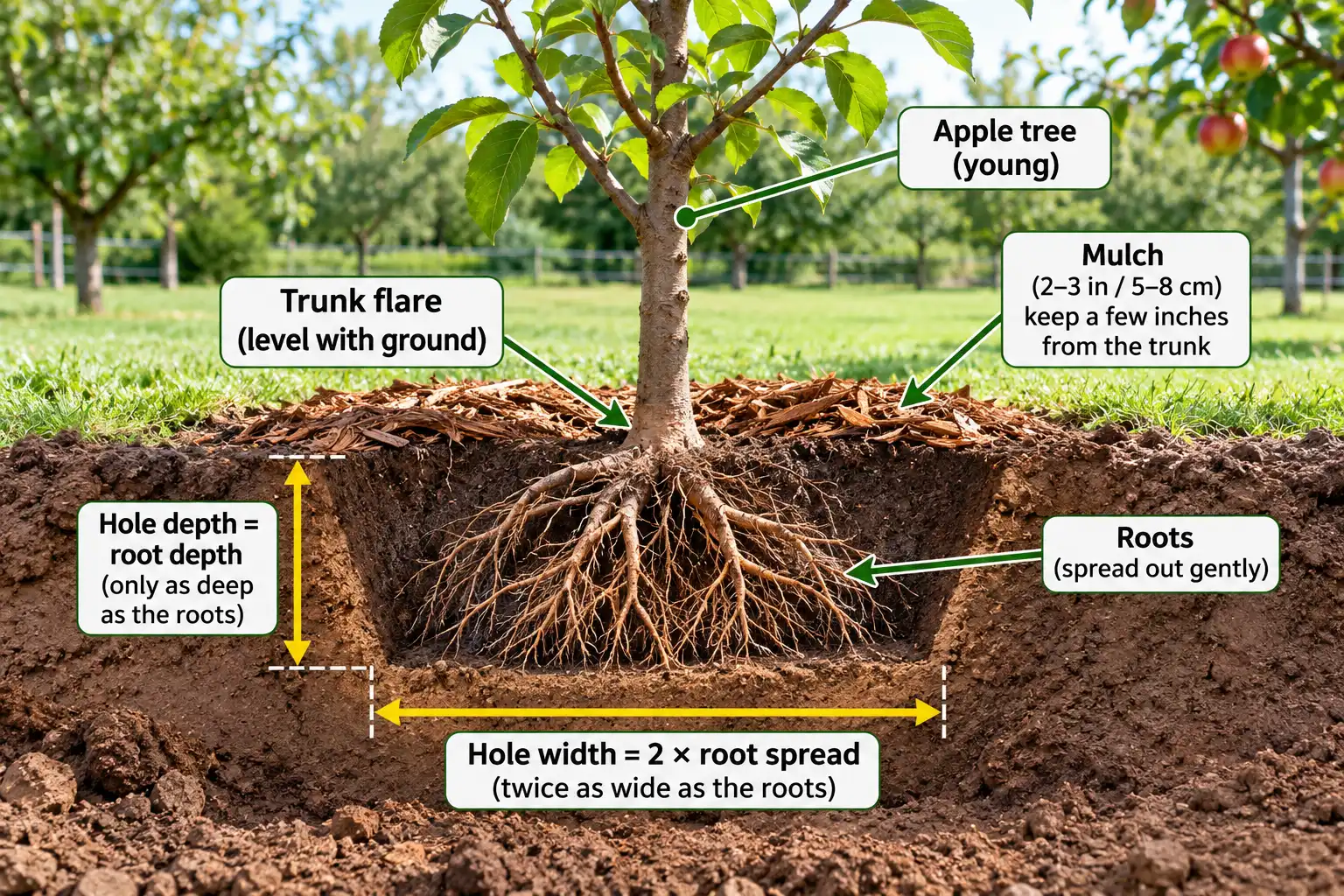
For an apple tree, dig the hole at least twice as wide as the root spread and only as deep as the roots. UC ANR sets that width for California. It also says the hole should go no deeper than the root ball unless the soil is compacted deep down. For Iowa, Iowa State Extension’s bare-root guide suggests 2 to 2.5 times the root spread.
Width matters more than depth. New roots grow outward, and loose soil makes that easier. A deep hole, on the other hand, lets the tree sink as the soil settles.
So measure before you dig. Say your bare-root apple tree has roots spreading 18 inches. UC ANR’s rule calls for a hole about 36 inches across, while Iowa State’s calls for 36 to 45 inches.
For depth, Iowa State Extension matches the hole to the distance from the trunk flare to the bottom of the roots. That way, the flare sits level with the surrounding soil.
How Deep to Plant an Apple Tree
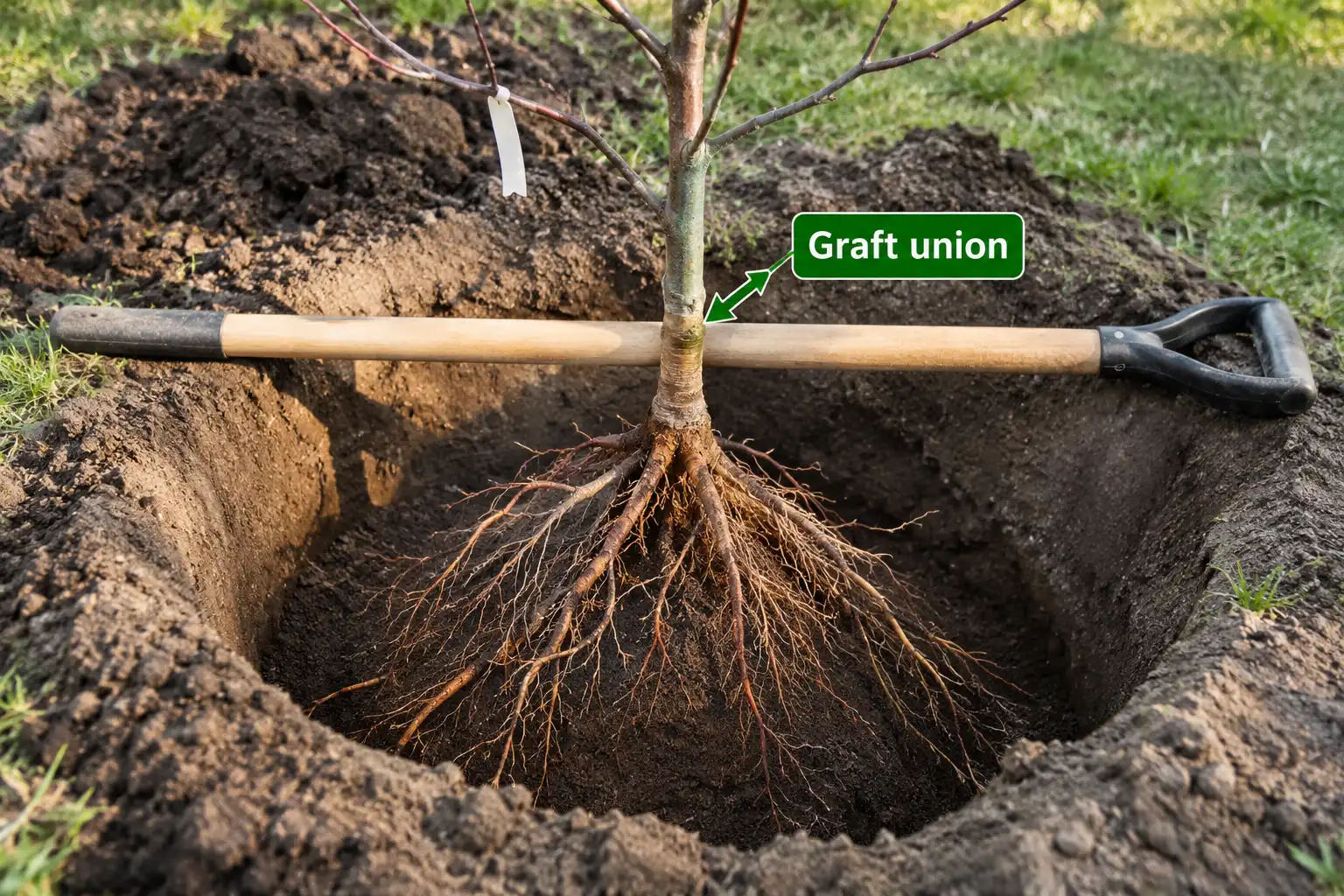
Plant an apple tree so the graft union stays above the soil line. The graft union is the swollen joint near the base of the trunk where the variety meets the rootstock. Iowa State Extension notes that it usually sits 1 to 3 inches above the trunk flare, so the two are easy to confuse.
| Source and region | Graft union height above the soil |
|---|---|
| UMaine Extension, Maine (dwarf and semi-dwarf apple) | 1 to 3 inches |
| UC ANR, California | At least 2 to 4 inches |
| Virginia Tech, Virginia | Never below the soil once the hole is filled |
The reason is size control. UMaine Extension warns that a buried union lets roots form above the graft. The tree then grows to full size instead of staying dwarf or semi-dwarf. UC ANR also advises turning the bulge of the union toward the northeast to cut sunburn risk in California.
Loose soil settles after watering, so check the union again after the first few waterings. If the tree has sunk, UC ANR’s Alameda County Master Gardeners advise loosening the fill and rebuilding the mound.
What to Put in the Planting Hole
Put nothing in the planting hole except the soil you dug out. UMaine Extension says fertilizer in the hole can burn roots and stunt the tree. UC ANR likewise advises against adding amendments or fertilizer to the hole. Iowa State Extension also rules out compost, moss, and sand in the backfill.
Here is what goes in:
- Native soil, broken up so no large clods remain
- Water, added in stages as you backfill
- Nothing else: no fertilizer, compost, peat, or sand
If your soil needs organic matter, improve the whole area instead. UMaine Extension says compost can be tilled into the soil before planting and mixed well. Similarly, UC ANR suggests working well-decomposed compost into the surrounding soil before you dig.
Hold off on fertilizer, too. Virginia Tech states that a new tree needs no fertilizer at planting time. UC ANR says to wait until new growth is several inches long. After that, base any feeding on a soil test and your county extension office’s advice for apples in your region.
How to Plant an Apple Tree From Bare Root
A bare-root apple tree settles best when you work in this order. The steps follow Iowa State Extension’s bare-root guide and UC ANR’s planting advice.
- Keep the roots moist. If planting is delayed, Iowa State advises storing bare-root trees near 40 degrees F. The packing should feel like a wrung-out sponge, and the roots should never dry out.
- Soak the roots for 1 to 2 hours. Iowa State gives that soak time for bare-root trees just before planting. It rehydrates roots after shipping.
- Trim damaged roots. UC ANR says to cut off broken or kinked roots. Widen the hole rather than shortening healthy ones.
- Dig and build a cone. Dig the hole twice as wide as the roots. Then build a cone of native soil in the center.
- Set the tree and check the depth. Spread the roots over the cone without bending them. Next, lay a shovel handle across the hole to confirm the graft union sits above grade.
- Backfill in stages. Firm the soil by hand. Iowa State advises watering when the hole is three-fourths full and again at grade, which removes air pockets.
- Water deeply. UMaine Extension recommends 2 to 5 gallons per tree in Maine, applied slowly so it soaks in.
How to Plant a Potted Apple Tree
A potted apple tree goes in much like a bare-root one, with three differences.
First, fix the roots. UC ANR warns that container-grown trees may have circling or girdling roots. Gently pull them away from the root ball before you plant.
Second, set the depth by the graft union, not the potting mix. The mix may sit higher or lower on the trunk than the right planting depth. So find the trunk flare and set it level with the ground. The union should then sit above the soil.
Third, the timing loosens. UC ANR allows planting through the year in California. However, a container apple tree set out in the growing season needs basin watering. UC ANR’s guide says to fill the basin once or twice a week in hot weather.
Otherwise, follow the same rules. Dig the hole twice as wide as the root ball, and backfill with native soil only.
How to Plant a Dwarf Apple Tree
A dwarf apple tree needs exact depth and support from day one. Depth comes first, because a buried graft union cancels the dwarfing rootstock.
Support comes second. UMaine Extension’s rootstock page says dwarf apple trees have weak roots. They will not hold themselves up once they bear fruit, so they need a stake or trellis. Virginia Tech is more specific. Trees on M.9 must have mechanical support, and most varieties on M.7 need it, while MM.111 does not.
Set the stake when you plant. Iowa State Extension advises a sturdy stake just outside the root ball, with a soft, flexible tie. Check the tie often so it doesn’t rub or girdle the trunk. A stake driven later can tear new roots.
Advice splits on semi-dwarf trees. UMaine Extension says semi-dwarf trees do not need staking, while Iowa State says some need permanent support. The rootstock decides it, so ask the nursery which one your tree is on. If space is tight, dwarf and container fruit trees fit patios and small yards.
Water and Mulch After Planting
Water a new apple tree often in its first season, then taper off. In Iowa, Iowa State Extension advises checking 3 to 4 times a week at first, then weekly as the season goes on. Each watering should soak the soil 12 to 18 inches deep.
In Maine, UMaine Extension suggests about 5 gallons per tree per week during dry periods. At that rate, three young apple trees need about 15 gallons a week in a dry Maine spell (3 x 5). Iowa State adds that dry-weather watering should continue for one to two more years.
Still, don’t overdo it. UMaine Extension warns that apple roots are sensitive to flooding. So skip a watering when the soil is still moist a few inches down.
Next, mulch with bark or wood chips. UMaine Extension advises against straw and fabric mulch, which favor root rot and attract voles. Also keep mulch pulled back from the trunk, as Virginia Tech advises, so mice can’t hide against the bark.
Protect and Prune the New Tree
Wrap the trunk before rabbits find it. Virginia Tech recommends galvanized hardware cloth with 1/4-inch mesh, cut into 14 by 18 inch pieces. Wrap it around the trunk and push the bottom edge into the soil. The guard can stay on all year, and comparing trunk guards for young trees helps you match one to your pests.
In hot, sunny regions, protect the bark from sunburn as well. For young trunks in California, UC ANR suggests white interior latex paint diluted to half strength with water.
Then make the first pruning cut. Sources disagree on the height:
- UC ANR (California): head the tree at knee height, about 18 to 24 inches, or up to 36 inches for room underneath
- Virginia Tech (Virginia): head 1-year-old whips to 30 to 35 inches
A lower cut starts the branches lower, while a higher cut leaves room to work under the tree. From there, training a young apple tree builds on that first cut.
When Your New Apple Tree Will Bear
Rootstock sets the wait. Dwarf apple trees bear first and standard trees last, and three extension services give different ranges.
| Apple rootstock | Illinois Extension | Virginia Tech | UMaine Extension |
|---|---|---|---|
| Dwarf | 2 to 4 years | 2 to 3 years | 2 to 3 years |
| Semi-dwarf | 3 to 4 years | 4 to 6 years | 4 to 5 years |
| Standard | 4 to 6 years | 6 to 10 years | Up to 7 to 10 years |
Years count from planting. The Illinois figures come from Illinois Extension’s fruit tree table, and the Maine figures come from UMaine Extension’s rootstock page.
Now put it on a calendar. Plant a dwarf apple tree in spring 2027, and Illinois Extension’s range puts the first fruit between 2029 and 2031. A standard apple tree planted that spring may wait until 2031 to 2033 by Illinois Extension’s range. By Virginia Tech’s range, it could wait until 2033 to 2037. Other fruits run on different clocks, and the years to first fruit by type set them side by side.
How to Transplant an Apple Tree
Move an apple tree only while it is dormant and still small. In Iowa, Iowa State Extension names two windows for deciduous trees: early spring before leaves emerge, and fall after leaf drop. It also says trees with trunks over 2 inches across should go to nursery professionals.
- Water ahead. If the soil is dry, water thoroughly 3 to 4 days before digging, as Iowa State advises.
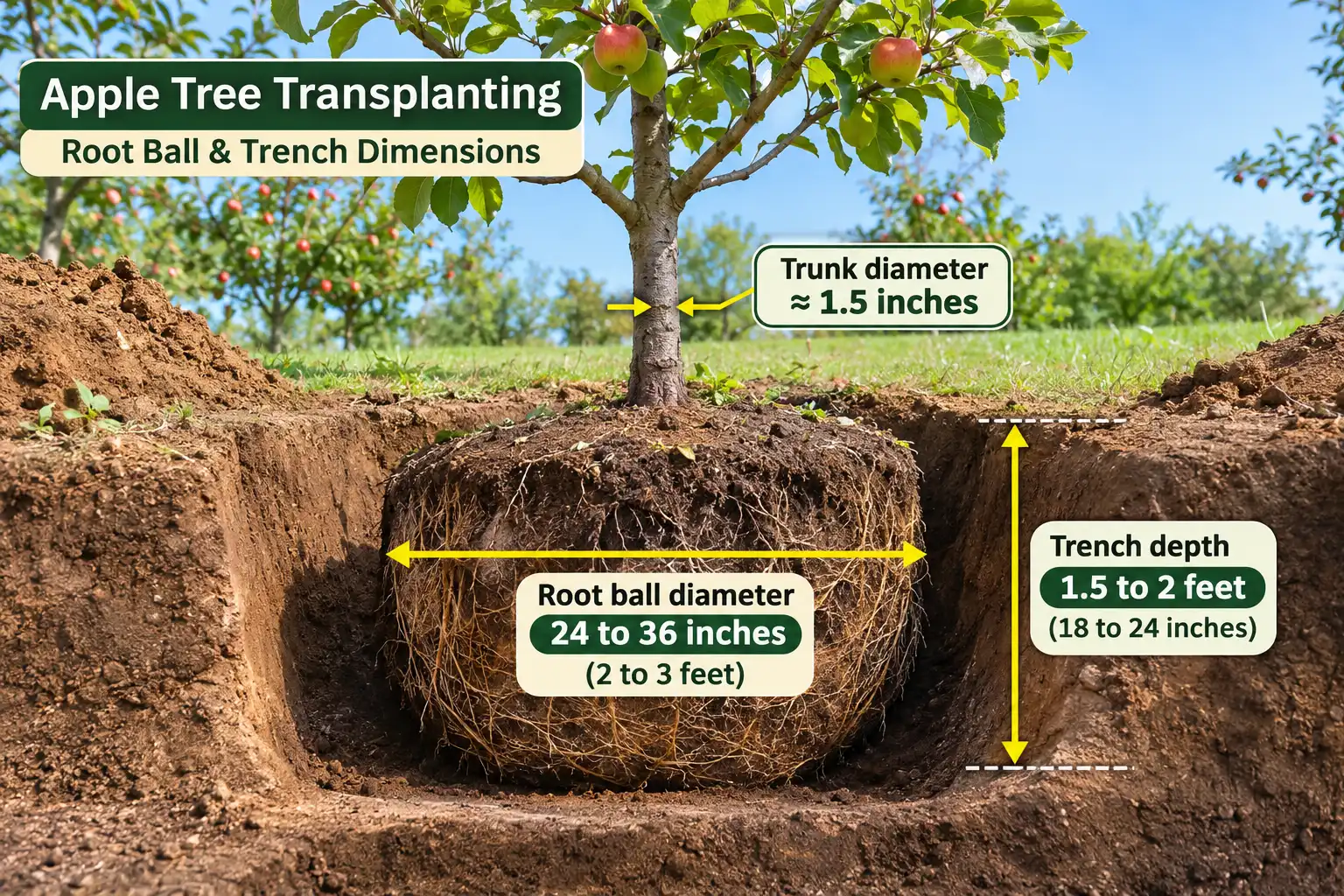
- Size the root ball. Iowa State calls for a root ball radius of 8 to 12 inches per inch of trunk diameter. So an apple tree with a 1.5-inch trunk needs a ball 24 to 36 inches across.
- Dig the trench. Cut a trench around the ball 1.5 to 2 feet deep.
- Lift by the ball. Carry the root ball, not the trunk. Get help, because a soil ball that size is heavy.
- Replant at the right depth. Iowa State advises a new hole 2 to 3 times the root ball’s width and 2 or 3 inches shallower than its height. Keep the graft union above the soil, then water thoroughly.
Planting Mistakes That Set Trees Back
Most first-year failures trace back to planting day. These are the common ones.
| Mistake | What it causes |
|---|---|
| Graft union buried | Roots form above the graft, and a dwarf tree grows to full size |
| Fertilizer in the hole | Burned roots and a stunted tree |
| Circling roots left on a potted tree | Roots that can girdle the tree |
| Low, frosty site | Blossoms lost to late spring frost |
| Soggy soil or overwatering | Root rot and poor growth |
| Straw mulch against the trunk | Root rot and vole damage |
| No stake on a dwarf tree | A tree that can’t hold up its first crops |
If a new tree wilts, yellows, or fails to leaf out, several problems look alike. Your county extension office or a state plant diagnostic lab can identify the cause, and many accept samples.
FAQs About Planting Apple Tree
Can I plant an apple tree in the fall?
Yes, where winters are mild. Virginia Tech recommends planting about a month after the first killing frost in Virginia, while Iowa State Extension favors early spring in Iowa, once severe freezes pass.
Should I add compost or fertilizer to the planting hole?
No, UMaine Extension, UC ANR, and Iowa State Extension all advise backfilling with native soil only. If your soil needs compost, till it across the whole planting area before you dig.
Do I need two apple trees to get fruit?
Usually, yes. Most apple varieties need pollen from a different variety that blooms at the same time, and Iowa State Extension notes that a nearby flowering crabapple can fill that role.
How long should I soak a bare-root apple tree?
Soak the roots for 1 to 2 hours just before planting, as Iowa State Extension advises for bare-root trees. If planting is delayed, store the tree near 40 degrees F with its roots in damp packing.
Should I stake a newly planted apple tree?
Stake every dwarf apple tree at planting and keep the support for life. For other apple trees, Iowa State Extension advises staking for the first two to three years, with soft ties checked often for rubbing.
Can I plant an apple tree in summer?
Only a container-grown tree. UC ANR allows year-round planting in California, but a potted apple tree set out in summer needs basin watering once or twice a week in hot weather.
What happens if I plant an apple tree too deep?
The tree can lose its rootstock’s size control. UMaine Extension warns that a buried graft union lets roots form above the graft, so a dwarf or semi-dwarf apple tree can grow to full size.
Before You Plant
Settle four things before planting day. Confirm your region’s window, get a soil test, measure the root spread, and find the graft union on the trunk. Then buy a second variety that blooms with the first. For a dwarf tree, drive the stake before you backfill.