
Best Apple Tree Varieties for Home Gardens by Zone and Climate
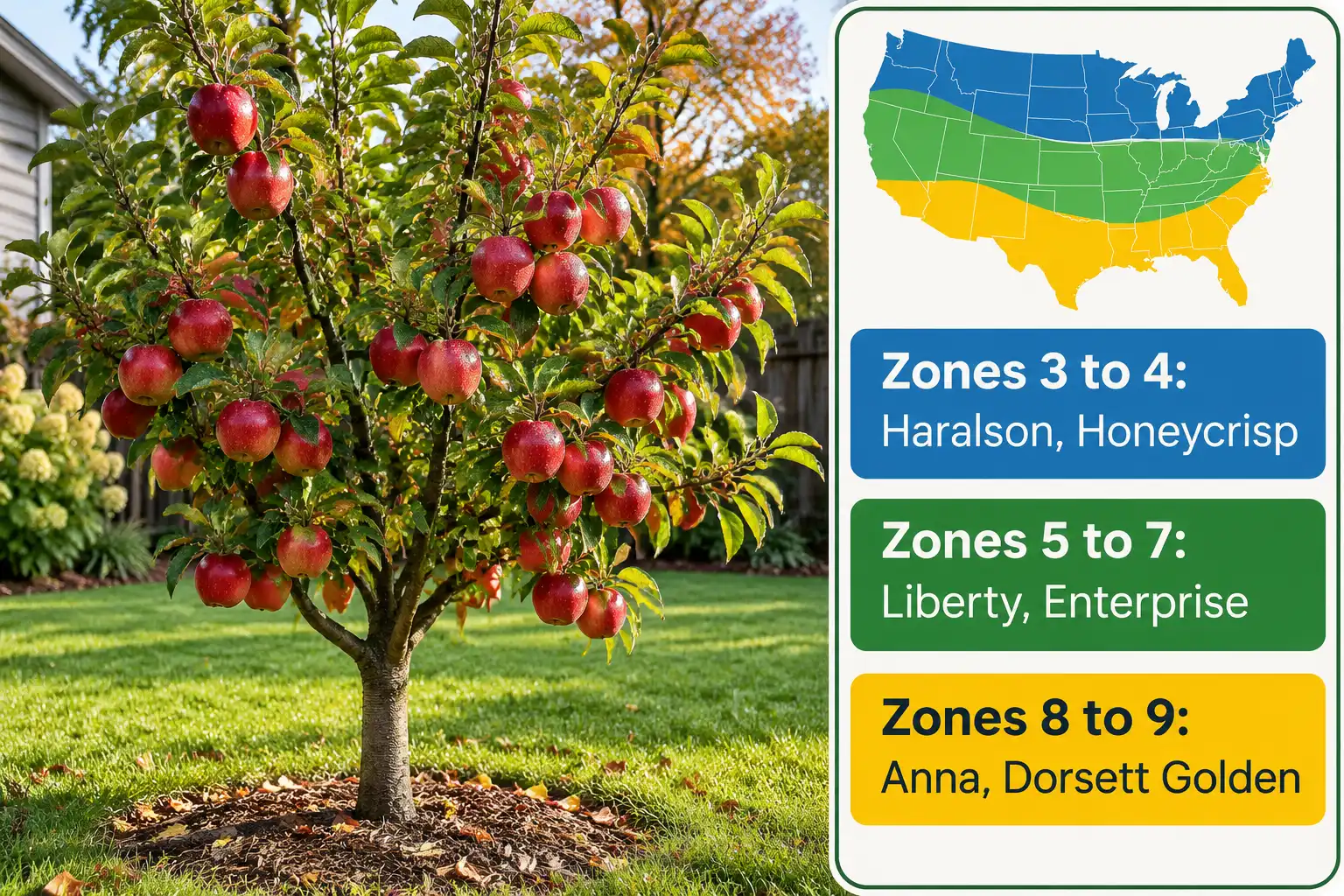
The best apple tree varieties for home gardens depend on how cold your winters get, how much winter chill they deliver, and how much disease your summers bring. Each US climate below gets its own short list, with the extension source behind every pick.
For most home gardens, Liberty is the best apple tree variety. It resists scab, and Penn State rates it resistant to cedar apple rust, powdery mildew, and fire blight. Zones 3 to 4 suit Haralson, and warm zones need Anna.
Which Apple Tree Should You Plant?
Plant a variety that survives your winter, gets enough winter chill, resists your local diseases, and fits your space. Check these four points in order, because any one of them can rule a variety out.
- Winter cold. Your hardiness zone reflects the average coldest winter night, and that sets which varieties survive.
- Chill hours. Texas A&M AgriLife counts chill hours as hours below 45 degrees F from November to March. Varieties from the Pacific Northwest, the Great Lakes, and New England need 1,000 to 2,200 hours. So they struggle where winters stay mild.
- Disease pressure. UF/IFAS notes that high humidity and rainfall raise disease pressure. As a result, resistant varieties matter most in humid regions.
- Space. The rootstock, not the variety, sets tree size. University of Minnesota Extension says standard trees grow 20 feet or taller. Dwarfing rootstocks hold a tree to 8, 12, or 15 feet.
Look up your zone on the USDA Plant Hardiness Zone Map before you buy. USDA ARS released the current map in November 2023, and about half the country moved to the next warmer half zone. So a zone you checked before 2023 may be out of date. After that, plan a pollination partner, covered further down.
Know more: How Far Apart to Plant Apple Trees: Spacing by Rootstock
Best Disease-Resistant Apple Trees for Beginners
Scab-resistant varieties are the easiest apple trees for beginners. Penn State Extension recommends a set of them for Pennsylvania home plantings, and it rates each one for three more diseases. The table shows eight of the twelve on Penn State’s scab-resistant variety table, updated July 2026.
| Variety | Ripens in Pennsylvania | Cedar apple rust | Powdery mildew | Fire blight |
|---|---|---|---|---|
| Pristine | Late July to early August | Moderate | Resistant | Moderate |
| Redfree | Late August to mid-September | Resistant | Resistant to moderate | Resistant to moderate |
| Crimson Crisp | Early September | Moderate | Moderate | Susceptible |
| Liberty | Mid to late September | Resistant | Resistant | Resistant |
| Freedom | Mid to late September | Resistant | Resistant | Resistant to moderate |
| Enterprise | Mid-October | Resistant | Moderate | Resistant |
| WineCrisp | Mid-October | Susceptible | Moderate | Resistant |
| GoldRush | Late October | Susceptible | Resistant | Moderate |
Liberty is the only one Penn State rates resistant to all three. Freedom comes close, although Penn State notes it is susceptible to black rot. In contrast, GoldRush and WineCrisp are susceptible to cedar apple rust, and Crimson Crisp is susceptible to fire blight. So “resistant” covers named diseases, not every problem.
Several apple problems look alike, too. Typical signs of scab, rust, and fire blight appear under common fruit tree diseases. Still, your county extension office or a state plant diagnostic lab confirms the cause, and many accept samples.
Best Apple Trees for Cold Climates (Zones 3 and 4)
Minnesota-bred varieties are the best apple trees for cold climates. University of Minnesota Extension’s home apple guide rates each variety below for hardiness in zones 3 and 4.
| Variety | Hardiness (UMN) | Harvest in Minnesota | Storage |
|---|---|---|---|
| Frostbite | Excellent to very good | Late September to mid-October | 3 to 4 months |
| Chestnut crab | Excellent to very good | Early to mid-September | 4 to 5 weeks |
| Haralson | Very good to good | Late September to early October | 4 to 5 months |
| Honeycrisp | Very good to good | Late September | 7 months or more |
| Sweet Sixteen | Very good to good | Mid to late September | 5 to 8 weeks |
| Zestar! | Good to fair | Late August to early September | 6 to 8 weeks |
In zone 3, the two varieties rated excellent to very good carry the least winter risk. Triumph, released in 2021, rates very good in zone 4 but is not recommended for zone 3.
UMN’s list also includes scab-immune Liberty and Freedom, both rated good to fair for hardiness. So cold-zone gardeners can still plant for disease resistance. However, UMN rates Zestar! susceptible to scab, and it rates Honeygold and Regent susceptible to both scab and fire blight.
Best Apple Trees for Zones 5, 6, and 7
Zones 5 to 7 have the widest choice, so season length and summer humidity narrow the list. No extension service publishes variety lists by zone, though. Instead, match your zone to a state list from a similar climate.
Zone 5
Zone 5 sits between the Minnesota and Pennsylvania lists. The cold-hardy picks above survive its winters, and so do Liberty and Freedom. Penn State lists GoldRush ripening in late October, the latest on its table. So check your average first fall frost date before you choose it.
Zone 6
Pennsylvania spans roughly zones 5 to 7 on the 2023 USDA map. That makes Penn State’s scab-resistant table a close fit for zone 6. For example, Liberty, Enterprise, and GoldRush together stretch the harvest from mid-September to late October.
Zone 7
Zone 7 summers run hotter and, in the East, more humid. Virginia Tech’s home tree fruit guide flags most of its suggested apples as difficult in Eastern Virginia. The list includes Fuji, Gala, Granny Smith, and even Liberty. There, it warns, mildew, blight, brown rot, fruit cracking, and poor color can be serious.
By contrast, Ginger Gold, Summer Rambo, and Golden Delicious carry no such flag. Southeastern Pennsylvania also falls in zone 7, so Penn State’s table applies there too.
Best Apple Trees for Warm Climates (Zones 8 and 9)
Low-chill varieties are the best apple trees for warm climates, led by Anna, Dorsett Golden, and TropicSweet. In these zones, chill hours matter more than the zone number. Texas A&M AgriLife’s apple guide and UF/IFAS’s low-chill apple publication list different chill needs for the same varieties. So the table shows both, and you can compare your local chill-hour total with each.
| Variety | Chill hours (Texas A&M) | Chill hours (UF/IFAS) | Harvest |
|---|---|---|---|
| Anna | 400 | 300 | Late June in Texas |
| Dorsett Golden | 350 | 250 | Early July in Texas |
| TropicSweet | Not listed | 300 | Late May to June in Florida |
| Mollie’s Delicious | 450 to 500 | Not listed | Summer in Texas |
| Pink Lady | 500 to 600 | Not listed | October in Texas |
| Fuji and Gala | 600 | Not listed | 140 to 160 days after bloom |
Texas A&M says only Anna and Dorsett Golden fruit reliably where winters give 400 or fewer hours. Similarly, UF/IFAS tested 43 varieties and recommends only Anna, Dorsett Golden, and TropicSweet for Florida, from Ocala northward. Texas A&M also notes that moderate-chill varieties perform best in years with above-average chill.
Low-chill trees bloom early, too. UF/IFAS says they usually flower in late February in Florida, so frost injury to flower buds is common. Bloom runs over a long late-winter period, though, so later flowers often escape freeze damage and still set a crop.
Best Apple Trees for Small Gardens: Pick the Rootstock
For small gardens, the dwarfing rootstock matters more than the variety, because the rootstock sets the tree’s size. University of Minnesota Extension notes that fruit size and quality stay the same on dwarf and standard rootstocks. Penn State’s apple rootstock spacing table, updated June 2026, compares the common choices.
| Rootstock | Size (% of seedling tree) | Spacing, in row x between rows (feet) | Yield at 10+ years (bushels) |
|---|---|---|---|
| B.9 | 25 | 3 x 12 | 1 to 2 |
| M.9 | 35 | 3 to 5 x 12 | 1 to 2 |
| G.41 | 35 | 4 to 5 x 12 | 1 to 2 |
| M.26 | 40 | 8 x 16 | 3 to 4 |
| G.935 | 40 to 45 | 7 to 8 x 12 to 14 | 3 to 4 |
| M.7 | 60 | 12 x 20 | 10 to 12 |
| MM.111 | 70 | 18 x 26 | 20 to 25 |
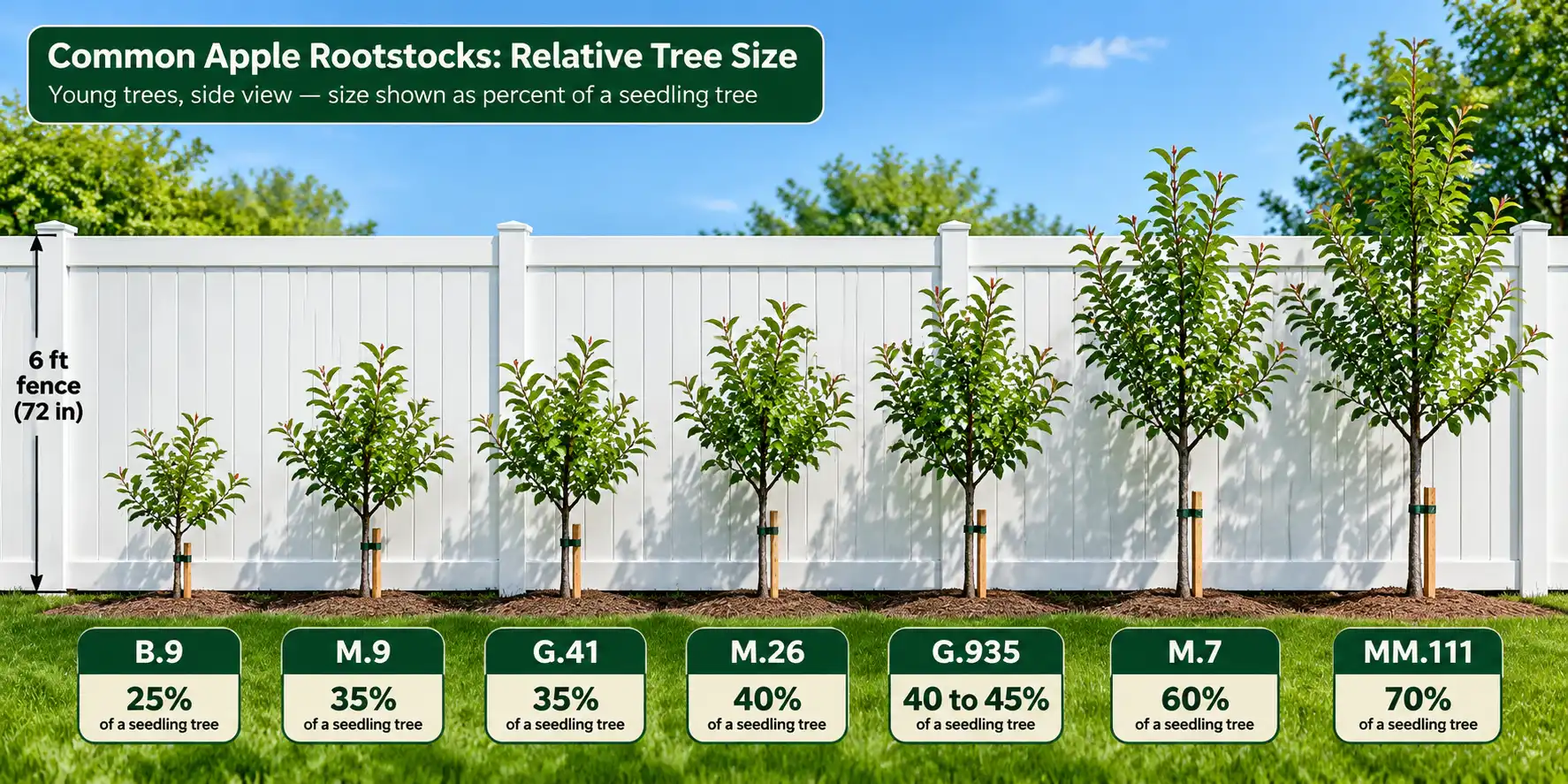
The smallest rootstocks need help standing up. UMN says M.9 needs staking for the life of the tree, and B.9 should be supported as well. Meanwhile, G.41 offers some fire blight resistance and suits higher-pH soils. Penn State warns that MM.111 needs very well-drained soil and should not go in heavy clay. Patios and very tight yards bring added limits, covered under dwarf and container fruit trees.
How Many Apple Trees Fit Your Space
Run this formula with Penn State’s spacing figures:
Trees for your area = area in square feet / (in-row spacing x between-row spacing)
Take a 24 by 24 foot corner, or 576 square feet, as an example:
- B.9 at 3 x 12 feet (36 square feet each): 576 / 36 = 16 trees
- M.26 at 8 x 16 feet (128 square feet each): 576 / 128 = 4.5, so 4 trees
- M.7 at 12 x 20 feet (240 square feet each): 576 / 240 = 2.4, so 2 trees
- MM.111 at 18 x 26 feet (468 square feet each): 576 / 468 = 1.2, so 1 tree
Edges and paths lower these counts, so treat them as ceilings. Even so, the same corner holds either one MM.111 tree or a supported hedge of up to 16 B.9 trees. And because apples need two varieties for pollination, a single tree only works if a pollen source grows nearby.
When Will Your Apple Tree Bear Fruit?
A dwarf apple tree bears 2 to 3 years after planting, according to both Virginia Tech and University of Minnesota Extension. Standard trees take much longer, and here the sources differ. Virginia Tech gives 6 to 10 years, while UMN says standard trees can take up to 8. Variety, site, and care push a tree toward one end of the range.
To find your first harvest year, add the bearing age to the year you plant:
Year of first harvest = planting year + years to bearing
| Tree size | Years to bearing (Virginia Tech) | First harvest if planted in spring 2027 | Mature yield per tree (Virginia Tech) |
|---|---|---|---|
| Dwarf | 2 to 3 | 2029 to 2030 | About 2 bushels |
| Semi-dwarf | 4 to 6 | 2031 to 2033 | About 4 bushels |
| Standard | 6 to 10 | 2033 to 2037 | About 8 bushels |
Penn State’s rootstock table gives higher yields for semi-dwarf M.7 trees, at 10 to 12 bushels once trees reach 10 years. So expect a range rather than a fixed number. Pears, peaches, and cherries follow their own timelines, laid out in the chart of years to first fruit by type.
Best Early and Late Season Apple Varieties
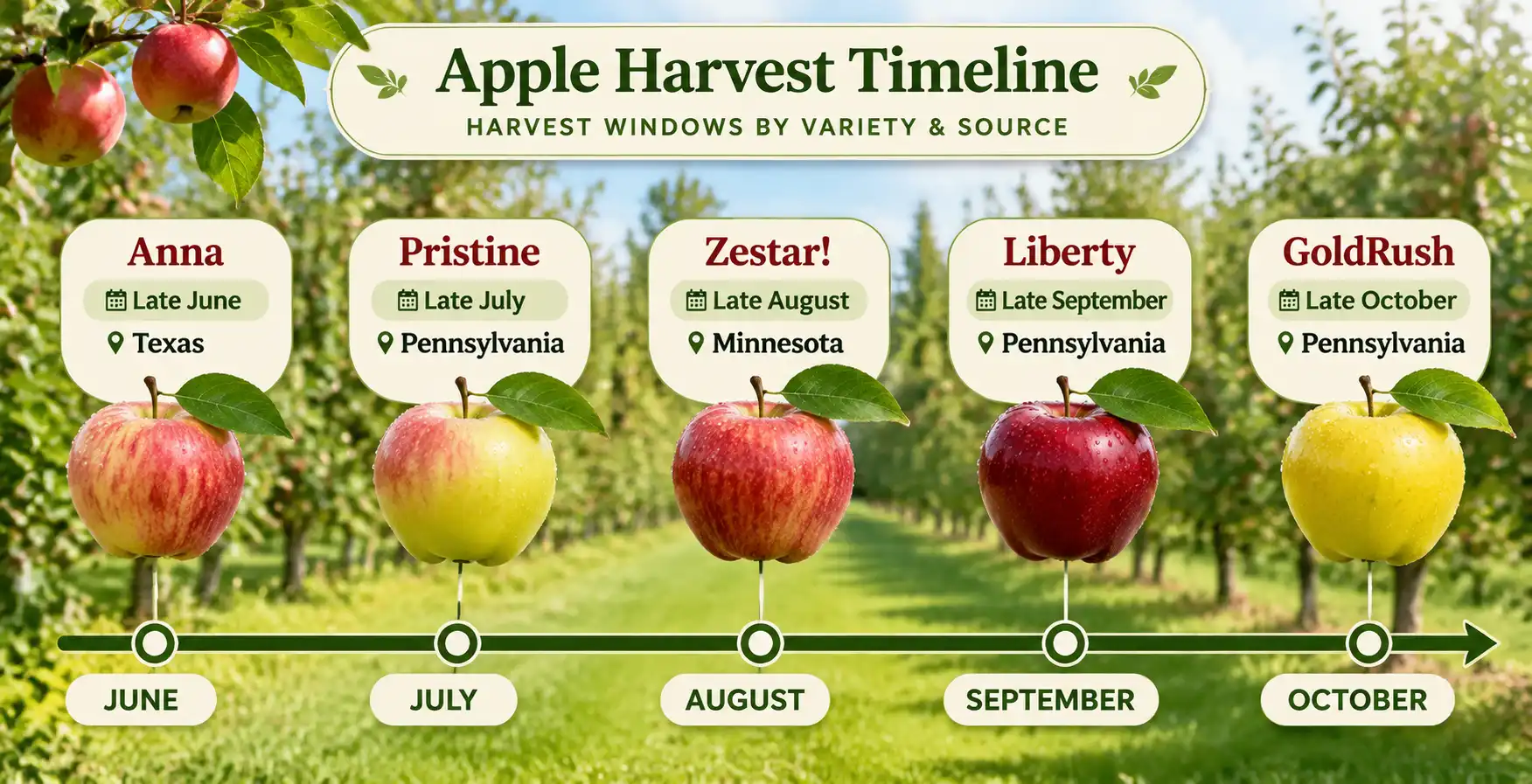
Pristine, Williams’ Pride, and Zestar! lead the early season, while Enterprise, GoldRush, and Haralson lead the late season. Each date below comes from the source’s home state, so expect some shift where you live.
| Season | Variety | Harvest window | Where the date applies |
|---|---|---|---|
| Early | Anna | Late June | Texas |
| Early | Pristine | Late July to early August | Pennsylvania |
| Early | Williams’ Pride | Mid-August | Minnesota |
| Early | Zestar! | Late August to early September | Minnesota |
| Midseason | Liberty | Mid to late September | Pennsylvania |
| Midseason | Honeycrisp | Late September | Minnesota |
| Late | Haralson | Late September to early October | Minnesota |
| Late | Enterprise | Mid-October | Pennsylvania |
| Late | SnowSweet | Mid-October | Minnesota |
| Late | GoldRush | Late October | Pennsylvania |
Early apples tend to keep only a short time. Penn State notes that Redfree has a short storage life, and UMN puts Zestar! at 6 to 8 weeks. By contrast, UMN lists Honeycrisp at 7 months or more and Haralson at 4 to 5 months. Penn State also says Enterprise and GoldRush store well.
So plant one early and one late variety for fresh apples over the longest stretch. Harvest season does not tell you bloom time, though, so confirm that the pair blooms together.
Apple Pollination: Plant Two Varieties Within 100 Feet
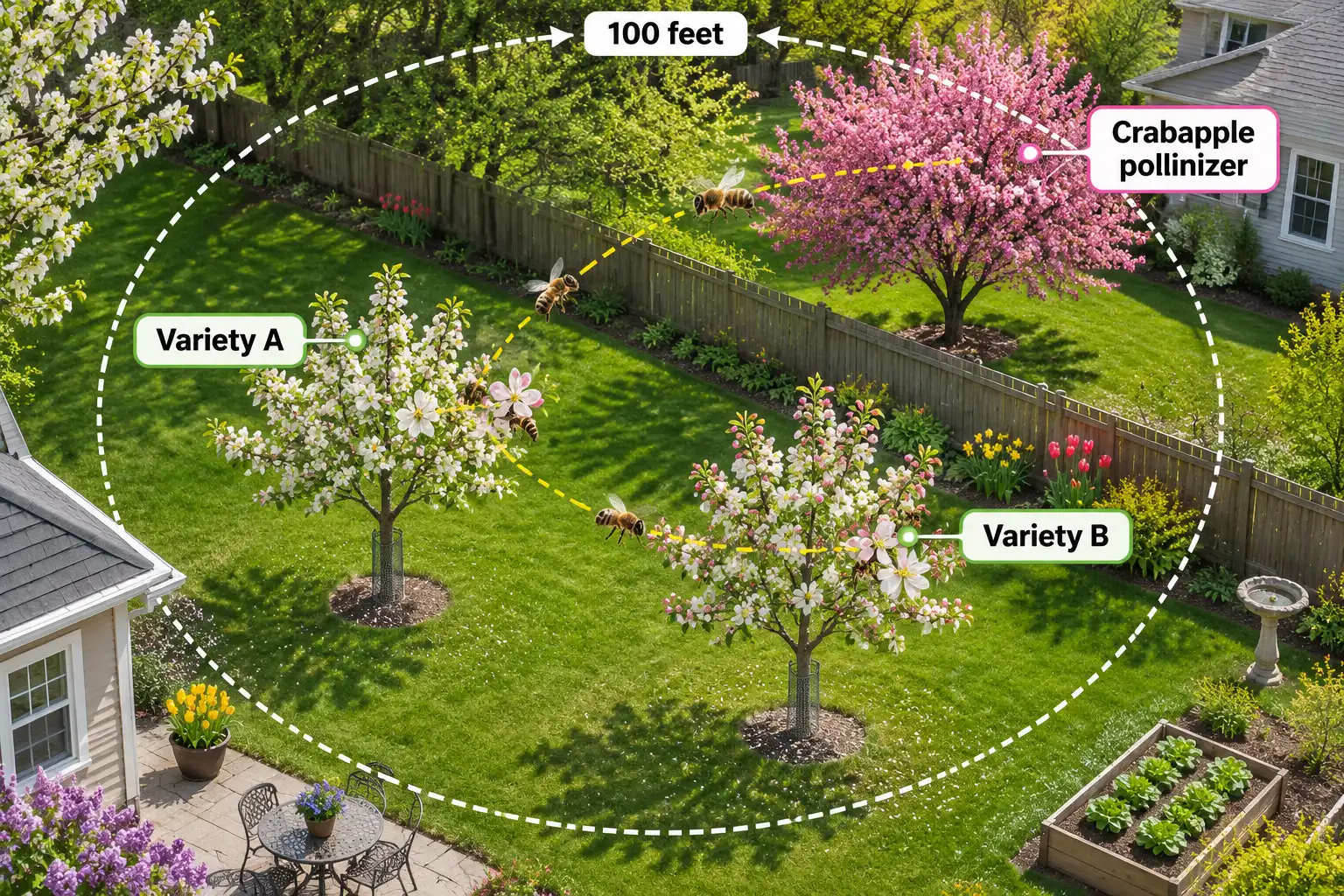
Most apple trees need pollen from a different variety that blooms at the same time, within about 100 feet. University of Minnesota Extension says one of the two can be a crabapple, so a neighbor’s flowering crabapple may already cover you. Virginia Tech goes further and suggests three varieties to be certain.
Bloom overlap decides the match, because cross-pollinating fruit trees only works when both trees flower in the same window. Some pairings fail, and some work especially well:
- Virginia Tech says Winesap, Stayman, and Summer Rambo will not pollinate each other.
- Texas A&M says Gala, Imperial Gala, and Royal Gala will not serve as adequate pollinizers for each other.
- UF/IFAS says Anna, Dorsett Golden, and TropicSweet pollinate one another in warm zones.
- Texas A&M calls Mollie’s Delicious an excellent pollinator because of its long bloom period.
Why a Well-Chosen Apple Tree Still Fails
A good variety still fails when the site or setup works against it. Watch for these problems:
- Too little winter chill. Texas A&M says moderate-chill varieties perform best in years with above-average chill, so a mild winter can weaken the crop.
- No pollen partner. A lone tree needs another variety or a crabapple within about 100 feet, per UMN.
- Shade. UMN calls for at least 8 hours of direct sun a day during the growing season.
- An unstaked dwarf. UMN says M.9 has brittle roots and poor anchorage, so it needs staking for life.
- Wet, heavy soil. Penn State warns that MM.111 needs very well-drained soil.
- Cotton root rot. Texas A&M says apples generally fail in warmer areas with alkaline soils above pH 7.0 because of this disease. No resistant rootstocks exist.
- Botryosphaeria canker. UF/IFAS calls it the most debilitating apple disease in Florida, worst from June through August.
Your county extension office can tell you which of these diseases occur locally. Also, a state plant diagnostic lab can identify a problem from a sample.
FAQs About Which Apple Tree Should I Plant
What is the easiest apple tree to grow at home?
Liberty is the easiest choice for most yards outside the warmest zones. Penn State calls it the most disease resistant on its list, and UMN includes it for zones 3 and 4.
Can I plant just one apple tree?
Yes, if another apple or crabapple blooms within about 100 feet of it. UMN Extension says crabapples in your neighborhood can supply pollen, but without one, plant two varieties that bloom together.
Do dwarf apple trees produce full-size apples?
Yes, dwarf apple trees grow full-size apples of the same variety. UMN Extension says fruit size and quality stay the same on any rootstock, though a dwarf tree bears fewer apples.
How many apples does a dwarf apple tree produce?
Expect about 1 to 2 bushels a year from a mature dwarf apple tree. Penn State gives 1 to 2 bushels for mature B.9 and M.9 trees, and Virginia Tech gives about 2.
Can I grow apples in Florida?
Yes, from Ocala northward, if you plant low-chill varieties needing about 250 to 300 chill hours. Out of 43 varieties tested, UF/IFAS recommends only Anna, Dorsett Golden, and TropicSweet, which pollinate one another.
Are disease-resistant apple trees spray-free?
No, resistance covers named diseases, not insects or every possible infection. Penn State, for example, rates GoldRush and WineCrisp susceptible to cedar apple rust, so they can still need care.
Why are apple trees sold grafted?
Nurseries graft apple trees because the rootstock controls tree size and how soon the tree bears. UMN Extension notes each tree joins two plants: the scion that bears fruit and the rootstock below.
Before You Plant
Confirm your zone on the 2023 USDA map first, and in zones 8 and 9, your local chill-hour total. Next, choose a variety that resists the diseases your region sees most, on a rootstock that fits your space. Then line up a second variety or a crabapple within about 100 feet. Your county extension office can confirm the picks for your county. After that, planting bare-root apple trees comes next, and ongoing apple tree care follows from there.