How Long Apple Trees Take to Bear Fruit, by Rootstock
Rootstock decides most of the wait for a first apple. The variety on top matters, but the root below sets tree size and how soon the tree bears. Here is how long apple trees take to bear fruit on each rootstock, with named sources and first-harvest math.
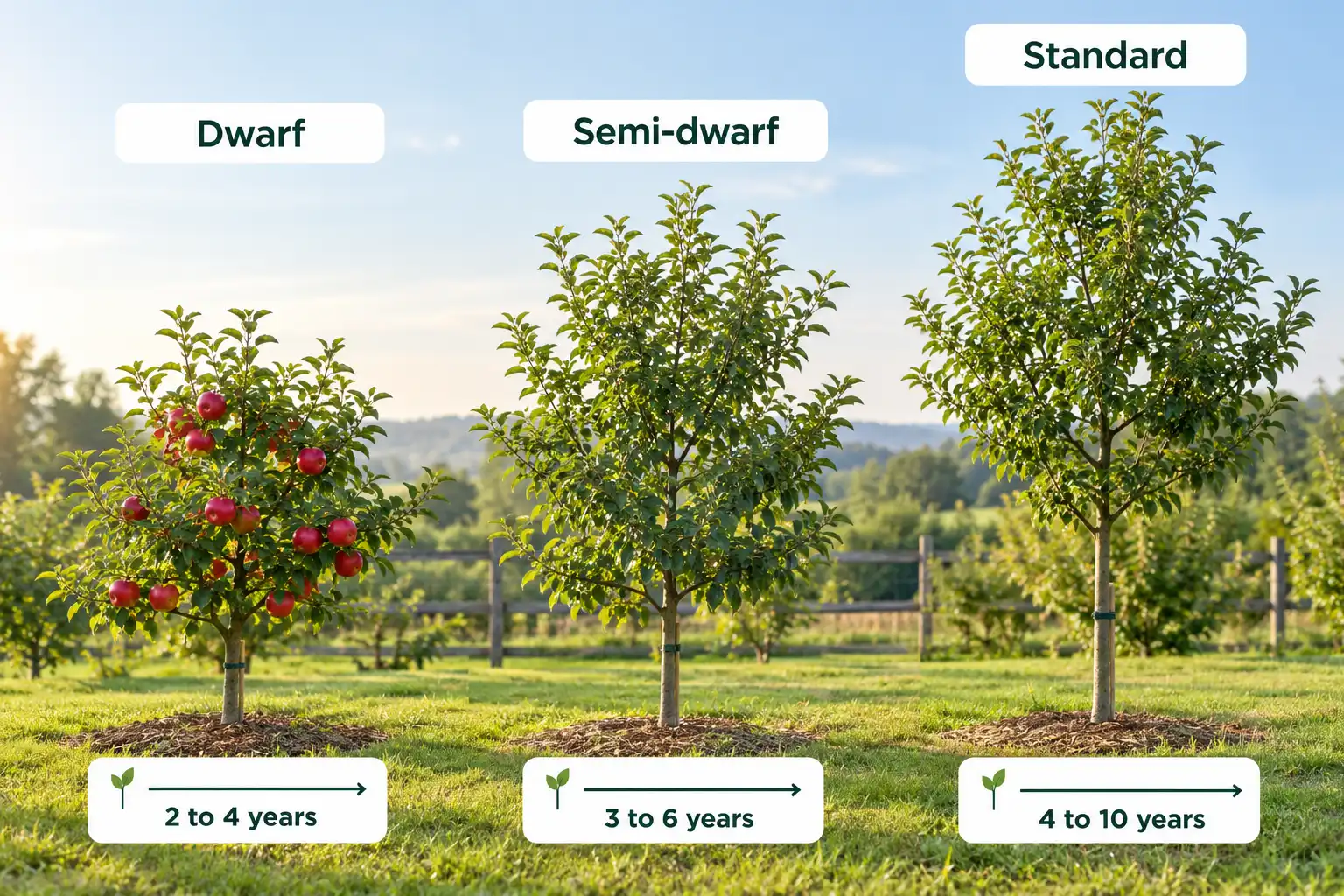
How long apple trees take to bear fruit depends on rootstock. Illinois Extension lists dwarf at 2 to 4 years, semi-dwarf at 3 to 4, and standard at 4 to 6. Virginia Tech gives standard trees 6 to 10.
How Long Apple Trees Take to Bear Fruit by Rootstock Size
Dwarf trees fruit first, semi-dwarf trees follow, and standard trees take longest. Two extension services publish ranges for home apple plantings in their states, and the ranges do not match.
| Size class | Common rootstocks | Illinois Extension, years from planting | Virginia Tech, bearing age in years |
|---|---|---|---|
| Dwarf | Bud.9, M.9, G.41, G.11 | 2 to 4 | 2 to 3 |
| Semi-dwarf | G.935, MM.106, G.890, M.7 | 3 to 4 | 4 to 6 |
| Standard | Seedling | 4 to 6 | 6 to 10 |
Rootstock classes follow WVU Extension’s apple rootstock guide. Year ranges come from the Illinois Extension home fruit tree table and Virginia Tech’s Tree Fruit in the Home Garden.
Colder states report similar timing. University of Minnesota Extension says apples on dwarf rootstocks start bearing 2 to 3 years after planting. Standard apple trees there can take up to 8 years. Meanwhile, Iowa State Extension gives Iowa apples an average of 4 to 5 years, without splitting by rootstock.
Illinois Extension also lists spur-type apple trees at 3 to 4 years. Spur type describes a compact growth habit of the variety, not the root.
How Individual Rootstocks Compare
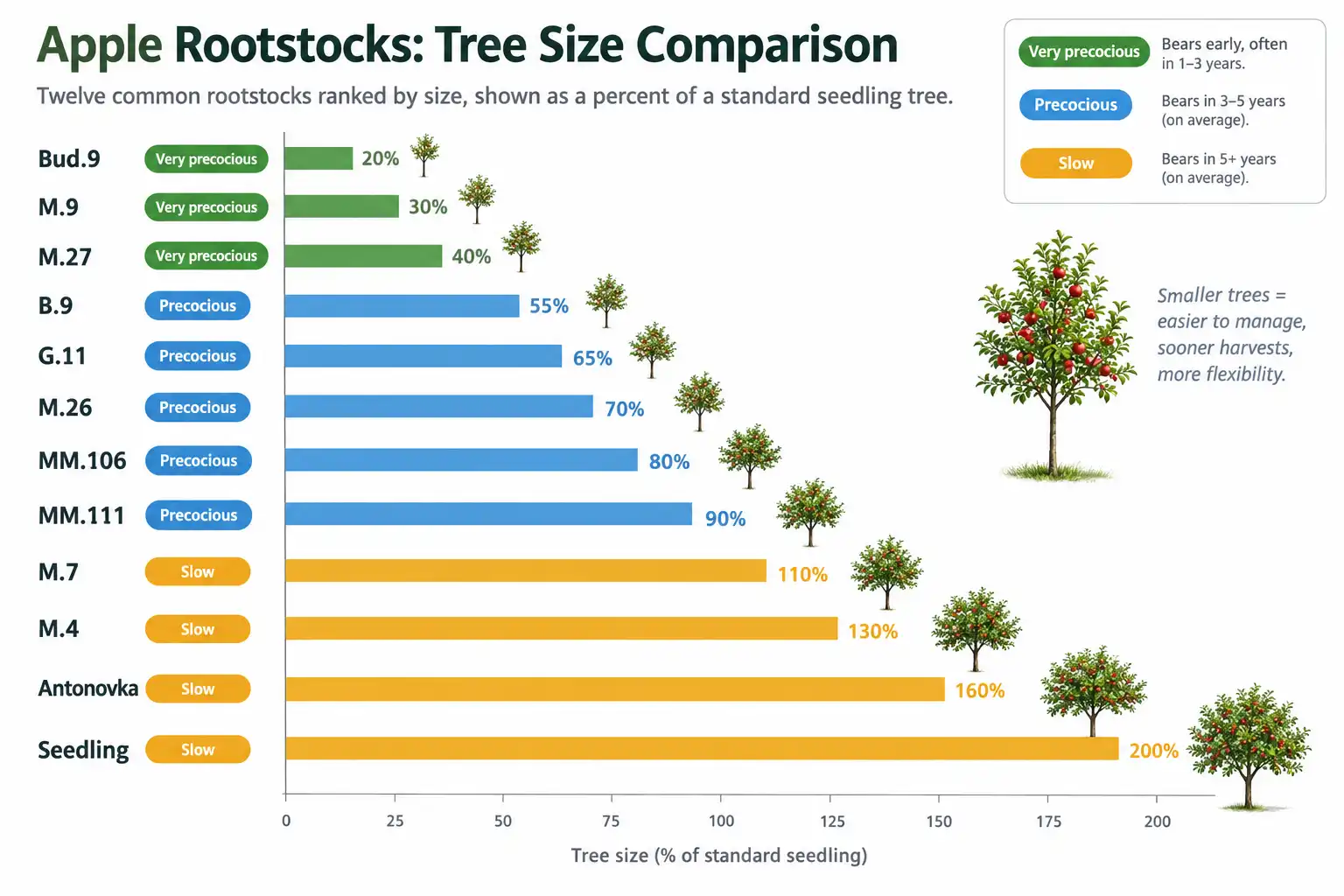
Extension guides rate each rootstock for precocity, which means how early it brings a tree into bearing. However, they seldom give a year count for a single rootstock. So use the size class ranges above for the timeline, and use these ratings to choose within a class.
| Rootstock | Size, percent of standard | Early bearing rating |
|---|---|---|
| Bud.9 | 35 to 45 | Very precocious |
| M.9 EMLA | 35 to 45 | Precocious |
| G.41 | 40 to 45 | Very precocious |
| M.26 | 40 to 50 | Precocious |
| G.11 | 45 to 50 | Yield efficiency similar to M.9 |
| G.935 | 45 to 55 | Most precocious semi-dwarf Geneva root |
| MM.106 | 60 to 75 | Precocious |
| M.7 EMLA | 60 to 65 (80 to 90 if virus-free) | Not precocious |
| G.890 | 60 to 65 | Very precocious |
| Bud.118 | 75 to 85 | Very precocious |
| MM.111 EMLA | 85 to 90 | Slow, about 7 years to full production |
| Seedling | 100 | Baseline for vigor |
All sizes and ratings come from WVU Extension.
Two cautions apply. First, sources classify M.26 differently. WVU Extension calls it semi-dwarf. University of Minnesota Extension calls it dwarfing and says trees on it sometimes fruit within three years of planting. Second, full production is not the first crop. The seven years WVU Extension gives for MM.111 marks a full crop, not the first apples.
Why the Sources Give Different Numbers
Each extension service writes for its own climate, soils, and common varieties, so the ranges differ. For standard apple trees, Illinois Extension lists 4 to 6 years from planting, while Virginia Tech gives 6 to 10. University of Minnesota Extension puts standard trees at up to 8 years. So plan with the full range, not a midpoint.
Vigor explains much of the spread. Illinois Extension notes that standard trees grow more vigorously and usually come into bearing later than trees on dwarfing roots. Iowa State Extension adds that the variety itself changes the timing.
The word “bearing” also hides a gap. A tree can bear a handful of apples years before a full crop, as the yield table below shows.
If a nursery tag promises a faster timeline, treat it as the nursery’s own claim.
When to Expect Your First Harvest
Add the bearing range to your planting year:
Year of first harvest = planting year + years to bearing
For a spring 2027 planting, the published ranges work out like this:
| Size class | First fruit, Illinois Extension range | First fruit, Virginia Tech range |
|---|---|---|
| Dwarf | 2029 to 2031 | 2029 to 2030 |
| Semi-dwarf | 2030 to 2031 | 2031 to 2033 |
| Standard | 2031 to 2033 | 2033 to 2037 |
Count from the day you plant, not from the tree’s age. Iowa State Extension notes that nursery apple trees are usually 1 to 2 years old when sold. Its bearing ages still run from planting.

How Much Fruit to Expect in the First Years
The first crop is small on every rootstock. Illinois Extension estimates these per-tree apple crops for Illinois home plantings:
| Size class | At 3 years | At 6 years | At 10 years |
|---|---|---|---|
| Dwarf | 0 to 2 pecks | 1 to 2 bushels | 3 to 5 bushels |
| Semi-dwarf | 0 to 2 pecks | 1 to 3 bushels | 4 to 10 bushels |
| Standard | None | 0 to 2 bushels | 5 to 15 bushels |
A peck is a quarter bushel, so a dwarf tree’s third-year crop tops out near half a bushel. Now scale it to your planting. On the same table, four semi-dwarf trees at year 6 would give about 4 to 12 bushels.
Per acre, the math flips in favor of small trees. Virginia Tech’s home garden table gives minimum spacing and mature yield per apple tree. On a square grid, trees per acre = 43,560 / (spacing x spacing).
| Size class | Spacing, feet | Trees per acre | Mature yield per tree, bushels | Bushels per acre at maturity |
|---|---|---|---|---|
| Dwarf | 8 | 680 | 2 | 1,360 |
| Semi-dwarf | 18 | 134 | 4 | 536 |
| Standard | 30 | 48 | 8 | 384 |
Treat this as arithmetic on home garden figures, not a commercial yield forecast.
What Delays Bearing on Any Rootstock
A precocious rootstock can still bear late. These five causes explain most delays.
Graft Union Buried Below the Soil
On dwarfing rootstocks, keep the graft union above ground. Illinois Extension’s apple guide sets it 3 to 4 inches above the soil line. A buried union lets the variety root, University of Minnesota Extension warns. The tree then grows to full size and bears later. Since soil settles, check the union a few days after planting a young apple tree.

Too Much Pruning Too Soon
Illinois Extension recommends light to moderate pruning to encourage bearing. It also warns that removing too much wood at once can upset bearing for several years. So keep cuts few while training young apple trees.
No Pollen Partner Nearby
Apples need pollen from a different variety. University of Minnesota Extension wants that source within about 100 feet. A crabapple can count among the pollen partners for apples. Without one, a tree can bloom well and still set little fruit.
Shade or Excess Nitrogen
University of Minnesota Extension calls for at least 8 hours of direct sun a day. It also notes that young, non-bearing apple branches grow 12 to 18 inches a year. Much longer growth can signal excess nitrogen, so test the soil before feeding.
Heavy Early Crops
Illinois Extension notes that early crops can bend a young dwarf tree out of shape. Oversized crops also lead to biennial bearing, University of Minnesota Extension adds. So thin fruit on young trees harder than on mature ones.
If a tree passes its range with no bloom, or shows dieback or leaf spots, ask your county extension office. Many offices accept samples.
Choosing a Rootstock When Time to Fruit Matters
Rootstock is only one choice in planning a home apple planting, so pick for your site first and speed second. A fast rootstock gains nothing if it fails in your soil or winters.
Fastest fruit in a small yard. Bud.9, M.9, and G.41 bear early, but WVU Extension says trees on them need support. Plan on stakes or trellis supports for the life of the tree.
Cold winters. University of Minnesota Extension names B.9 the most common apple rootstock in Minnesota. For a larger tree, WVU Extension rates Bud.118 extremely winter hardy and very precocious.
A freestanding tree. MM.106 stands without support and rates as precocious, but WVU Extension says it needs well-drained soil. By contrast, M.7 rates as not precocious. Illinois Extension adds that trees on it may need support until about year 10.
Fire blight pressure. WVU Extension rates G.41, G.935, and G.890 highly tolerant of fire blight. It rates M.9 extremely susceptible, however, and M.26 highly susceptible.
Patience and room. Seedling roots bear last. Still, University of Minnesota Extension says they handle wetter and drier soils and anchor better than dwarf trees.
Commercial blocks. Penn State Extension lists M.9, Bud 9, and G.11 among rootstocks recommended for commercial orchards.
FAQs About Apple Rootstock Bearing Age
Why isn’t my 5-year-old apple tree producing fruit?
A 5-year-old standard tree may still be young, since Virginia Tech lists 6 to 10 years. On dwarfing roots, check for a buried graft union, heavy pruning, shade, or no pollen partner within about 100 feet.
Do dwarf apple trees produce less fruit?
Per tree, yes: Virginia Tech lists mature yields near 2 bushels for a dwarf apple tree and 8 for a standard. Per acre, though, far more dwarf trees fit, so total yield runs higher.
Do bearing ages count from planting or from the tree’s age?
From planting in your yard, in both Illinois Extension’s and Iowa State Extension’s figures. Iowa State notes that nursery apple trees are usually 1 to 2 years old when you buy them.
Which apple rootstock bears fruit the fastest?
Highly dwarfing roots such as Bud.9 and G.41 bear first, and WVU Extension rates both very precocious. University of Minnesota Extension says apples on dwarf rootstocks can bear 2 to 3 years after planting.
How long do apple trees on dwarf rootstock live?
Estimates for dwarf apple trees run from 10 to 35 years, depending on the source. Illinois Extension gives them 10 to 15 useful years, while Virginia Tech lists a life expectancy of 30 to 35.
Can you make an apple tree bear sooner?
Partly: keep pruning light, the graft union above the soil, and nitrogen in check. A different apple variety within about 100 feet helps too, but rootstock still sets the outer limit.
Before You Plant
Decide how long you can wait, then match a rootstock to your soil and winters. Next, write down the planting year and add the bearing range from the size class table. That gives your first-harvest window. If a tree passes that window with no bloom, check the graft union, pruning, and pollen partner first.