How to Grow Apple Trees: Planting, Care, and Years to First Fruit

Knowing how to grow apple trees starts with two choices made before planting: the rootstock and the variety. Rootstock sets how big the tree gets and how long you wait for fruit. Your region decides which varieties bloom and crop well.
Plant two varieties that bloom together in full sun and well-drained soil. Keep the graft union above the soil line, then water, prune, and thin fruit each year.
How Long Does an Apple Tree Take to Grow and Bear Fruit?
Extension figures from Illinois and Virginia put a dwarf apple tree at 2 to 4 years from planting to fruit. A standard apple tree takes 4 to 10. Rootstock drives most of that gap, but the two sources don’t print the same numbers.
Illinois Extension’s fruit tree production table puts dwarf apple trees at 2 to 4 years to bearing. Its standard trees take 4 to 6. By contrast, Virginia Tech’s Tree Fruit in the Home Garden gives standard apple trees 6 to 10 years. Variety, site, and care push each tree toward one end of the range.
| Apple tree type | Illinois Extension | Virginia Tech | Oklahoma State Extension |
|---|---|---|---|
| Dwarf | 2 to 4 years | 2 to 3 years | About 3 years (M.9, M.26) |
| Semi-dwarf | 3 to 4 years | 4 to 6 years | About 5 years (MM.111, MM.106) |
| Standard (seedling rootstock) | 4 to 6 years | 6 to 10 years | About 8 years |
When Will Your Apple Tree Fruit?
Add the years to bearing to your planting year. For example, plant a dwarf apple tree in spring 2027. On Illinois Extension’s 2 to 4 years, expect the first apples between 2029 and 2031. A standard apple tree planted that same spring would fruit between 2031 and 2033 on Illinois figures. On Virginia Tech’s figures, though, first fruit comes between 2033 and 2037.
How Fast Do Apple Trees Grow?
Young apple trees grow fastest before they start bearing. University of Minnesota Extension (UMN) says young, non-bearing apple trees in Minnesota grow 12 to 18 inches a year. Once trees bear, growth slows to about 8 to 12 inches a season. So measure last year’s new wood each winter. UMN uses that number as a feeding guide, covered under fertilizing below.
Learn more: Growing Apple Tree From Seed
How Big Do Apple Trees Get?
An apple tree’s size depends mostly on its rootstock. UMN says dwarfing rootstocks keep apple trees about 8 to 10 feet tall. Standard apple trees, by contrast, grow 20 feet or more. Width follows height. Oklahoma State Extension lists canopies of about 10 feet for M.9 and M.26 trees. MM.111 and MM.106 trees reach about 20 feet across, and seedling trees about 25.
| Size class | Common rootstocks | Mature height (UMN) | Canopy width (Oklahoma State) | Needs support? |
|---|---|---|---|---|
| Dwarf | M.9, M.26, B.9 | About 8 to 10 feet | About 10 feet | Yes |
| Semi-dwarf | MM.111, MM.106 | About 80% of standard (MM.111) | About 20 feet | Usually not |
| Standard | Seedling | 20 feet or more | About 25 feet | No |
Dwarf trees trade strength for size. Texas A&M AgriLife notes that M.9 and M.26 have shallow roots and need a trellis-type support. Semi-dwarf MM.111 trees, by contrast, stand on their own.
How Far Apart to Plant Apple Trees
Give each apple tree at least as much space as its expected height. That is the rule UMN uses. Its Minnesota spacing is 6 to 10 feet for dwarf trees and 12 to 15 feet for semi-dwarfs. Standard trees get 20 to 25 feet. Virginia Tech sets wider minimums: 8 feet for dwarf, 18 feet for semi-dwarf, and 30 feet for standard apple trees. So the two sources overlap for dwarfs but differ for bigger trees. Virginia Tech also warns that crowded trees are harder to keep low enough for pest control.
How Many Apple Trees Fit Your Space?
Divide your planting area by the space each tree needs.
Trees for your area = area in square feet ÷ (in-row spacing × between-row spacing)
Take a 30 by 40 foot plot, which is 1,200 square feet. Then apply Virginia Tech’s minimum spacing on a square grid:
- Dwarf apple at 8 by 8 feet: 1,200 ÷ 64 = about 18 trees
- Semi-dwarf apple at 18 by 18 feet: 1,200 ÷ 324 = about 3 trees
- Standard apple at 30 by 30 feet: 1,200 ÷ 900 = 1 tree
On a full acre (43,560 square feet), the same spacing gives about 680 dwarf, 134 semi-dwarf, or 48 standard apple trees. Swap in your own plot size. Also leave room at the edges for mowing and ladders.
How Much Sun Do Apple Trees Need?
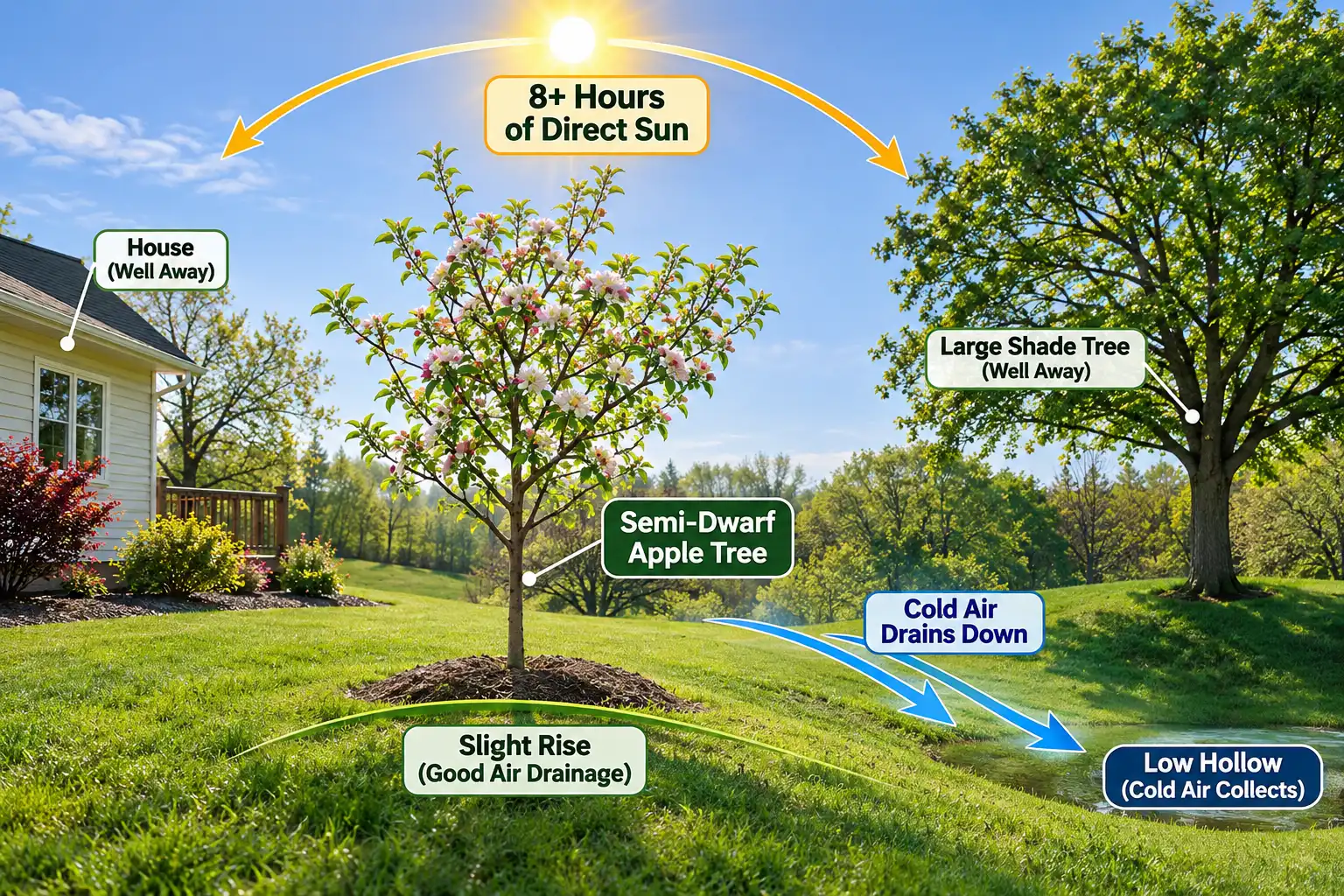
Apple trees need full sun. UMN defines that as at least 8 hours of direct sun each day in Minnesota. Oklahoma State Extension also calls for full sun most of the day and says to expect reduced performance otherwise. Morning sun matters most, because it dries dew from the leaves and reduces disease, Oklahoma State notes.
Elevation counts too. Illinois Extension points out that cold air settles in low areas, so higher ground suits fruit plantings better. As a result, a gentle rise often escapes spring frost that pools in a hollow.
Can Apple Trees Grow in Shade?
Apple trees can survive in partial shade, but they fruit poorly there. Shade cuts the light leaves use to feed the crop. It also keeps leaves wet longer, and Oklahoma State links that wetness to disease. Texas A&M AgriLife trains trees to a central leader for the same reason: to cut shade and catch more sunlight.
So if your best spot gets less than 8 hours, choose the site with the most morning sun. Then prune to keep the canopy open. Even so, expect smaller crops than a full-sun tree gives.
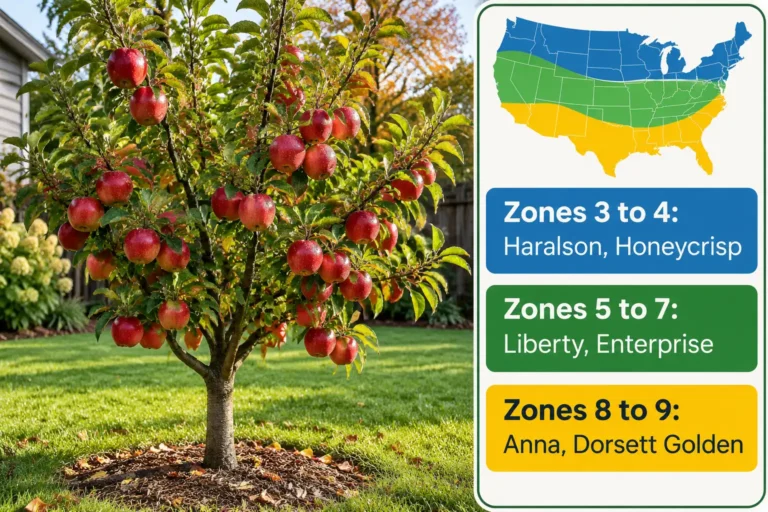
How to Grow Apple Trees in Your Region: Chill Hours and Varieties
Choose apple varieties whose winter chill needs match your area, or the tree may bloom poorly. Texas A&M AgriLife’s apple guide counts chill hours, traditionally, as hours below 45°F from November to March. It notes that apples grown in the Pacific Northwest, Great Lakes, and New England need 1,000 to 2,200 chill hours. Meanwhile, the highest-chill zone in Texas averages only 800 to 1,000.
Too little chill means fewer buds flower. Worse, Texas A&M warns that repeated low-chill winters can kill unadapted trees. Too low a chill need causes the opposite problem. The tree blooms early, and a late frost can take the crop. For that reason, Texas A&M advises picking varieties within 150 hours of your area’s average chill.
| Region | Climate figure | Varieties the source names | Source |
|---|---|---|---|
| Minnesota | Hardiness zones 3 and 4 | Haralson, Honeycrisp, Zestar!, SnowSweet, Frostbite | University of Minnesota Extension |
| Oklahoma | 800 to 1,200 chill hours a year | Enterprise, Freedom, Liberty, Honeycrisp | Oklahoma State Extension |
| Texas, higher-chill areas | More than 400 chill hours | Fuji, Gala, Mutsu, Pink Lady | Texas A&M AgriLife |
| Texas, low-chill areas | 400 chill hours or fewer | Anna, Dorsett Golden | Texas A&M AgriLife |
When the Chill Numbers Disagree
Chill figures for the same variety vary by source. Texas A&M lists Anna at about 400 chill hours, while Oklahoma State lists 200. For Dorsett Golden, Texas A&M gives about 350, and Oklahoma State gives 100 to 300. Neither source explains the gap. So use the figure from your own state’s extension service, since it reflects your winters.
Disease-Resistant Apple Varieties
Resistant varieties cut disease problems before they start. Oklahoma State rates common varieties for fire blight, cedar-apple rust, apple scab, and powdery mildew. In its table, Freedom, Liberty, and Enterprise rate resistant or very resistant to the first three. Gala, by contrast, rates very susceptible to fire blight and scab.
| Variety | Chill hours | Fire blight | Cedar-apple rust | Apple scab |
|---|---|---|---|---|
| Freedom | 500 to 600 | Very resistant | Resistant | Very resistant |
| Liberty | 800 | Resistant | Very resistant | Very resistant |
| Enterprise | 800 | Resistant | Resistant | Very resistant |
| GoldRush | 800 | Moderately resistant | Susceptible | Very resistant |
| Honeycrisp | 800 | Resistant | Susceptible | Moderately resistant |
| Gala | 600 | Very susceptible | Mixed rating | Very susceptible |
Ratings and chill hours are Oklahoma State Extension’s, for Oklahoma conditions. Farther north, University of Minnesota Extension also recommends Freedom and Liberty for Minnesota home orchards.
Do You Need Two Apple Trees for Pollination?
Yes. Most apple trees need pollen from a different variety to set a good crop. University of Minnesota Extension says you need two varieties, and one can be a crabapple. The pollen source should stand within about 100 feet. So a neighbor’s apple or crabapple inside that distance can count.
Bloom timing matters as much as distance. Texas A&M AgriLife advises planting more than one variety with overlapping bloom dates. In low-chill Texas, for example, it names Dorsett Golden as a reliable pollinizer for Anna. Two trees of the same variety won’t do the job, because they are genetically the same plant.
Bees carry the pollen, so protect them during bloom. Many pesticide labels carry pollinator protection directions, and you must follow the label. Bloom overlap is also the first thing to check when pairing fruit trees for cross-pollination.
How to Plant an Apple Tree
Plant bare-root apple trees while they are still dormant. UMN sets that window at April or May in Minnesota, once you can work the soil. Oklahoma State gives mid-February to early March in Oklahoma. For potted trees in Minnesota, UMN suggests May or June, after frost risk passes.
Start with a lab soil test, since pH and nutrients are easiest to fix before the tree goes in. Then follow these steps.
- Check the pH. UMN calls for a soil pH between 6 and 7.
- Check drainage. Avoid spots where water stands for several hours after rain, as UMN advises. Wet roots invite crown rot, a disease UMN lists for apples.
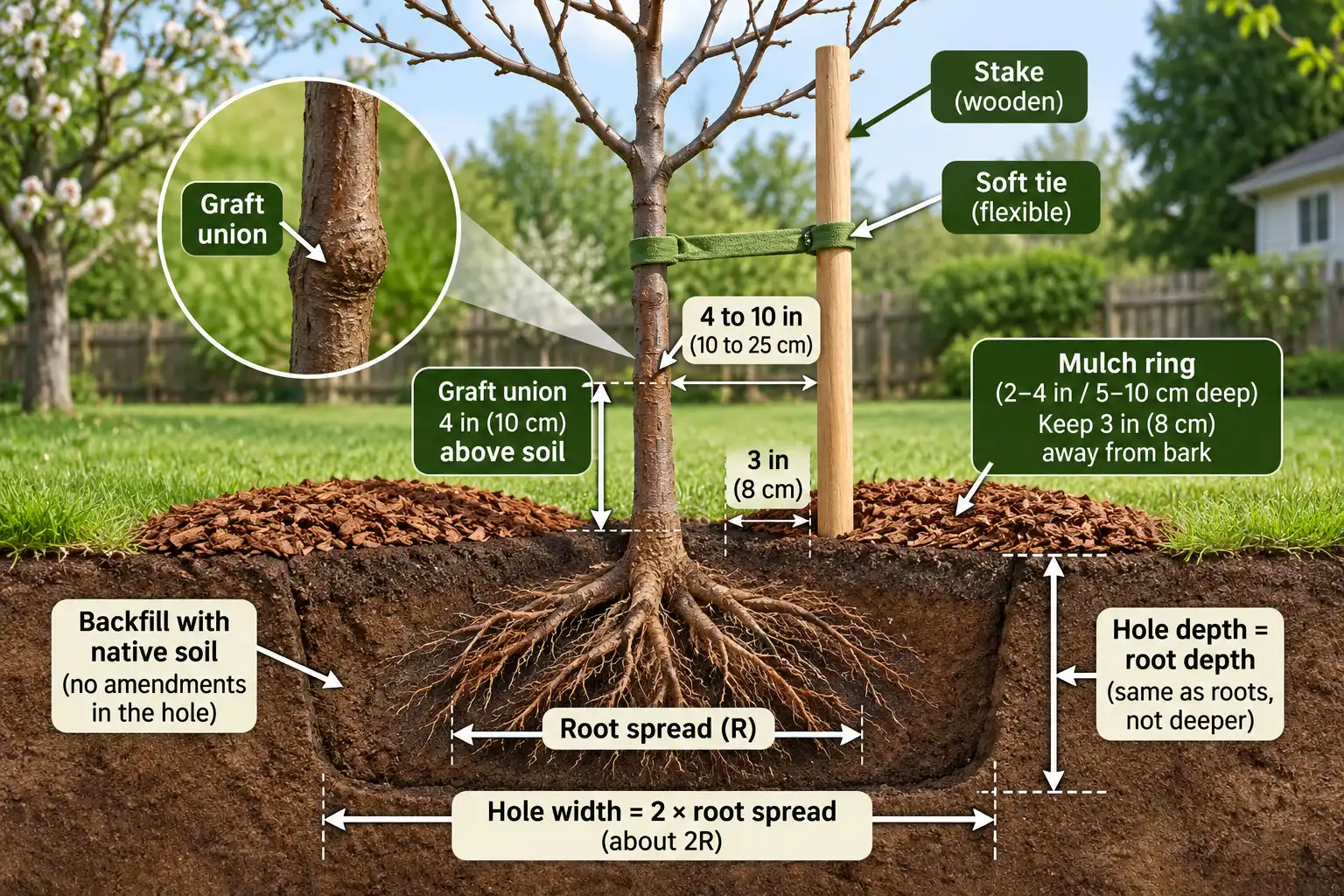
- Dig wide, not deep. Make the hole no deeper than the root ball and about twice as wide. Add no fertilizer to the hole, per UMN.
- Fix the roots. Cut away circling or J-shaped roots so new roots grow outward.
- Set the graft union high. Keep the graft union, the knobby joint low on the trunk, about 4 inches above the soil, per UMN. Illinois Extension gives 3 to 4 inches for dwarfing rootstocks. If it sits too low, the variety can root and grow into a full-size tree.
- Backfill and water. Refill with native soil, firm it gently, and water to settle air pockets.
- Head it back. Illinois Extension advises cutting the tree back to 30 inches right after planting. That cut starts the central-leader framework.
First-Year Care: Stakes, Mulch, and Trunk Guards
Stake dwarf trees from day one. UMN advises driving the stake about 2 feet into the ground, 4 to 10 inches from the trunk. Then tie the tree with soft ties, not wire or twine. Next, keep a 3-foot circle around the trunk free of grass and weeds for the first 3 to 5 years. Mulch a few inches deep, but hold it at least 3 inches back from the bark. Otherwise, UMN notes, mulch invites rodent damage and fungal growth.
Rabbits and voles chew bark in winter. So UMN recommends white tree guards in November in Minnesota. Where wildlife pressure is high, add fencing or cages from November through March. Guard height and material matter most when you compare trunk guards and tree wraps. These same basics apply to most fruit trees when planting bare-root trees.
How to Take Care of an Apple Tree
Apple tree care follows the seasons. You water through the growing season, feed based on growth, prune in late winter, and thin fruit in early summer.
How Much Water Does an Apple Tree Need?
Both UMN and Oklahoma State put an apple tree’s need near 1 inch of water a week in the growing season, rain included. UMN gives 1 inch per week from May through October in Minnesota. Oklahoma State gives about 1 inch every 7 to 10 days in Oklahoma. Young trees there need weekly watering when rain falls short.
To turn inches into gallons, note that 1 inch of water over 1 square foot is about 0.62 gallons. Say you water the 3-foot circle UMN suggests keeping weed-free. That circle covers about 28.3 square feet (3.14 × 3 × 3). So 1 inch there is about 17.5 gallons a week (28.3 × 0.62), minus any rain that fell. A rain gauge makes the math easy.
How to Fertilize an Apple Tree
Get a soil test before you feed, then let shoot growth guide you. UMN treats 12 to 18 inches of new growth a year as normal for young, non-bearing apple trees in Minnesota. If last year’s growth fell under 12 inches, UMN suggests spreading compost around the base in April or May. On the other hand, growth well past that range can mean too much nitrogen. UMN also notes that most Minnesota sites don’t need added phosphorus.
Oklahoma State publishes its own fertilizer schedule for Oklahoma apple trees, and the amount rises with tree age. So follow your state’s schedule and your soil test, rather than a general rate.
When to Prune an Apple Tree
Prune apple trees in late winter, before buds break. UMN sets this for March in Minnesota: after the coldest weather, before growth begins, and outside wet periods. Illinois Extension suggests a central-leader shape for apple trees on every rootstock. Similarly, Oklahoma State prefers a modified central leader for trees without a trellis.
Keep each year’s cuts moderate. Oklahoma State advises removing no more than one-third of the wood in a dormant pruning. Illinois Extension also warns that heavy pruning at one time can upset normal bearing for several years. Illinois lists different trunk heights and scaffold counts for dwarf and standard trees. So central-leader training starts with knowing your rootstock. On standard trees, set any ladder on firm, level ground before you climb.
How to Thin Apples
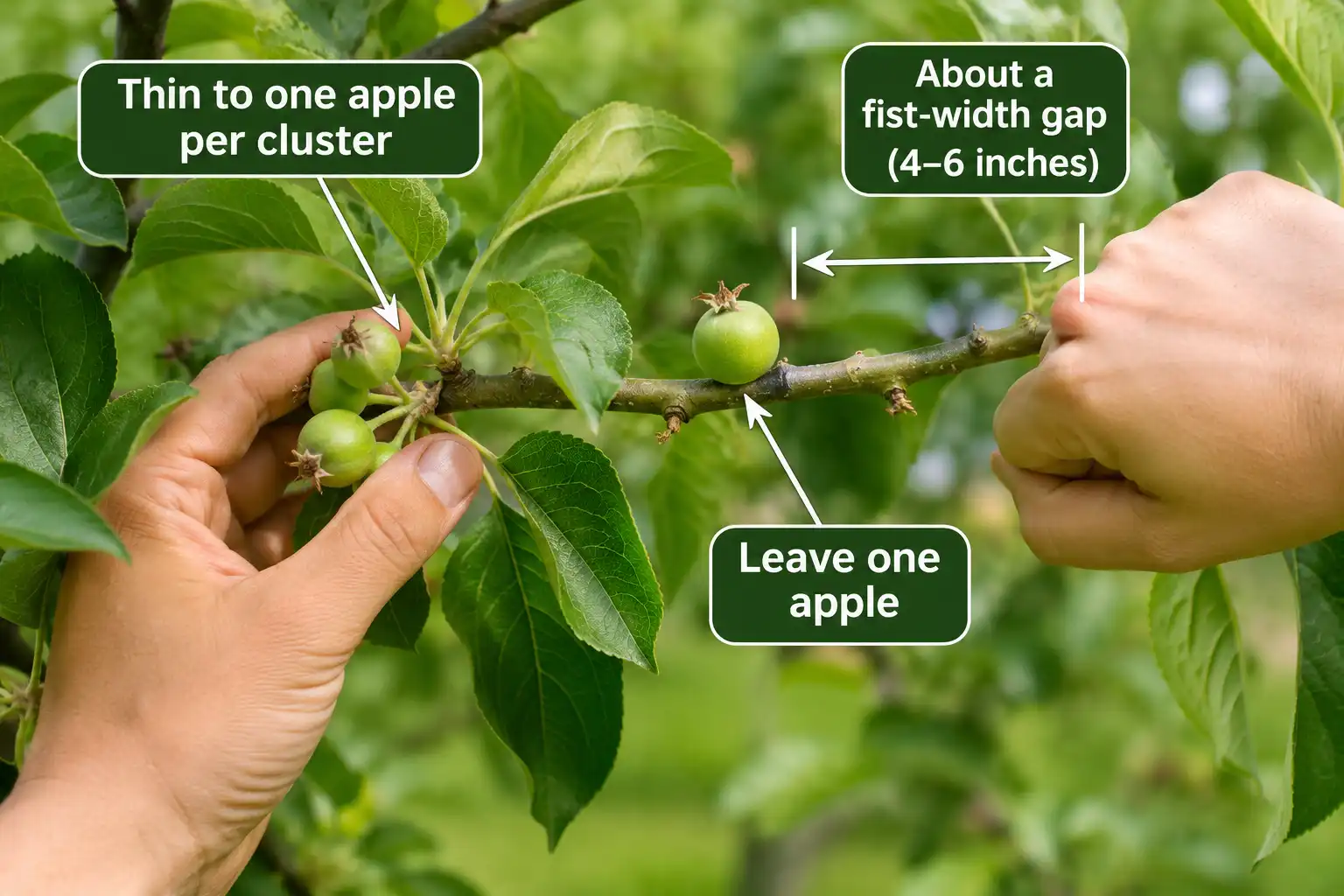
Thin apples once they set, leaving one fruit per cluster. UMN advises thinning at about marble size, in late June or early July in Minnesota. Wait until some fruit drops on its own. UMN calls for one apple per cluster and at least a fist-width between apples. Oklahoma State starts earlier, at about dime size, with apples 4 to 6 inches apart.
Thinning gives larger fruit and, per UMN, reduces biennial bearing. Those payoffs hold for most tree fruits, which is why thinning young fruit belongs on every early-summer task list.
Apple Tree Growth Stages
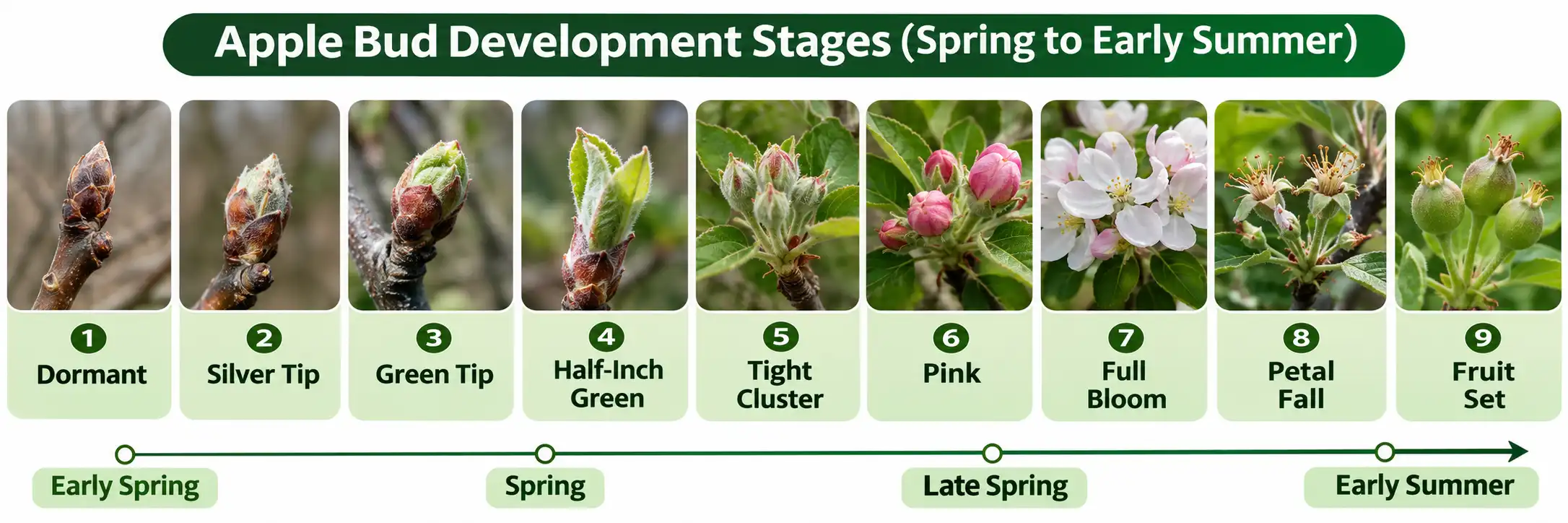
An apple tree goes through two sets of stages: life stages across the years, and bud stages every spring.
Life Stages From Planting to Old Age
| Stage | Typical timing | What to expect |
|---|---|---|
| Training years | Planting to first crop, 2 to 10 years by rootstock | Shoots grow 12 to 18 inches a year (UMN), and pruning builds the framework |
| Early bearing | First few crops | Early fruit can bend young dwarf trees out of shape (Illinois), so thin hard |
| Full bearing | Standard trees bear regularly by year 10 (Illinois) | Growth slows to 8 to 12 inches a year (UMN), and crops steady with thinning |
| Decline | After the useful life, below | Vigor drops, and Illinois advises more pruning as trees age |
Bud Stages Each Spring
Michigan State University Extension’s apple growth stage chart names each step from dormant bud to young fruit. Growers use these stages to time work, because pests, diseases, and frost risk change from one stage to the next.
| Bud stage | What you see | What to do |
|---|---|---|
| Dormant | Tight, closed buds | Prune before growth begins (UMN) |
| Silver tip and green tip | Bud scales part, then green leaf tips show | Growth has begun, so UMN’s pruning window has closed |
| Tight cluster and pink | Flower buds appear, then turn pink | Scout for insects and disease as buds turn pink (UMN) |
| King bloom and full bloom | The center flower opens, then the rest | Protect bees and follow label pollinator directions |
| Petal fall | Petals drop | Watch for small fruit forming |
| Fruit set | Young fruit near 1/3 inch, MSU’s 8 mm and 10 mm stages | Thin at marble size, after natural drop (UMN) |
When and How to Harvest Apples
Pick apples when the background skin color shifts toward yellow and the flesh tastes sweet, not starchy. UMN puts the harvest at August through October in Minnesota. On red varieties, watch the background color change from green to greenish-yellow. Ripe apples also develop aroma. To pick, lift the apple and twist it gently. Pulling can remove next year’s flower buds, UMN warns.
Expect the crop to grow with the tree. Virginia Tech estimates about 2 bushels per dwarf apple tree, 4 per semi-dwarf, and 8 per standard tree. Illinois Extension’s table runs higher at year 10. It gives 3 to 5 bushels for a dwarf and 5 to 15 for a standard. So a pair of dwarf trees could give about 4 bushels a year on Virginia Tech figures. On Illinois figures, the same pair gives 6 to 10 by year 10.
Common Apple Tree Problems
Many apple problems look alike, so have your county extension office or a state plant diagnostic lab confirm the cause. Many accept samples. The descriptions below show what to watch for, not what your tree has.
- Apple scab. UMN describes olive green to brown leaf spots with a feathered edge that darken with age. Infected fruit can show brown, raised, corky spots. The fungus spends winter on fallen leaves, so UMN advises raking or mowing them after leaf fall.
- Fire blight. This bacterial disease often bends young shoot tips into a shepherd’s crook. UMN adds that infected leaves wilt, turn gray, then dark brown, and stay on the tree. Texas A&M AgriLife lists resistant varieties, pruning out infected limbs, and limiting nitrogen among its management steps.
- Cedar-apple rust. Leaves often show yellow, then bright orange spots with a red border, per UMN. Nearby junipers carry the other half of its cycle. On them, it forms brown woody galls that push out orange tentacles in wet spring weather.
- Voles and rabbits. Both chew bark in winter. Trunk guards and fencing, covered under first-year care, are the main defense.
Sprays are labeled for some apple diseases. However, whether a product suits your tree, and how to apply it, comes from the label, which is the law.
Why Isn’t My Apple Tree Producing Fruit?
A healthy apple tree that won’t fruit is often too young, unpollinated, or frosted at bloom. Start with age, since a standard tree may need 6 to 10 years on Virginia Tech’s figures. Next, check for a second variety blooming within about 100 feet (UMN). After that, consider chill and frost. Texas A&M notes that too little chill thins bloom. Too low a chill need brings early bloom and frost risk instead. Shade and heavy pruning can also cut fruiting. Finally, a tree that crops heavily one year and lightly the next may be biennial bearing. UMN says thinning helps reduce it. If none of these fits, your county extension office can help sort it out.
How Long Does an Apple Tree Live?
Published extension figures for apple trees run from about 10 to 45 years, depending on rootstock and source. The two main tables measure different things, so their numbers don’t match.
| Apple tree type | Illinois Extension: useful life | Virginia Tech: life expectancy |
|---|---|---|
| Dwarf | 10 to 15 years | 30 to 35 years |
| Semi-dwarf | 15 to 20 years | 30 to 35 years |
| Standard | 15 to 20 years | 35 to 45 years |
Illinois labels its figure useful life, which points to productive years. Virginia Tech lists life expectancy instead. Oklahoma State says only that apple trees live for several decades. None of these sources gives a maximum age, and published data on very old trees is thin. So plan replanting around the productive years, not the oldest tree you have heard of.
FAQs About Growing Apple Trees
Can you grow an apple tree from seed?
You can, but the tree won’t produce the same apple as the fruit the seed came from. A seedling also grows to full standard size, which UMN puts at 20 feet or more.
Should you let a young apple tree fruit?
Yes, but thin those first apples hard on a young tree. Illinois Extension warns that early fruit can bend young dwarf apple trees out of shape while the branch framework forms.
Why does my apple tree fruit only every other year?
That pattern is biennial bearing, and heavy crops tend to set it off. University of Minnesota Extension says thinning to one apple per cluster helps even out crops from year to year.
Do apple trees need to be staked?
Most dwarf apple trees do, because their shallow roots anchor poorly. Texas A&M AgriLife says M.9 and M.26 trees need a trellis-type support, while semi-dwarf MM.111 trees stand on their own.
Do apple trees need fertilizer every year?
Not always, because shoot growth shows when to feed. UMN suggests compost when a young Minnesota tree grew under 12 inches last year, and a soil test covers the rest.
Is it normal for small apples to drop in early summer?
Yes, some natural fruit drop in early summer is normal. UMN times hand thinning for after that drop, in late June or early July in Minnesota, at about marble size.
Before You Plant
Decide on rootstock first, because it sets the tree’s size, its spacing, and your wait for fruit. Then match varieties to your chill hours or hardiness zone with your state extension service’s list. Buy two that bloom together, and give them the sunniest, best-drained spot you have. After that, the yearly routine is short: water, prune in late winter, and thin in early summer.