
Drip Irrigation for Fruit Trees: Emitter Count, Layout, and Run Time

Getting drip irrigation for fruit trees right comes down to three choices: emitter count, emitter placement, and run time. Each one changes as the tree grows.
Drip irrigation for fruit trees should follow the roots. Start a young tree on one or two emitters about a foot from the trunk. As the canopy spreads, add emitters and move them toward the canopy edge.
What a Fruit Tree Drip System Needs
A working system needs six parts, and each one prevents a specific failure. Oklahoma State Extension’s drip irrigation fact sheet calls water quality and filtration the most serious concerns. Emitter openings are tiny and plug easily. Utah State University Extension’s guide to drip irrigation for trees calls for a low-pressure backflow preventer on drinking water lines.
- Backflow preventer. Keeps irrigation water from flowing back into your water supply.
- Filter. Catches sand, silt, and debris before they reach the emitters.
- Pressure regulator. Holds the line at 10 to 30 psi, the range USU gives for most drip systems.
- Supply line. Carries water down the row. New Mexico State University Extension lists 1/2-inch, 15 mm, and 16 mm tubing as the most common sizes.
- Emitters. Oklahoma State lists common flows of 1/2, 1, 2, and 4 gallons per hour (gph).
- End cap or flush valve. Lets you open the line and flush out sediment, which Oklahoma State recommends doing regularly.
You also choose between two emitter styles. Point-source emitters plug into the line at each tree, and Oklahoma State recommends them for trees spaced several feet apart. Inline emitter tubing has emitters built in at a fixed spacing. It suits plants set close together in a row.
Before comparing ready-made drip kits, check that a kit includes both a filter and a pressure regulator.

How Many Emitters Does Each Fruit Tree Need?
Enough to wet at least half the soil under the canopy. USU sets 50 percent as the floor and calls 60 percent or more better. New Mexico State University Extension’s orchard drip circular uses 60 percent as its minimum. Roots grow only where soil stays moist, so wetting too little leaves a tree root-bound, as USU puts it.
USU’s method turns that target into an emitter count:
- Canopy area = canopy diameter × canopy diameter × 0.7854
- Emitters = canopy area × 0.60 ÷ area wetted per emitter
Soil texture sets the last number. Per USU, one emitter wets 5 to 21 square feet in sand. Loam gets 21 to 65, and clay 65 to 161. The table below gives emitters per tree, using the low end of each range, rounded up.
| Canopy diameter | Canopy area | Sand | Loam | Clay |
|---|---|---|---|---|
| 6 feet | 28 sq ft | 4 | 1 | 1 |
| 12 feet | 113 sq ft | 14 | 4 | 2 |
| 18 feet | 254 sq ft | 31 | 8 | 3 |
Measure your own canopy from drip line to drip line, because rootstock, variety, and age all set its width. Then run a soil texture test before buying parts, since texture swings the count more than anything else.
Where the math says one emitter, add a second as insurance. If one clogs, the tree still gets water. On sand, counts climb fast, so a loop of inline emitter tubing beats 31 separate emitters.
Where to Place Emitters Around the Trunk
Place emitters as far from the trunk as the roots can still reach. Then move them out as the tree grows. UC IPM’s Pest Notes on Phytophthora root and crown rot put young trees’ emitters within about a foot of the trunk. Mature trees’ emitters belong near the drip line. NMSU gives 1 to 1.5 feet from the trunk for newly transplanted trees.
For a mature tree, Oklahoma State splits the water among several emitters. Space them evenly around the trunk, near the drip line. That spread keeps root growth balanced on every side.
The spacing matters for disease, too. UC IPM says Phytophthora root and crown rot can develop after just 4 to 8 hours of saturated soil. Constant moisture at the trunk base favors it. Poorly drained ground raises the same risk. Several root, crown, and water problems look alike. If a watered tree wilts, ask your county extension office or a state plant diagnostic lab to identify the cause.
Move emitters outward every year for at least the first few years, as UC IPM advises. Keep them on the soil surface, too. USU notes that surface emitters are easy to inspect and stay free of root intrusion.

Which Drip Layout Fits Your Planting?
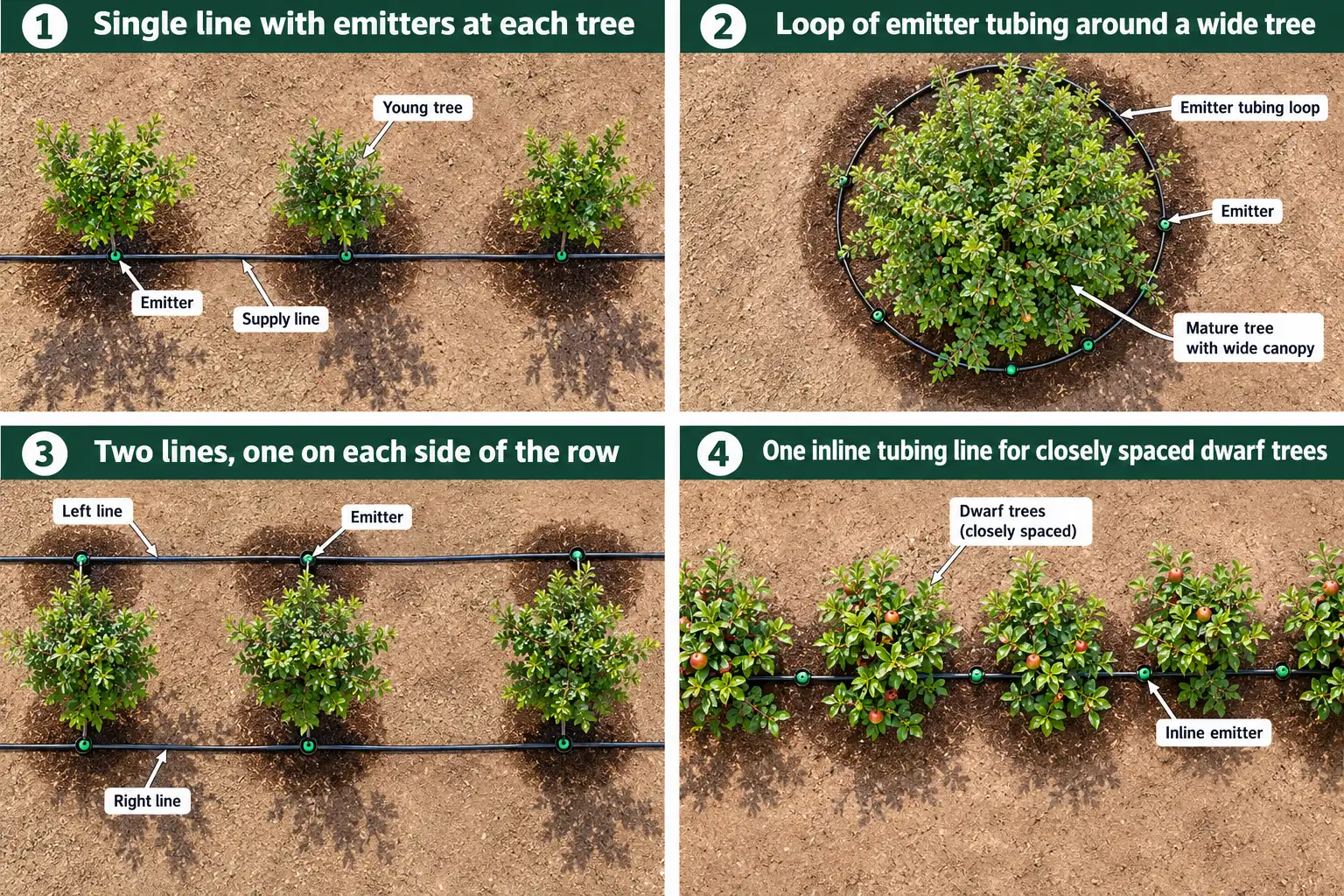
One supply line with emitters at each tree fits most young plantings. NMSU finds that one line with in-line or attached emitters works well for peaches, apples, and citrus. It uses two to four emitters per tree. Tree loops and second lines take over as canopies widen.
| Layout | Best fit | Trade-off |
|---|---|---|
| Single line, emitters at each tree | Young trees, small canopies | Emitters move out yearly |
| Tubing loop around each trunk | Wide canopies, sandy soil | Loop grows with the tree |
| Two lines, one per side of the row | Trees that outgrow one line | Double the tubing |
| One line of inline tubing | Close-set dwarf trees | Wets a strip only |
For two lines, NMSU sets each one out from the trees by a quarter of the row spacing. For example, in rows 16 feet apart, each line sits 4 feet from the trunk. A University of Georgia peach irrigation trial gave young ‘Julyprince’ peaches on ‘Guardian’ rootstock four emitters each, mimicking a double line. The trial ran in Griffin, Georgia.
Slope changes the layout too. Oklahoma State says pressure rises 1 psi for every 2.31 feet of drop. So run lines across the slope or slightly downhill rather than uphill. Pressure-compensating emitters hold steady flow on uneven ground within their rated range. Also leave 5 to 10 feet of slack at each line’s end, as NMSU suggests, so emitters can move later.
How Much Water Does a Fruit Tree Need From Drip?
It depends on canopy size, fruit, and weather. Oklahoma State gives one example. A peach tree in Oklahoma with a 12-foot canopy, using 0.24 inch of water a day, needs 18.8 gallons daily.
USU’s formula runs your own numbers:
- Gallons per day = 0.623 × canopy area × plant factor × daily PET ÷ system efficiency
PET (potential evapotranspiration) is the daily water use of well-watered grass under your local weather. USU’s plant factors are 0.85 for apples and cherries and 0.75 for peaches, plums, pears, and apricots. USU also rates most drip systems 85 to 90 percent efficient.
Peak daily need for a 12-foot canopy at 90 percent efficiency:
| Fruit and place | Daily water figure used | Gallons per tree per day |
|---|---|---|
| Peach, Oklahoma | 0.24 inch tree water use (Oklahoma State) | 18.8 |
| Apple, most of Utah | 0.25 to 0.30 inch PET (USU) | 16.6 to 20.0 |
| Peach, Moab, Utah | 0.35 to 0.40 inch PET (USU) | 20.6 to 23.5 |
The Utah rows are our arithmetic from USU’s inputs.
Size the system for the mature tree in the hottest weeks, as USU advises. NMSU treats the in-row spacing as the mature canopy width. So peaches spaced 18 by 24 feet reach an 18-foot canopy. At Moab’s 0.40 inch PET, that tree needs about 52.8 gallons a day.
Your county extension office can often supply local PET. In rainy regions, rain covers part of the need, so trim run times with a seasonal watering schedule.
Sizing Drip Irrigation for Fruit Trees: Run Time and Zones
Two formulas from Oklahoma State turn daily gallons into a schedule:
- Hours per day = gallons per tree per day ÷ (emitters per tree × gph per emitter)
- Zone flow in gpm = trees × emitters per tree × gph per emitter ÷ 60
Here is a worked case. Take 30 apple trees in most of Utah, each with a 12-foot canopy. At the high end of the table above, each needs 20 gallons a day at peak. On loam, each tree gets four 2-gph emitters, or 8 gph.
- Run time: 20 ÷ 8 = 2.5 hours a day
- Zone flow: 30 × 8 ÷ 60 = 4 gpm
Oklahoma State puts a standard outside faucet at about 5 gpm, enough for roughly 300 one-gph emitters. So 30 trees fit on one zone. At 50 trees, however, flow climbs to 6.7 gpm, which is too much for one faucet. Split them into two zones of 25 trees at about 3.3 gpm each. Then run the zones back to back, 5 hours in all.
Check your own faucet first. Time how long it takes to fill a 5-gallon bucket, then divide 5 by the minutes to get gpm.
Watering less often means longer runs. Oklahoma State’s peach example needs 16.5 hours to apply a full week’s water at once. That runs past its own 16-hour limit for any one zone. Oklahoma State also caps the whole system at 18 hours a day. That leaves time to catch up after a breakdown.
How to Install a Fruit Tree Drip System
Install from the faucet outward, then test before the first full run.
- Measure canopies and faucet flow. These two numbers set the emitter count and zone size.
- Check soil texture. Sand, loam, and clay change emitter counts several times over, as the emitter table shows.
- Build the head assembly at the faucet. Fit the backflow preventer at the water source, then the filter and pressure regulator.
- Lay the supply line. Run it across the slope, snaked loosely, with slack at each end.
- Set the emitters. Place them about a foot out on young trees and near the drip line on mature ones, spaced evenly.
- Flush, then cap. Run water through the open end to clear soil and plastic bits left from installation. NMSU lists pipe shavings and thread tape among the debris that clogs new systems.
- Test the output. Catch water from several emitters for one minute each. NMSU converts milliliters per minute to gph by multiplying by 0.015852, so a 2-gph emitter fills about 126 ml. Oklahoma State allows no more than a 10 percent gap between the lowest and highest emitter.
- Add a timer. A battery hose-end timer needs no wiring. A hardwired controller or pump circuit is a job for a licensed electrician.
For new trees, lay the line once planting and backfilling are done. The first watering then settles soil around the new roots.
Never inject a pesticide through drip unless the product label allows it. NMSU notes that federal rules require specific chemigation equipment, and the label governs the rest.
Troubleshooting Common Drip Problems
Clogging tops the list. NMSU calls emitter clogging the greatest potential problem after design. Oklahoma State likewise ranks water quality and filtration as the top concerns. Most other failures trace back to pressure or placement.
| Problem | Likely cause | What to do |
|---|---|---|
| Emitters drip slowly or stop | Sediment, minerals such as iron or calcium, or algae | Clean the filter, open the line ends to flush, and have the water tested |
| Far end of the row gets less water | Line too long, or running uphill | Shorten runs, split the zone, or switch to pressure-compensating emitters |
| Soggy soil at the trunk base | Emitters too close to the trunk | Move emitters outward toward the drip line |
| Dry patches between emitters | Sandy soil, where water moves mostly straight down | Add emitters or a tubing loop, or consider micro-sprinklers |
| White crust ring on the soil | Salts collecting at the edge of the wet zone | Space emitters so wet areas overlap |
| Tree wilts though soil is moist | Several possible causes, including root and crown problems | Contact your county extension office or a plant diagnostic lab |
Line length has a hard ceiling. NMSU’s guideline caps a half-inch line carrying 2 gpm at 500 feet. At 8 gph per tree, 2 gpm serves 15 trees. Salt crusts form where wet areas end, NMSU explains. That is why USU advises spacing emitters to prevent buildup.
FAQs About Drip Irrigation for Fruit Trees
Should drip emitters be buried under mulch?
Keep emitters on the surface where you can see them, as USU advises, since buried ones invite root intrusion. Mulch can cover the tubing, but UC IPM warns against mulch over the trunk or graft union.
Is drip or micro-sprinkler better for fruit trees?
On clay-loam soil in Georgia, drip used about 36 percent less water than micro-sprinklers on young peaches in UGA trials. On sandy soil, the same researchers suggest micro-sprinklers may spread water better.
Do I need a pressure regulator for drip?
Yes, if your household water pressure runs above the drip range. Utah State University Extension puts most drip systems at 10 to 30 psi, and a regulator holds that range.
How many fruit trees can one garden faucet run?
Roughly 37 trees at once, if each one gets four 2-gph emitters. Oklahoma State Extension rates a standard outside faucet at about 5 gpm, which is 300 gallons per hour.
Can I add fertilizer through the drip line?
Yes, but only after a soil test shows what the trees need. NMSU places the injector upstream of the filter, with a check valve and vacuum breaker guarding the water source.
Do young fruit trees in the humid Southeast need drip?
Often, yes, even though Southeast growers traditionally wait two to three years to irrigate. In UGA trials, irrigated young ‘Julyprince’ peaches grew about 1.5 times the trunk cross-section of unirrigated trees.
Before You Install
Start with three numbers: each tree’s canopy width, your soil texture, and your faucet’s flow. Together they set the emitter count, the run time, and the number of zones. Then size the supply line for mature trees, not today’s saplings. Move emitters outward each year until the canopy stops spreading. For drainage, testing, and timing questions, the soil and water guides pick up where this one ends.