How to Plant an Apricot Tree: Timing, Hole Depth, and Spacing

Apricots bloom early in spring, so the planting site and the planting job shape how often the tree crops. Here is how to plant an apricot tree, bare-root or potted, and get it through its first season.
To plant an apricot tree, pick sunny, well-drained ground. Plant in late winter in mild climates or early spring in cold ones. Dig twice as wide as the roots, no deeper. Keep the graft union 2 to 4 inches above soil.
When to Plant an Apricot Tree
Plant an apricot tree while it is still dormant, before the buds open. Your winter sets the month.
In mild-winter California, UC ANR’s Alameda County Master Gardeners plant bare-root fruit trees, apricots included, December through March. That is when nurseries stock bare-root trees. In colder regions, the window moves to spring. University of Minnesota Extension plants bare-root apricots and other stone fruits in early spring. It plants once the ground is workable and before growth starts. For New Hampshire, UNH Extension narrows it to late April through mid-May, before the buds break.
Bare-Root or Potted: Does the Timing Change?
Yes, a potted apricot gives you more room. A bare-root tree has to go in while dormant. By contrast, University of Minnesota Extension says container stone fruits can go in any time during the growing season. Spring is still ideal, and it advises waiting until frost danger passes.
Summer planting costs you water, though. For example, UC ANR Publication 8048 fills a new apricot’s basin once or twice a week in California heat.
Also know: Grow Apricot Tree from Seed
Where to Plant an Apricot Tree
Plant an apricot tree in full sun and well-drained soil, on ground where cold air drains away.
Pick a Frost-Safe Spot
A late freeze at bloom can take the whole crop. In fact, Utah State University Extension says apricots in Utah may fruit only 3 out of 5 years. Site choice is how you shift those odds.
- Plant on higher ground. UNH Extension favors elevated sites, because cold air flows away from them on clear, cold nights.
- Skip low spots. Hollows and the bottom of a slope collect that cold air.
- Stay off south walls. University of Minnesota Extension warns that heat trapped by a south wall can push early bloom.
On a marginal site, plan your late frost protection before the first buds swell.
Sun, Drainage, and Soil
Give the tree as much sun as the yard allows. University of Minnesota Extension sets the minimum at a half day of sun. UC ANR asks for 6 hours, and UNH Extension wants full sun all day.
Drainage matters more than richness. Utah State notes that apricots have little tolerance of wet, heavy soils, which raise the risk of root rot. So avoid any spot where water stands after rain. On heavy clay, UC ANR’s Alameda County Master Gardeners set the tree on a small mound with sloping sides.
Next, check the pH. UNH Extension recommends 6.0 to 7.0 for stone fruits in New Hampshire. In Utah’s alkaline soils, by contrast, Utah State says apricots are prone to iron chlorosis. A lab soil test shows your pH and nutrient levels before the tree goes in.
Also keep apricots out of the lawn. Utah State points out that lawns get more water than the trees need, and grass competes for nutrients.
Match the Variety and Spacing to Your Site
Choose the variety for your zone first, then space for a full-size tree.
Check Your Hardiness Zone and Pollination Needs
Utah State University Extension says apricots thrive in USDA zones 5 to 8. Many common varieties survive zone 4 but fruit only now and then. For zone 3, Utah State points to Manchurian and Siberian types, though their fruit is smaller and lower in quality.
Regional picks vary. University of Minnesota Extension lists cold-hardy hybrids such as ‘Moongold’ and ‘Sungold’. Utah State favors late bloomers such as ‘Goldrich’ and ‘Harglow’.
Pollination needs differ too. Utah State says most apricots are self-fruitful, but yields improve with a second variety that blooms at the same time. However, the Minnesota hybrids are self-incompatible and need a second variety within about 100 yards. NMSU Extension adds that ‘Goldrich’ and ‘Perfection’ must be cross-pollinated to bear. So confirm the pollinizer before you order.
How Much Space Does an Apricot Tree Need?
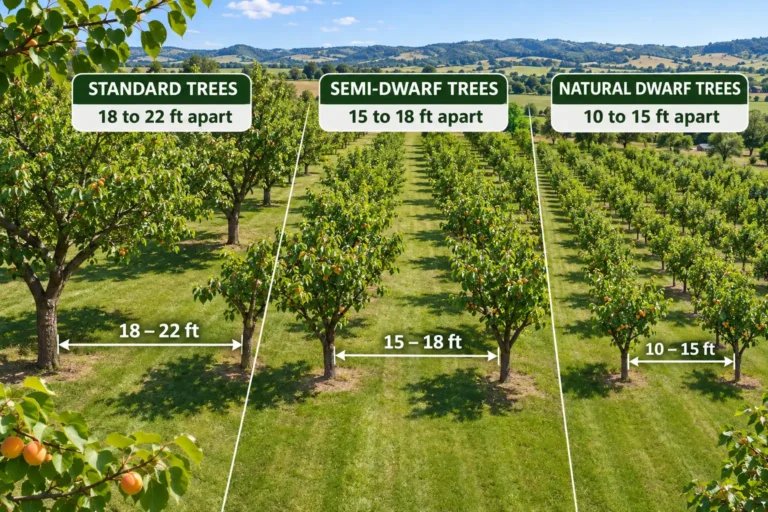
Plan on 12 to 22 feet between apricot trees, depending on your region’s guidance. Utah State spaces apricots 18 to 22 feet apart in Utah. UNH Extension uses 15 to 20 feet in New Hampshire. University of Minnesota Extension lists 12 to 20 feet for stone fruits. For two hybrid apricots that reach 15 to 20 feet, it allows at least 20 feet.
Dwarf apricots are scarce. UNH Extension notes that dwarfing rootstocks for apricots are not readily available to home gardeners. So plan for a full-size tree.
To see how many apricots fit, divide your area by the square feet each tree takes.
| Apricot spacing (feet) | Square feet per tree | Trees per quarter acre | Trees per acre |
|---|---|---|---|
| 12 x 12 | 144 | 75 | 302 |
| 15 x 15 | 225 | 48 | 193 |
| 18 x 18 | 324 | 33 | 134 |
| 20 x 20 | 400 | 27 | 108 |
| 22 x 22 | 484 | 22 | 90 |
Trees for your area = area in square feet / (in-row spacing x between-row spacing). For example, a 40 by 60 foot backyard plot covers 2,400 square feet. At 20 by 20 feet, it holds about 6 apricot trees (2,400 / 400). Round down, because edge trees still need room to spread.
How to Prepare a Planting Hole for an Apricot Tree
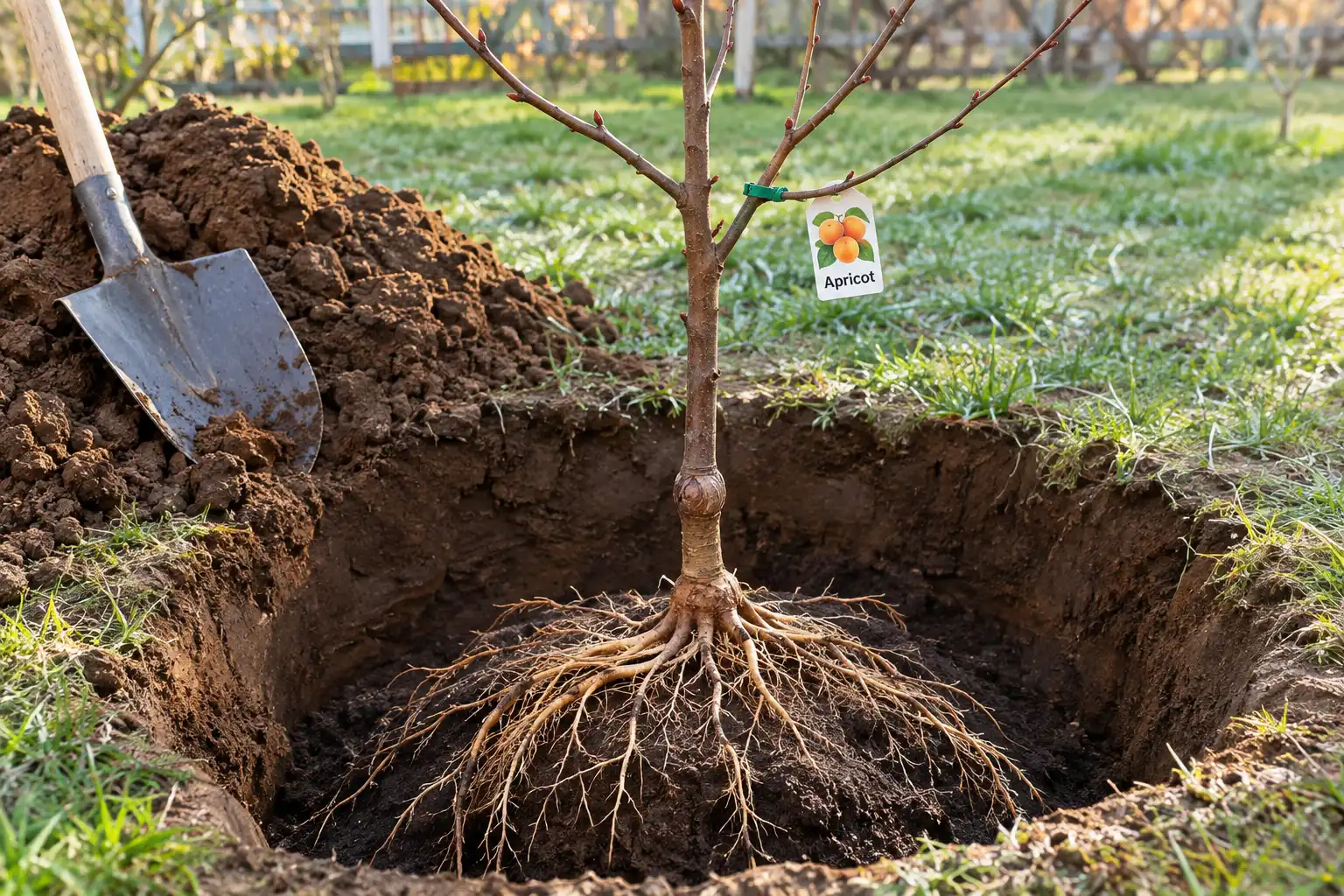
Dig a wide, shallow hole: wide enough for the roots to spread flat, and no deeper than the root system.
How Wide to Dig the Hole
UC ANR Publication 8048 says to dig at least twice as wide as the spread of the roots. Utah State University Extension uses the same rule for potted trees: twice the width of the container. For bare-root trees, though, Utah State asks only for a hole slightly wider than the roots.
Either way, go wide enough that no root has to bend. For example, apricot roots that spread 18 inches need a hole about 36 inches across under UC ANR’s rule.
How Deep to Plant an Apricot Tree
Plant the tree at its nursery depth, with the graft union 2 to 4 inches above the soil. UC ANR and Utah State both use that 2 to 4 inch range. Can’t see the old soil line on the trunk? Then University of Minnesota Extension sets the graft union 3 to 4 inches above the soil.
Dig no deeper than the roots, and leave the bottom of the hole undisturbed, as UC ANR advises. That way the tree rests on firm soil. UC ANR also keeps the trunk’s soil line 1 to 2 inches above the surrounding ground. That lowers the chance of crown rot. Finally, turn the notch of the graft union to face north or northeast, which UC ANR says limits sunburn.

Should You Amend Soil When Planting an Apricot Tree?
Not inside the planting hole. UC ANR’s Stanislaus County Master Gardeners cite University of California research showing that amending the planting hole is not beneficial. Publication 8048 also keeps amendments and fertilizer out of the hole. Instead, till well-decomposed compost into the wider area before you dig.
Sources differ on how strict to be. University of Minnesota Extension allows compost or damp peat moss in the backfill. Still, at least half the mix must be original soil. Meanwhile, Utah State says to correct any nutrient shortfall your soil test shows and till it in before planting. On one point, UC ANR, University of Minnesota Extension, and UNH Extension all agree: no fertilizer goes in the hole.
How to Plant a Bare-Root Apricot Tree
Plant a bare-root apricot soon after it arrives. The soil cone method below comes from UC ANR’s Sonoma County Master Gardeners.
- Soak the roots. University of Minnesota Extension soaks bare-root apricots and other stone fruits for 2 to 4 hours before planting.
- Trim only damaged roots. UC ANR cuts off broken or kinked roots. Leave healthy roots full length, since University of Minnesota Extension trims only very long ones.
- Dig and build a cone. Dig twice as wide as the root spread and no deeper. Then shape a cone of native soil in the center. The cone holds the tree at the right height.
- Set the tree on the cone. Fan the roots down its sides. Then check the graft union. It should sit 2 to 4 inches above the surrounding soil, with the notch facing north or northeast.
- Backfill in two stages. Fill about two-thirds of the hole with native soil and firm it around the roots. Next, UNH Extension pours in 2 gallons of water for stone fruits such as apricots in New Hampshire. It then finishes the backfill.
- Water deeply. Utah State says a thorough watering settles the soil and removes air pockets. After that, shape a low ring of soil around the tree to hold water.
- Head the tree. UC ANR cuts the top back to knee height, about 18 to 24 inches.
The best heading height depends on how you will shape the tree. So pick a system first. Open center and central leader methods differ when training young fruit trees.
How to Plant a Potted Apricot Tree
Plant a potted apricot at the same depth it grew in the container, after you loosen any circling roots.
- Dig the hole. Make it twice as wide as the container and the same depth, as Utah State University Extension advises.
- Slide the tree out. Tip the pot on its side and ease the root ball free. Support the ball instead of pulling on the trunk.
- Loosen circling roots. UC ANR says to gently pull circling or girdling roots away from the root ball. Left alone, they keep wrapping around the root ball as the tree grows.
- Set the height. Keep the top of the root ball level with the soil and the graft union 2 to 4 inches above it. Utah State warns that planting too shallow dries out the root ball, while planting too deep causes root loss.
- Backfill and water. Refill with native soil and firm it gently. Then water slowly, because UC ANR stresses that the water must soak into the root ball itself.

How to Plant an Apricot Tree Without Damaging the Roots
Keep the roots moist, covered, and unbent from the nursery to the hole.
- Never let roots dry. Utah State University Extension is firm on this point. If the site isn’t ready, UNH Extension heels the roots into moist soil in a shady spot.
- Lift by the root ball. Iowa State University Extension carries a tree by its root ball or wrapping, never by the trunk.
- Remove the nursery tag. UNH Extension warns that a forgotten tag can girdle the trunk or a branch as it grows.
First-Season Care for a New Apricot Tree
In the first season, the tree needs steady water, a protected trunk, and no rush with fertilizer.
Water and Mulch
Keep the soil moist but not soggy. Utah State University Extension waters new apricots in Utah about twice a week during the first season. In California, UC ANR Publication 8048 fills a new apricot’s basin once or twice a week in hot weather. It waters less often when it is cool or rainy. A drip setup for young fruit trees makes either schedule easier to keep.
Next, mulch the root zone but keep it off the bark. UC ANR spreads mulch 3 to 6 inches thick, held several inches from the trunk. Also, if the soil around the trunk settles into a hollow, fill it by autumn. UNH Extension says this prevents ice damage to the lower trunk.
Protect the Trunk
Paint the trunk white. UC ANR uses white interior latex paint diluted to half strength with water. Apply it from 2 inches below the soil up the whole trunk. According to Publication 8048, the coating protects against sunburn and borer infestation. If damage still shows up at the trunk base, your county extension office can identify the cause.
Then guard the trunk from animals. University of Minnesota Extension recommends a tree guard for young stone fruit trees. Also, Iowa State University Extension warns that deer and rabbits can damage a young tree quickly. Guard height and material matter, so compare trunk guards and wraps before you buy. On windy sites, Utah State stakes bare-root apricots for 1 year, then removes the stake.

Hold Off on Fertilizer
Skip fertilizer at planting, and get a soil test before you add any later. Sources differ on when to start. Utah State says newly planted apricots in Utah should get no fertilizer in their first year. UC ANR waits until new growth is several inches long. By contrast, UNH Extension gives stone fruits in New Hampshire a first light feeding about 3 weeks after planting. So let your soil test and your county extension office set the amount.
When Will a New Apricot Tree Bear Fruit?
Expect the first apricots 2 to 5 years after planting, though the range differs by source. University of Minnesota Extension gives 2 to 5 years for a 1 or 2 year old hybrid apricot in Minnesota. NMSU Extension puts apricots in New Mexico at 3 to 5 years.
Year of first harvest = planting year + years to bearing. Plant in spring 2027, and the first fruit could come between 2029 and 2032 on Minnesota’s range. On New Mexico’s range, it falls between 2030 and 2032.
Frost can still skip a year. As noted above, Utah State says apricots in Utah may fruit only 3 out of 5 years. Still, University of Minnesota Extension says that when bloom freezes, you will probably get fruit the following year.
How to Transplant an Apricot Tree
Move an apricot tree only while it is dormant and still small. Iowa State University Extension limits home transplanting to trees with a trunk 2 inches across or less. Measure the trunk 6 inches above the ground. Larger trees call for a nursery professional or contractor.
Iowa State moves deciduous trees in early spring before growth begins, or in fall after the leaves drop. In cold regions, though, spring matches the stone fruit planting window from University of Minnesota and UNH Extension.
Size the root ball to the trunk. Iowa State lists these minimums:
| Trunk diameter (inches) | Minimum tree height (feet) | Minimum root ball diameter (inches) |
|---|---|---|
| 0.5 | 3 | 12 |
| 1 | 5 | 16 |
| 1.5 | 6 | 20 |
| 2 | 7 | 24 |
- Water ahead. If the soil is dry, water thoroughly 3 to 4 days before digging, as Iowa State advises.
- Dig the ball. Cut a trench around the tree 1.5 to 2 feet deep at the edge of the root ball. Then cut beneath the roots and round off the bottom.
- Wrap and carry. Tip the ball onto burlap or a tarp, wrap it, and carry it by the ball, never the trunk.
- Dig the new hole. Make it 2 to 3 times as wide as the ball and 1 to 2 inches shallower than its height.
- Replant and water. Keep the graft union 2 to 4 inches above the soil, backfill with native soil, and water thoroughly.
FAQs About How to Plant an Apricot Tree
Do you need two apricot trees to get fruit?
Usually not, because most apricots are self-fruitful, though Utah State says yields improve with a second variety nearby. Cold-hardy Minnesota hybrids, plus ‘Goldrich’ and ‘Perfection’ per NMSU, need that partner to fruit.
Can you plant an apricot tree in fall?
Extension guidance favors late winter or early spring instead of fall. UC ANR names December through March in California, and cold-region guides in Minnesota and New Hampshire pick early spring.
Should you prune an apricot tree right after planting?
Yes, a bare-root apricot gets a heading cut at planting. UC ANR heads it at knee height, about 18 to 24 inches, or up to 36 inches for more clearance.
What soil pH does an apricot tree need?
A pH of 6.0 to 7.0 suits stone fruits in New Hampshire, according to UNH Extension. Test first, since Utah State warns that apricots in Utah’s alkaline soils are prone to iron chlorosis.
How far from a house should you plant an apricot tree?
Allow for a canopy as wide as the tree is tall, and avoid the south side. University of Minnesota Extension says heat trapped there can push apricots into early bloom.
Before You Plant
Settle three things before the tree arrives. Pick a frost-safe, well-drained site and run a soil test. Then choose a variety rated for your zone, plus a pollinizer if it needs one.
Plant while the tree is dormant, with the graft union 2 to 4 inches above the soil. Backfill with native soil only, water it in, and paint the trunk. After that, the next jobs in growing apricots and plums are steady first-summer watering and training the scaffold limbs.