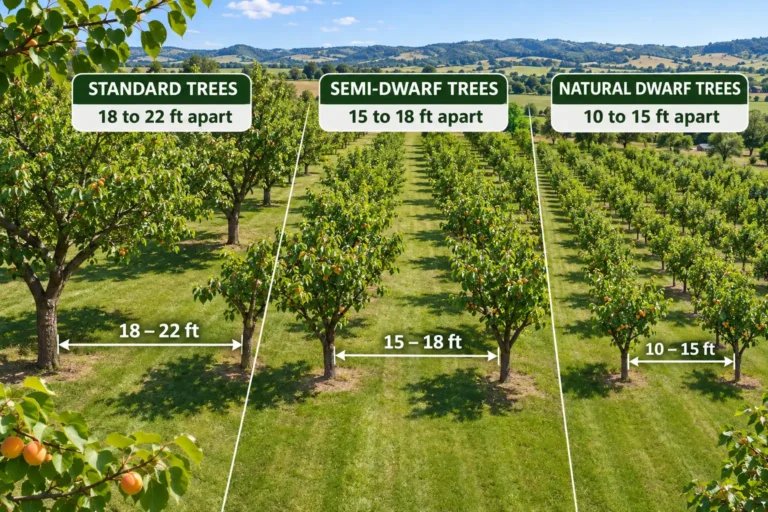
Where Can You Grow Apricot Trees? Zones, Chill Hours, and Frost by Region
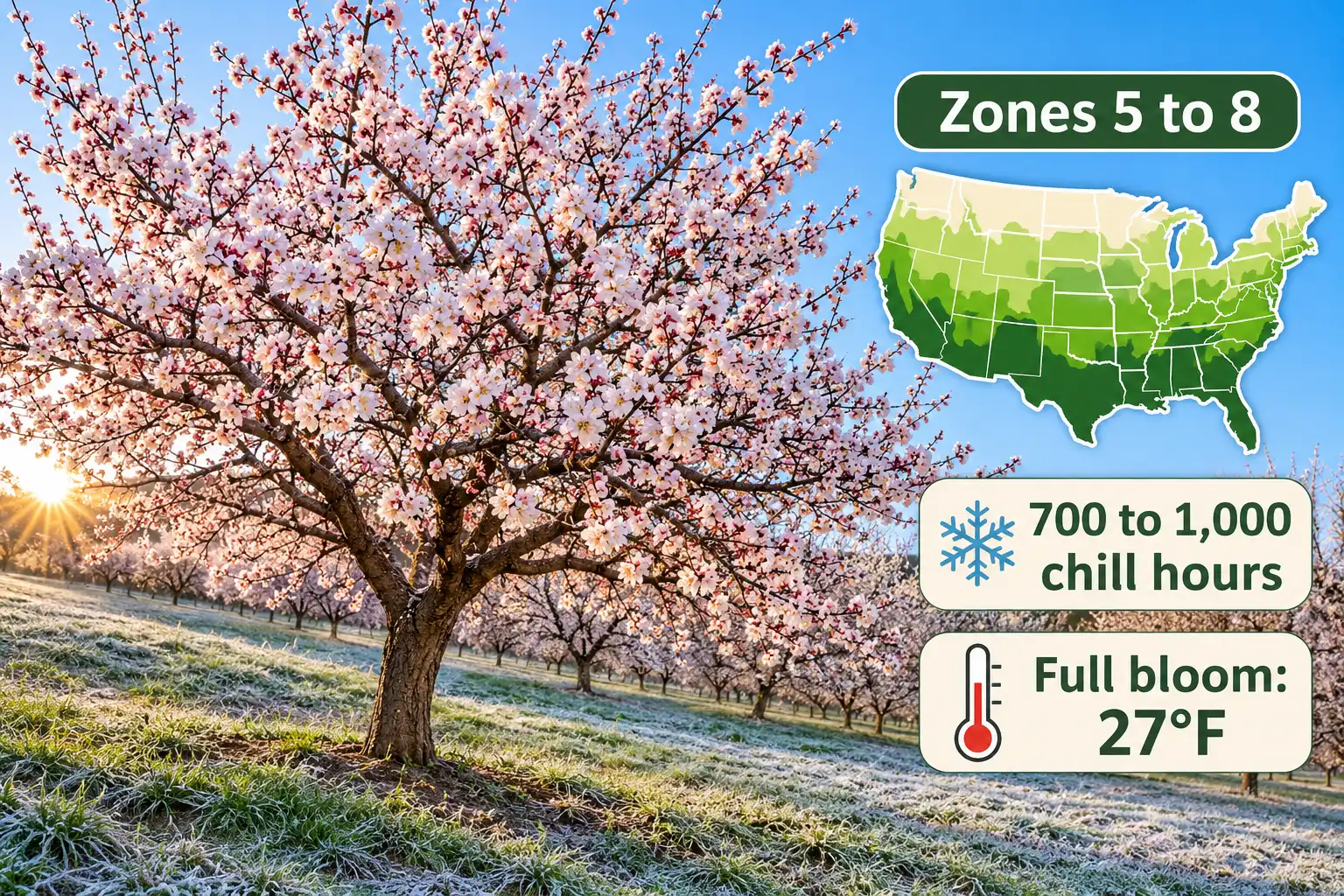
Apricot trees survive across much of the United States. Getting fruit is harder. Where you can grow apricot trees that bear depends on winter cold, winter chill, and frost after bloom. Each region fails a different test.
You can grow apricot trees reliably in USDA zones 5 to 8, per Utah State University Extension. UC ANR says most varieties need 700 to 1,000 chill hours. Springs must stay frost-free after bloom, so dry inland California fits best.
Where Apricot Trees Grow Best in the United States
California’s inland valleys grow almost all of the country’s apricots. USDA NASS’s Noncitrus Fruits and Nuts 2025 Summary counts 34,000 tons of California apricots in 2025, from 5,000 bearing acres. Washington, the only other state in the report, harvested 4,250 tons from 620 acres.
So California grew about 89 percent of the 38,250-ton US apricot crop in 2025. That share moves with Washington’s harvest, though. In 2024, Washington picked just 1,000 tons, and California’s share rose to about 97 percent.
Why California? UC ANR’s overview of growing apricots in California calls the apricot a Mediterranean crop that needs warm, dry growing seasons. It also warns that rain at bloom and near harvest brings disease. So the crop has come mainly from the Central Valley and inland valleys such as the Santa Clara.
Still, commercial maps understate the home range. Extension services in Utah and North Carolina publish apricot guidance for home growers. Those guides treat apricots as a home crop that bears less often than in California. Our plum and apricot guides cover care once you decide a tree fits your site.
Know more: Best Apricot Tree Varieties for Home Gardens, by US Climate
The Three Limits That Decide Where Apricots Fruit
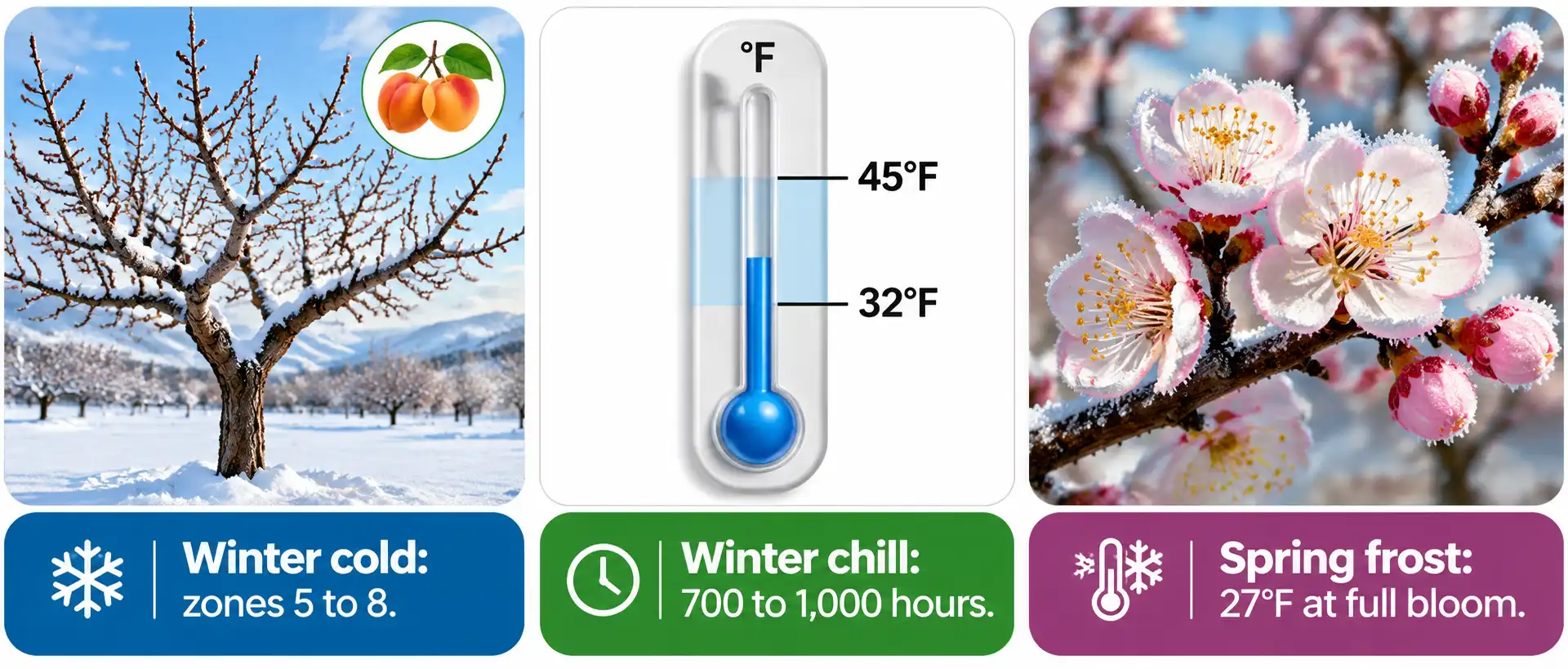
Three climate limits decide whether an apricot tree fruits in your yard. Winter cold decides whether the tree survives. Winter chill decides whether it blooms well. Then spring frost decides whether those flowers become fruit.
Frost causes the most disappointment, because the tree often lives where the crop does not. Utah State University Extension notes that apricots bloom so early that spring freezes can damage blossoms even in warmer zones.
Winter Cold: Hardiness Zones 5 to 8
Sources give slightly different zone ranges for apricots. Utah State University Extension’s apricot guide for home gardens puts them in USDA zones 5 to 8. It adds that some hardy selections grow in zone 4. NC State Extension’s apricot plant profile lists zones 5a to 7b instead.
Both sources agree on zones 5 to 7. So treat those zones as the core range, and zones 4 and 8 as the edges.
In zone 3, USU says only Manchurian and Siberian apricots grow. Their fruit is usually smaller and lower in quality. It names Mandan, Sungold, and Moongold for zone 3.
To find your zone, enter your ZIP code on the USDA Plant Hardiness Zone Map, last updated in 2023. Keep in mind what a zone tells you. It predicts whether the tree lives through winter. However, it says nothing about chill or spring frost.
Winter Chill: 700 to 1,000 Hours for Most Apricots
Chill hours are winter hours spent between 32°F and 45°F. Apricots need them to break dormancy. UC ANR’s California guidance puts most apricots at 700 to 1,000 hours at or below 45°F. It ties adequate chill to normal flowering and good fruit set. Some varieties need far fewer hours.
Chill also varies sharply within one state. UC ANR’s home orchard tree selection page says most of Northern California gets 800 to 1,500 chill hours. Southern California may get only 100 to 400.
A mismatch fails in either direction. Too little chill gives weak bloom and a light crop. On the other hand, a low-chill variety in a cold region meets its need early and blooms into frost. That is why USU suggests longer-chill varieties where frost is a risk. They bloom later.
Spring Frost: The Usual Crop Killer
Apricots bloom in late winter or early spring. For that reason, NC State Extension calls them extremely susceptible to frost.
MSU Extension’s critical temperature chart for tree fruit, compiled from Washington State University bud research, gives these apricot thresholds:
- First bloom: about 10 percent of buds killed at 25°F, about 90 percent at 19°F
- Full bloom: about 10 percent killed at 27°F, about 90 percent at 22°F
- Green fruit: about 10 percent killed at 28°F, about 90 percent at 25°F
So one 22°F night at full bloom can cost nearly the whole apricot crop. In practice, the real question for any site is how often it freezes after apricots open.

Apricot Growing Conditions by Region
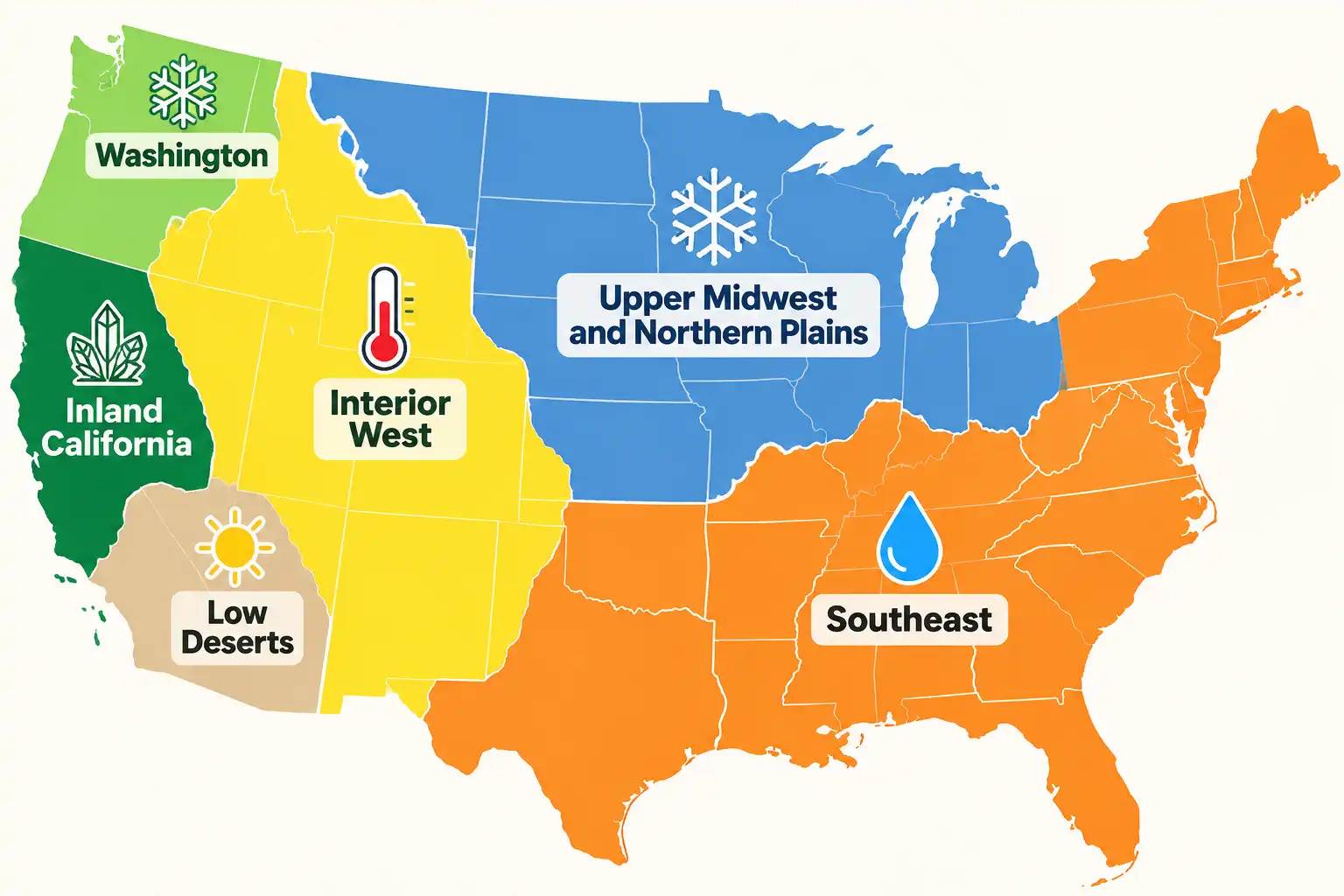
Each US region hits a different limit first. This table sums up what the cited extension sources say.
| Region | Main limit | What the sources say | Varieties the sources name |
|---|---|---|---|
| California inland valleys | Rain at bloom or harvest in wet years | Warm, dry springs and summers suit apricots; most need 700 to 1,000 chill hours (UC ANR) | Not named for home growers in the cited sources |
| Southern California coast and low deserts | Too little winter chill | 100 to 400 chill hours in Southern California (UC ANR); 300 to 400 in Arizona’s low desert (University of Arizona) | Gold Kist, Katy, Modesto |
| Interior West, using Utah as the guide | Spring frost after bloom | Fruit in about 3 of 5 years in Utah (USU) | Chinese (Mormon), Moorpark, Goldrich, Tilton, Harglow |
| Washington | Crop swings year to year | 3,520 tons in 2023, 1,000 in 2024, 4,250 in 2025 (USDA NASS) | Not named in the cited sources |
| Upper Midwest and Northern Plains, zones 3 to 4 | Winter cold, then frost | Zone 4 crops are sporadic; zone 3 needs Manchurian or Siberian types (USU) | Mandan, Sungold, Moongold |
| Southeast | Frost after early bloom; disease in wet weather | Needs chilly winters and a dry, frost-free spring; brown rot is a major disease (NC State) | Goldcot, Harcot |
California and the Low Deserts
Inland California is the benchmark. UC ANR says any county with warm, dry springs and summers and enough water should be able to grow apricots. Deep, well-drained soil gives larger crops and better fruit size. On heavy clay, Central Coast growers often choose Marianna 2624 rootstock because it handles clay and root rot better.
Southern California and the low deserts flip the problem. There, winters run short on chill. University of Arizona Extension’s low desert fruit guide puts most of Arizona’s low desert at 300 to 400 chill hours a year. It lists these low-chill apricots for warm winters:
- Gold Kist: 300 chill hours, self-fruitful, harvest late May to early June
- Katy: 400 chill hours, self-fruitful, harvest late May to early June
- Modesto: 300 to 400 chill hours, self-fruitful
Run the numbers before you buy. In Arizona’s low desert, a 700-hour apricot gets at most 400 hours. That covers about 57 percent of its need. Gold Kist, at 300 hours, fits even a low-chill year there.
The Interior West, Using Utah as the Guide
Here the tree survives, but the crop often does not. Utah State University Extension says Utah apricots may fruit only 3 years out of 5. Early bloom and spring freezes are the reason.
So variety choice matters most here. USU recommends winter-hardy, later-blooming varieties: Chinese (also sold as Mormon), Moorpark, Goldrich, Tilton, and Harglow. Of these, Goldrich and Harglow bloom latest. By contrast, USU does not recommend Royal Blenheim for Utah, because it is not winter hardy and blooms very early.
Soil sets the second limit. USU says apricots have little tolerance for wet, heavy soil and are prone to root rot in it. Utah’s alkaline soils also leave apricots very prone to iron chlorosis. For both reasons, USU advises a soil test before planting.
The Upper Midwest, Northern Plains, and Northeast
Cold sets the first limit in zones 3 and 4. USU says many common apricot varieties survive zone 4 but fruit only sporadically, because frost damages the blossoms. In zone 3, it limits the choice to Manchurian and Siberian types such as Mandan, Sungold, and Moongold.
Zone 5 and 6 areas of the Midwest and Northeast fall inside both the USU and NC State ranges. There, cold rarely kills the tree. Instead, the date of your last spring frost decides the crop.
Plant two varieties in these regions. USU says apricots are generally self-fruitful. Still, yields rise when a second variety with the same bloom time grows nearby.
The Southeast and Gulf Coast
Southern winters are mild enough for the tree, but the springs work against the crop. NC State Extension says apricots need chilly winters and a dry, frost-free spring. Many Southeast springs offer neither.
Disease adds pressure. NC State lists brown rot as a major apricot disease, along with bacterial canker, bacterial leaf spot, and powdery mildew. UC ANR adds that rain at bloom and near harvest causes disease damage. Many stone fruit problems look alike, though. Your county extension office or a state plant diagnostic lab can identify the cause, and many accept samples.
If you still want to try, NC State names Goldcot and Harcot. Both bloom later and handle frost better. It also warns against low-lying spots, which become frost pockets.
Published guidance for apricots along the Gulf Coast and in Florida is thin. None of the sources cited here recommend apricots there. So ask your county extension office which varieties, if any, have fruited locally before you buy.
How to Check Whether Your Site Can Grow Apricots
Work through these checks in order before you buy trees.
- Find your hardiness zone. Enter your ZIP code on the USDA map. Zones 5 to 7 sit inside both source ranges. Zones 4 and 8 are the edges.
- Find your chill hours. Ask your county extension office for local averages. Then compare that number with the chill rating of each variety you are considering.
- Check frost after bloom. Note how often your area drops to 27°F or lower once apricots open. Per the MSU chart, any such night costs part of the crop.
- Pick the warmest, best-drained spot. NC State warns against low-lying frost pockets. UC ANR advises giving early bloomers the warmest spot available.
- Test the soil. USU recommends a soil test before planting, especially on alkaline or heavy ground.
- Choose the variety last. Match its hardiness, chill rating, and bloom timing to what checks 1 to 3 found.
Use this rule for check 2. If your average chill falls below the variety’s rating, expect weak bloom. If it runs well above the rating in a frost-prone area, choose a later-blooming, higher-chill variety instead.
Our guide to choosing a site with good cold air drainage covers slope and frost pockets. Once a site passes, see planting a young apricot and spacing apricot trees by rootstock.
When Apricots Bear, and How Often
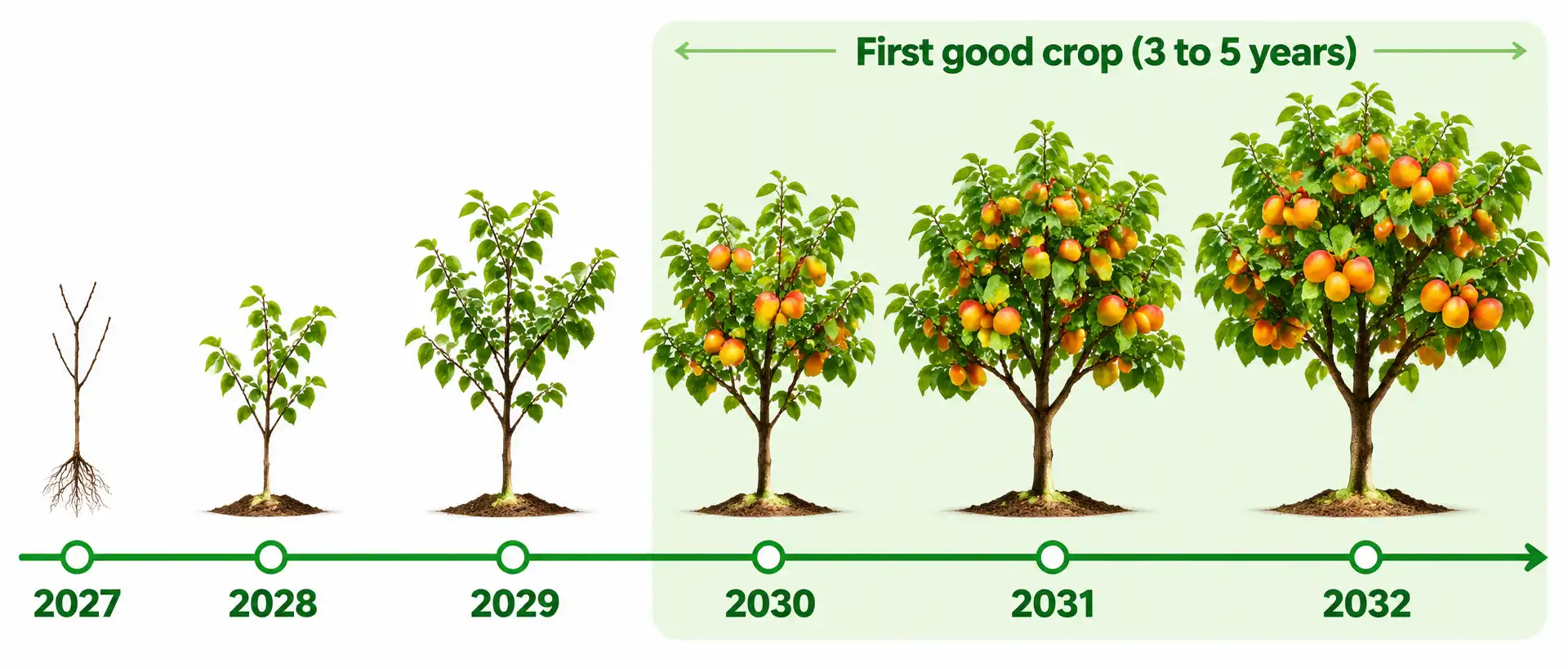
NC State Extension puts the best apricot harvests at 3 to 5 years after planting. To find your year of first harvest, add those years to your planting year. Plant in spring 2027, and expect the first good crop between 2030 and 2032.
Where frost limits crops, discount the yield as well. Utah State University Extension expects 3 to 4 bushels per tree in Utah, depending on variety. But it expects fruit in only about 3 of 5 years. So over five seasons, one Utah tree yields about 9 to 12 bushels (3 crops x 3 to 4 bushels). If it bore every year at the same rate, it would give 15 to 20. A pair of trees would yield about 18 to 24 bushels over the same five years.
That gap is the real cost of a frost-prone site. For year-round care once your tree is in the ground, see caring for an apricot tree from planting to harvest.
Why Apricots Fail Outside Their Range
Bloom, then no fruit. Frost after bloom is one common cause. At full bloom, MSU’s chart shows losses starting at 27°F. Our guide to protecting blossoms from spring frost explains frost covers and site choices.
Sparse, scattered bloom in a mild-winter area. The variety may need more chill than your winters give. UC ANR ties adequate chill to normal flowering and good fruit set.
A healthy tree that declines after wet years. USU says apricots tolerate little wet, heavy soil. They are prone to root rot in it.
Yellowing leaves on alkaline soil. USU says Utah’s alkaline soils leave apricots very prone to iron chlorosis. Other problems can cause yellowing too, so confirm with a soil test and your extension office.
Blossom and fruit rot after wet springs. UC ANR links rain at bloom and near harvest to disease. NC State names brown rot as a major apricot disease. Your county extension office or a plant diagnostic lab can confirm what is affecting your tree.
A variety bought for the wrong climate. Royal Blenheim, for example, is not recommended in Utah, according to USU. Always check a variety against your region’s extension list, not only the nursery tag.
FAQs About Grow Apricot Trees
Can you grow apricot trees in zone 4?
Yes, but zone 4 apricot crops come only now and then, even on healthy trees. Utah State University Extension says many common varieties survive there, but spring frost often damages the blossoms.
Can you grow apricots in Southern California or Arizona?
Yes, with low-chill apricot varieties for warm-winter yards. UC ANR puts Southern California at 100 to 400 chill hours, and University of Arizona Extension rates Gold Kist at just 300.
Do I need two apricot trees to get fruit?
Usually not, but a second variety helps. Utah State University Extension calls apricots generally self-fruitful, though yields rise when another variety with the same bloom time grows nearby.
Why does my apricot tree bloom but never fruit?
Frost after bloom is one frequent cause where springs swing between warm and cold. Your county extension office can help separate frost loss from disease, poor pollination, or a tree too young to bear.
Can you grow apricots in Florida or on the Gulf Coast?
Published extension support for apricots there is thin. The sources cited here cover California, Arizona, Utah, and North Carolina, so ask your county office which varieties have fruited locally.
How long until an apricot tree bears fruit?
NC State Extension puts the best apricot harvests at 3 to 5 years after planting. So a tree planted in spring 2027 should first crop well between 2030 and 2032, if frost spares the bloom.
Before You Plant
Start with frost, not zones. Across zones 5 to 8, an apricot tree usually survives winter. Regular crops, though, need a dry, frost-free spring. Check your zone, your chill hours, and your frost dates first. Then choose a variety bred for that combination, and plant it on the warmest, best-drained ground you have.