
How Far Apart to Plant Apricot Trees: Spacing by Size and Region
Apricot trees spread wide and bloom early, so spacing set at planting shapes sun, airflow, and pruning for years. Here is how far apart to plant apricot trees by tree size, row layout, and region. The math carries through to your own yard or acre.
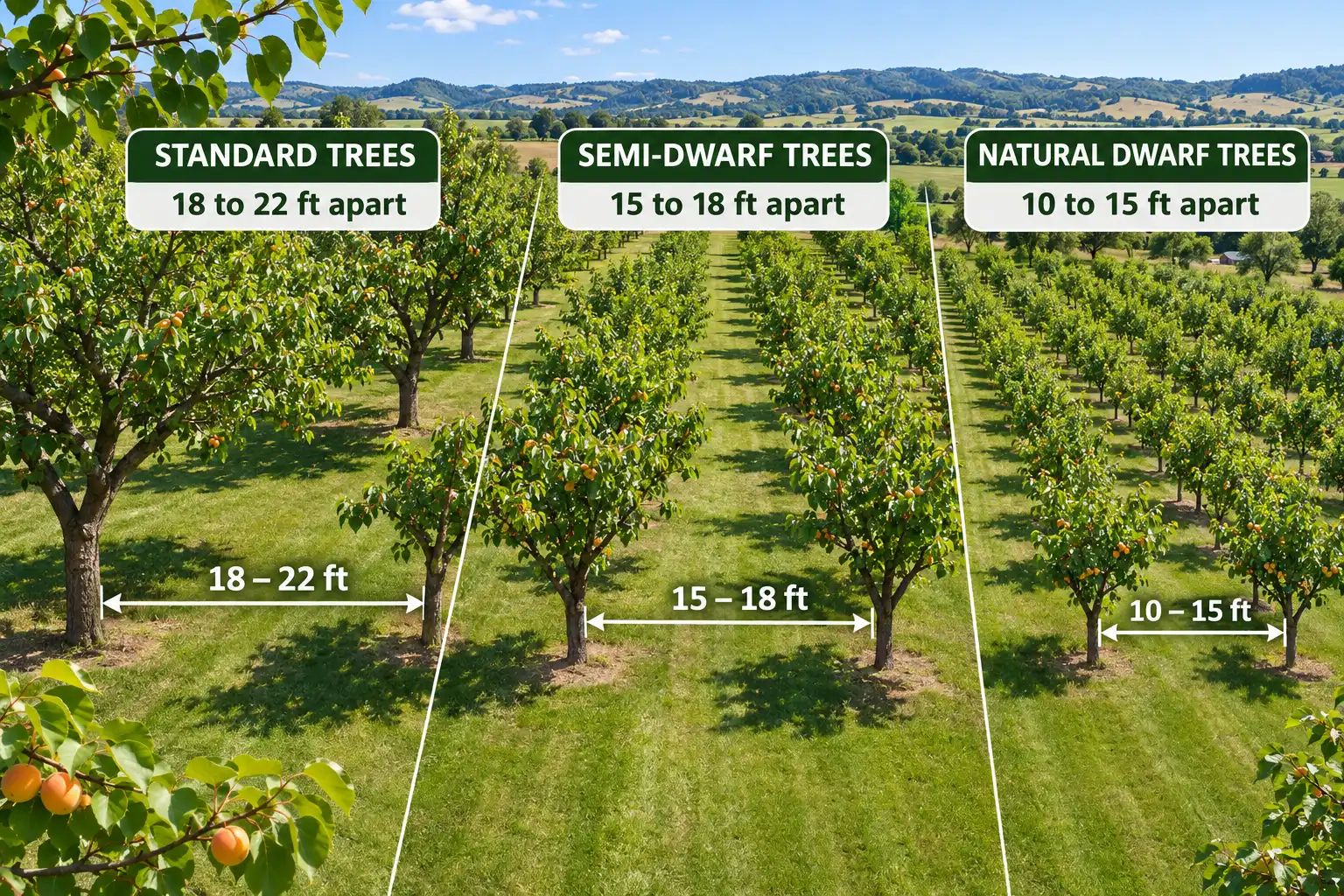
Plant standard apricot trees 18 to 22 feet apart, as Utah State Extension advises. Arizona Extension spaces semi-dwarf trees 15 to 18 feet apart. Natural dwarf varieties for North Dakota fit 10 to 15 feet apart, per NDSU.
How Far Apart to Plant Apricot Trees by Tree Size
Utah, Arizona, and North Dakota extension figures put standard apricots 18 to 22 feet apart, semi-dwarfs 15 to 18, and natural dwarfs 10 to 15. California and Pennsylvania add row layouts.
| Tree type | Region | Spacing | Source |
|---|---|---|---|
| Standard | Utah home gardens | 18 to 22 feet apart | USU Extension |
| Standard, conventional orchard | California | 20 x 20 or 22 x 22 feet | UC Cooperative Extension |
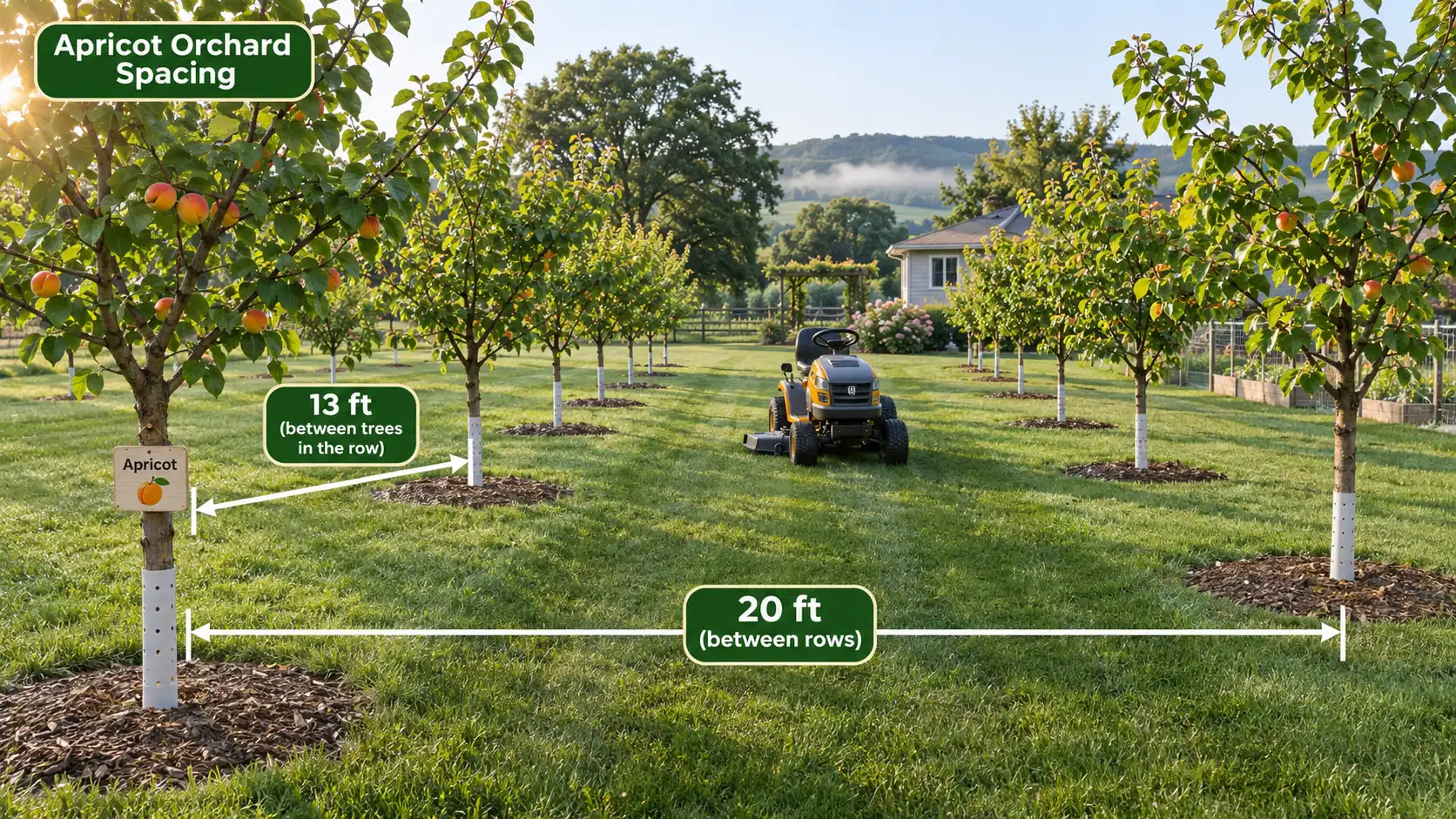
| Home orchard in rows | Pennsylvania | 13 feet in the row, 20 feet between rows | Penn State Extension |
| Semi-dwarf | Arizona (Yavapai County) | 15 to 18 feet apart | University of Arizona Extension |
| Natural dwarf, cold-hardy varieties | North Dakota | 10 to 15 feet apart | NDSU Extension |
USU Extension’s apricot fact sheet gives the 18 to 22 foot range for Utah. UC Cooperative Extension’s California apricot overview lists 20 x 20 and 22 x 22 feet for conventional orchards. Penn State’s home orchard spacing table sets apricots tighter in the row. Its 20-foot row gap still matches the Western figures. Arizona’s home orchard guide covers semi-dwarfs, and NDSU’s apricot variety page covers cold-hardy dwarfs.
The sources differ because each writes for its own climate, soils, and varieties. So we list each range as published instead of blending them.
Learn more: Growing Apricot Tree
Why Rootstock Sets Apricot Tree Spacing
Check the rootstock on the nursery tag first, because it tells you which spacing applies. UC Cooperative Extension lists five rootstocks used for California apricots. It says the choice depends on desired tree size, soil type, and problems such as salinity and nematodes.
Of those five, UC describes only Citation as slightly dwarfing. It also notes that Citation tolerates wet or dry conditions better than most. The other four are two peach stocks, Nemaguard and Lovell, and two plum stocks, Marianna 2624 and Myrobalan 29C. UC matches the peach stocks to well-drained sandy soils and Marianna 2624 to clay soils.
UC gives no size reduction for those four. So plan standard spacing for trees on them. And because Citation is only slightly dwarfing, a tree on it still needs semi-dwarf room, not dwarf spacing.
Some nurseries sell apricots on newer rootstocks and describe them as dwarfing. Those size ratings are the nurseries’ own claims. Published US extension spacing for apricots on those rootstocks is limited. Ask your county extension office how they have performed locally before you plant them close.
Seedlings are the simplest case. They have no size-controlling rootstock at all, so give apricots grown from a pit full standard spacing.
Spacing for Standard Apricot Trees
Give standard apricot trees 18 to 22 feet on every side, the range USU Extension uses for Utah home gardens. California’s conventional orchards run a similar 20 x 20 or 22 x 22 feet, per UC Cooperative Extension.
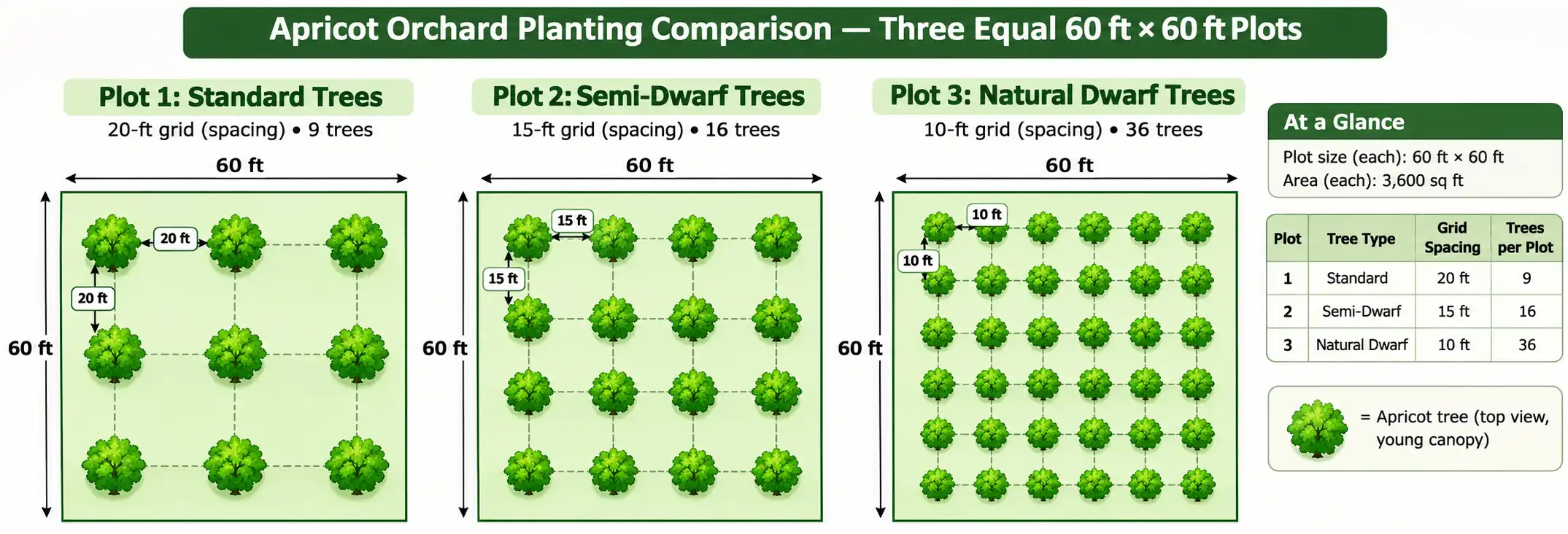
At 20 feet each way, each tree claims 400 square feet. At 22 feet, it claims 484. That room lets light into the canopy and leaves space to prune and pick from every side.
USU advises training apricots to an open vase, like peaches. In Utah’s hotter areas, a modified central leader also works. Its extra center foliage cuts fruit sunburn. Both forms stand free, so both need the full spacing.
Mark every spot on a grid before planting a bare-root apricot. A hole dug 3 feet off the grid stays off it for the life of the tree.
Spacing for Semi-Dwarf Apricot Trees
Space semi-dwarf apricot trees about 15 to 18 feet apart, the range University of Arizona Cooperative Extension gives for Yavapai County home orchards. It applies the same figure to semi-dwarf peaches and plums.
On a square grid, 15 feet each way gives each tree 225 square feet. That fits about 193 trees per acre (43,560 ÷ 225). At 18 feet, the count drops to about 134.
Semi-dwarf size comes from rootstock and pruning together. For California apricots, Citation is the one rootstock UC calls slightly dwarfing. So if a semi-dwarf tag names no rootstock, ask the nursery before you plant at 15 feet.
How Far Apart to Plant Dwarf Apricot Trees
Plant natural dwarf apricots 10 to 15 feet apart, per NDSU Extension’s guidance for North Dakota. That spacing covers six cold-hardy varieties: Moongold, Sungold, Debbie’s Gold, Scout, Westcot, and Brookcot.
Pollination shapes the layout for two of them. NDSU says Moongold and Sungold should be planted together, so budget space for a pair. Two trees 12 feet apart, with half that spacing at each end, fill a strip about 24 feet long.
Outside the Northern Plains, independent spacing data for genetic dwarf apricots is thin. Nursery spacing figures for those trees are the nursery’s own claims. Treat them as a starting point, and check local results with your county extension office.
How Far Apart to Plant Apricot Trees in Rows
In rows, plant apricot trees closer within the row than between rows, and size the row gap to your equipment. Penn State Extension’s home orchard table, written for Pennsylvania, lists apricots at 13 x 20 feet. Read it the usual way: 13 feet between trees in the row and 20 feet between rows.
California orchards use the same logic at a larger scale. UC Cooperative Extension reports newer, higher-density orchards with 18-foot rows and 14 to 16 feet between trees. UC also notes that equipment limits row spacing, and that mechanical harvest needs wide rows.
So set the numbers one at a time:
- Between rows: Measure the widest machine you will drive down the alley, mower or sprayer included. Then add the canopy that will hang into the alley at maturity.
- In the row: Use the in-row figure for your tree size and region from the tables above.
- Row ends: Leave turning room for that same machine at both ends. That headland comes off your planting area before you count trees.
How Many Apricot Trees Per Acre
At the spacings UC, USU, and Penn State publish, an acre holds about 90 to 172 apricot trees. Use this formula for any spacing, in feet:
Trees per acre = 43,560 ÷ (in-row spacing × between-row spacing)
| Spacing (feet) | Source and region | Square feet per tree | Trees per acre |
|---|---|---|---|
| 22 x 22 | UC, California conventional | 484 | 90 |
| 20 x 20 | UC, California conventional | 400 | 108 |
| 18 x 18 | USU, Utah | 324 | 134 |
| 16 x 18 | UC, California higher density | 288 | 151 |
| 13 x 20 | Penn State, Pennsylvania | 260 | 167 |
| 14 x 18 | UC, California higher density | 252 | 172 |
| 15 x 15 | Arizona, semi-dwarf | 225 | 193 |
| 10 x 10 | NDSU, North Dakota natural dwarfs | 100 | 435 |
Counts are rounded down. Real blocks hold fewer trees, since edges and row-end turning room take land out of planting.
Penn State lists average yields of 3 to 6 bushels per apricot tree at least 10 years old. At 167 trees per acre, that means about 500 to 1,000 bushels a year from a mature Pennsylvania block.
Spring frost can cut that sharply, though. USU warns that freezes can damage apricot blossoms even in warmer zones.
High-Density Apricot Orchard Spacing
High-density apricot orchards in California commonly use 18-foot rows with 14 to 16 feet between trees, per UC Cooperative Extension. That works out to about 151 to 172 trees per acre. Research plantings have gone much tighter.
A 1999 apricot trial by Southwick and Yeager in Acta Horticulturae grew Royal/Blenheim and Patterson on Citation and Marianna 2624. It compared four training systems:
| Training system | Trees per hectare | Trees per acre (rounded down) |
|---|---|---|
| Open center | 633 | 256 |
| Cordon | 897 | 363 |
| Delayed perpendicular V | 1,055 | 426 |
| Central leader | 1,196 | 484 |
The authors found the higher-density systems generally as productive as open center, or more. But the trial used summer pruning and regulated deficit irrigation to hold vigor in check.
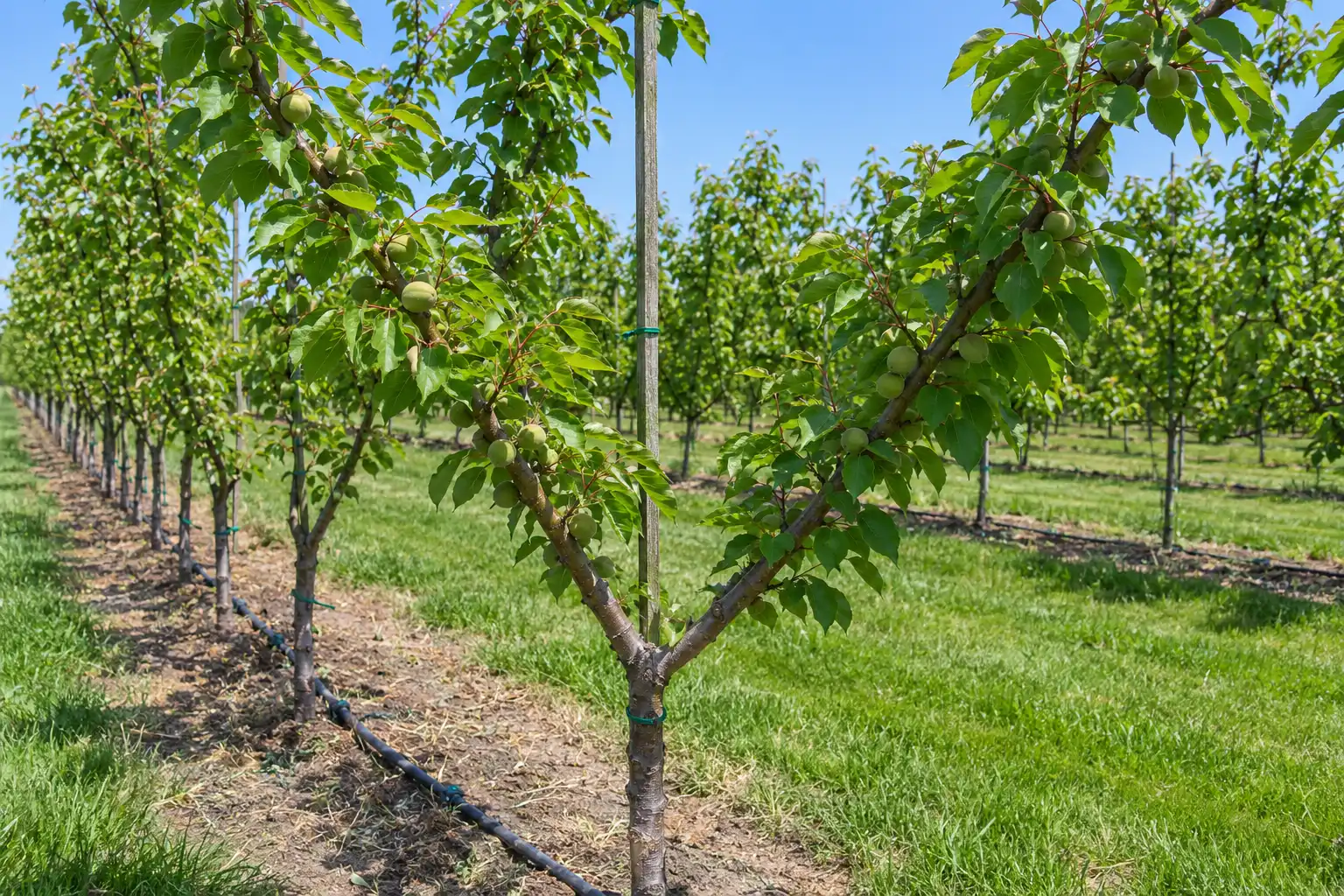
UC’s overview frames the tradeoff for growers. High-density orchards yield more sooner but cost more to establish. At maturity, their yield potential is similar to a conventional orchard. UC also points to a trend toward shorter trees that need no ladders for pruning, thinning, and harvest.
For most small farms, that favors a moderate density with a trained canopy over a research-level planting. Before you commit to trellised systems, talk with a farm advisor or certified crop adviser. The training and irrigation, not the spacing alone, make the density work.
Apricot Orchard Layout for a Small Farm
Lay out a small apricot block in straight rows, sized to your equipment, on your most frost-free ground. This worked half-acre example uses Penn State’s 13 x 20 spacing for Pennsylvania. The block size and turning room are example inputs, so swap in your own.
- Block: 180 feet long by 120 feet wide, or 21,600 square feet
- Rows: 6 rows running the long way, 20 feet apart, the first 10 feet in from the edge
- Turning room: 20 feet at each row end, leaving 140 feet of planted row
- Trees per row: 140 ÷ 13 gives 10 gaps, so 11 trees
- Total: 6 rows × 11 trees = 66 trees
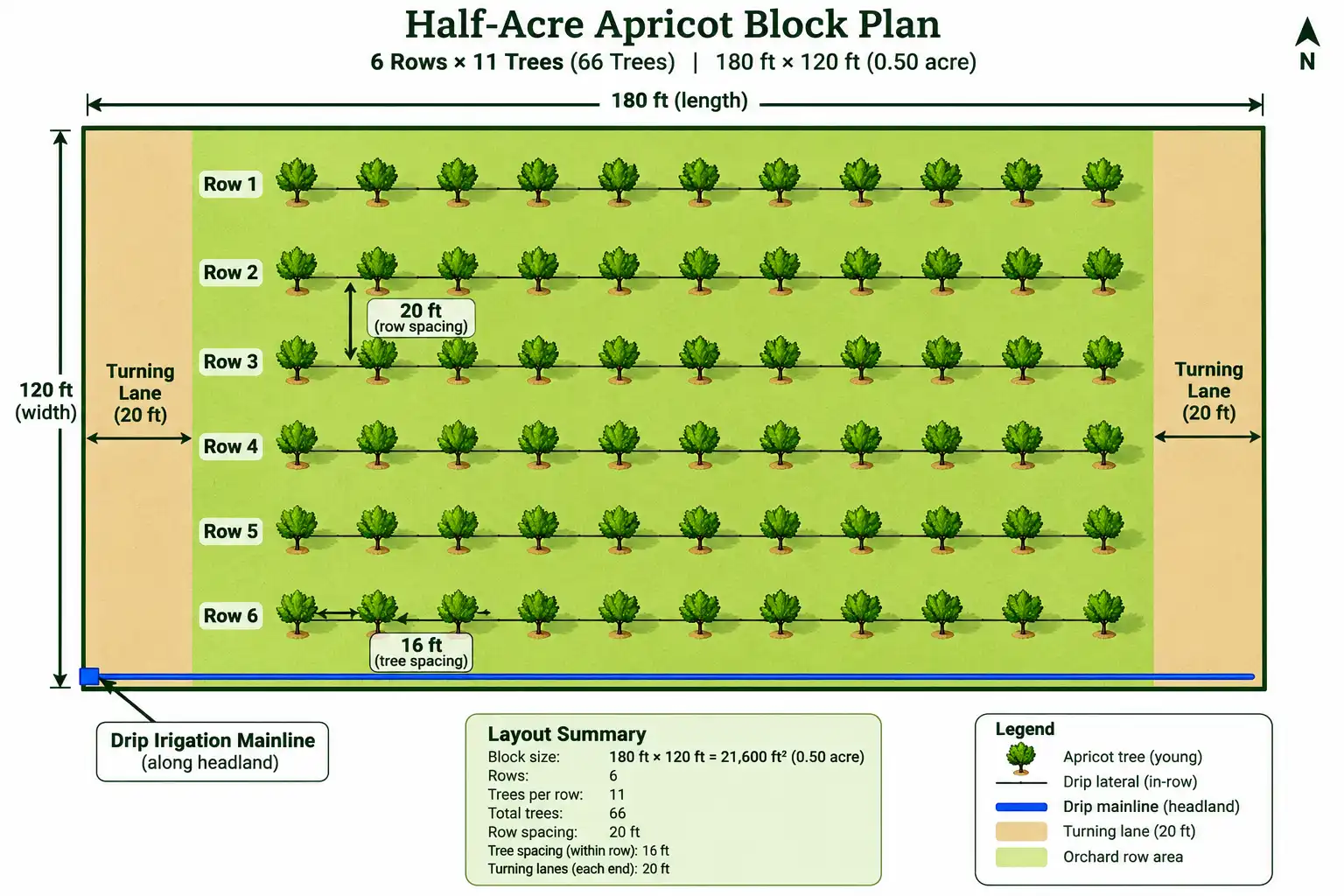
The formula alone predicts 83 trees (21,600 ÷ 260). Edges and headlands make up the difference. That is why a drawn plan beats the formula.
At 3 to 6 bushels per mature tree (Penn State), that is about 198 to 396 bushels in a frost-free year.
Site the block with frost in mind. NDSU advises keeping apricots out of frost pockets and in a protected site. It also notes that north- or east-facing ground warms more slowly than south- or west-facing ground.
Run the drip mainline along one headland so each row takes its own lateral. Then follow the steps for laying drip lines along tree rows. Price trees, drip, and fencing per row as part of planning a small fruit farm.
How Much Space Does an Apricot Tree Need in a Backyard
At USU Extension’s Utah spacing, one standard apricot needs a square 18 to 22 feet on a side. That is 324 to 484 square feet. A semi-dwarf at Arizona’s 15 feet needs about 225 square feet. A North Dakota natural dwarf at 10 feet needs about 100.
Measure that space from fences, walls, and other trees too, not only from other apricots. Then pick the spot with the same care:
- Shelter: NDSU recommends a protected site, out of frost pockets.
- Lawn: USU advises keeping apricots out of lawns, which have different water and fertilizer needs.
- Weeds and drainage: USU also calls for a site free of perennial weeds, on soil that drains well.
The spacing only holds if pruning holds the canopy. So make yearly pruning part of year-round apricot care, and the tree stays inside the space you planned.
Apricot Spacing Mistakes to Avoid
Most spacing problems come from planning for the tree you buy instead of the tree it becomes. These are the common ones:
- Spacing by nursery size. A young tree gives no clue to its mature spread. Space by rootstock and variety instead.
- Reading “dwarf” as apple-style dwarf. UC calls Citation only slightly dwarfing, so a tree on it still needs semi-dwarf room.
- Rows too narrow for equipment. UC notes that equipment limits row spacing. A mower that can’t pass means hand work for the life of the block.
- Filling a frost pocket. A low spot looks like spare room, but NDSU warns against planting apricots there.
- Planting close without a vigor plan. The high-density trial above relied on summer pruning and controlled irrigation. Without that work, close spacing leaves crowded canopies.
FAQs About Apricot Spacing
Can I plant apricot and peach trees in the same row?
Yes, at the wider peach spacing of 14 x 22 feet from Penn State Extension’s Pennsylvania table. That table sets apricots slightly tighter, at 13 x 20, so the peach figure suits both.
How many apricot trees fit on a quarter acre?
About 27 standard trees fit on a quarter acre at UC’s 20 x 20 foot California spacing (10,890 ÷ 400). At Penn State’s 13 x 20 Pennsylvania spacing, the figure rises to about 41, before edges and turning room.
Can I space apricot trees closer with hard pruning?
Yes, if you commit to yearly summer pruning and vigor control. In Southwick and Yeager’s 1999 trial, denser apricot plantings matched or beat open center with summer pruning and deficit irrigation.
When will newly planted apricot trees bear fruit?
UC says most California apricots start fruiting in year two or three, with substantial crops in year four or five. Counting 2027 as year one, trees planted that spring would first fruit in 2028 or 2029.
Do I need two apricot trees to get fruit?
Usually not, since UC Cooperative Extension says most apricot varieties are self-fertile. USU notes better yields with a similar-blooming second apricot variety, and NDSU says Moongold and Sungold belong together.
Before You Plant
Find the rootstock on the tag first. Then pick the spacing your region’s extension service gives for that tree size. Lay out rows for the widest machine you own, and keep the block out of frost pockets.
Next, run the trees-per-acre math, and draw the plan to see what edges and turning room cost. If you want to plant tighter than the published figures, call your county extension office before you order trees.