How to Grow an Apricot Tree: Planting, Care, and First Harvest

Apricots grow in yards across much of the country, but they bloom so early that spring frost decides many crops. Learning how to grow an apricot tree starts with climate and variety, then moves through planting, pruning, thinning, and harvest.
To grow an apricot tree, pick a late-blooming variety that fits your chill hours. Plant it in full sun on well-drained soil. Extension guides from California to Iowa put first fruit 2 to 5 years after planting.
Are Apricot Trees Easy to Grow?
Apricot trees are easy to keep healthy but hard to crop every year. The reason is early bloom. The tree itself is tough, but the flowers are not.
University of Minnesota Extension calls frost the biggest enemy of stone fruits. One cold night, it warns, can take a whole season’s fruit. Utah State University Extension (USU) says apricots in Utah may fruit only about 3 years out of 5. On the California coast, UC ANR’s Marin County Master Gardeners call steady crops unlikely, because bloom often meets cold rain.
So the answer depends on your spring. Apricots are easiest where late winter stays dry and hard frost rarely follows bloom. Even in tougher regions, the work stays manageable. Pick a late-blooming variety, plant on a well-drained site, and expect some springs to bring no fruit.
Learn more: Apricot Tree Planting Time, Hole Depth, and Spacing
How Do Apricots Grow?
Apricots grow from flower buds that form the summer before they open. Iowa State University Extension notes that fruit trees set flower buds during the growing season before bloom. In other words, last summer’s care shapes this spring’s flowers.
The flowers open on short spurs and on shoots from the previous year. Then the fruit ripens about 100 to 120 days after full bloom in Marin County, California, according to UC ANR. A late frost, a rainy bloom, or a missing pollen partner can stop the crop at any step.
How are apricots grown commercially? Growers plant grafted trees, mostly in California and Washington. UC ANR’s California overview describes orchards trained mostly to an open center. For 2025, USDA NASS counted 5,000 bearing acres in California and 620 in Washington. US production totaled 37,880 tons, and California supplied 33,630 of them.
Choosing an Apricot Variety for Your Region
Choose the variety first, because chill hours and bloom date decide whether a tree fruits where you live. Chill hours are winter hours spent below about 45°F, the cutoff UC ANR uses.
For standard apricots in California, two UC ANR sources give different ranges. Marin County Master Gardeners list 600 to 900 chill hours. UC Cooperative Extension’s California overview puts most varieties at about 700 to 1,000. Both note that a few varieties need far less. In cold regions, though, late bloom and winter hardiness matter more than chill.
| Region | Varieties named by extension | What to know |
|---|---|---|
| Coastal California (UC ANR, Marin County) | Katy (350 chill hours), Blenheim (400 to 500), Moorpark (600 to 700) | Low-chill types fit mild winters |
| Utah (USU) | Goldrich, Harglow, Moorpark, Tilton, Chinese (Mormon) | Goldrich and Harglow bloom latest; USU does not recommend Royal Blenheim for Utah |
| Minnesota, zones 4 and 3 (University of Minnesota Extension) | Scout, Westcot, Moongold, Sungold | Scout and Westcot rate highest for hardiness; Moongold and Sungold pollinate each other |
USU places most apricots in USDA zones 5 to 8. Some hardy selections survive zone 4 but fruit only sporadically. Look up your zone on the USDA Plant Hardiness Zone Map, last updated in 2023. Where standard apricots struggle, USU notes that plum-apricot hybrids are also sold. They sit alongside other plums and apricots for home orchards.
Pollination: One Apricot Tree or Two?
One tree is enough for most standard apricots, but a few varieties need a pollinizer, a second variety that supplies pollen. K-State Research and Extension says most apricots are self-fruitful. Still, a second variety raises yield and fruit size. K-State also lists Goldrich, Perfection, and Riland as varieties that must be cross-pollinated.
That matters in Utah, where USU suggests Goldrich for its late bloom. So if you plant Goldrich, add a second variety that blooms at the same time.
Cold-climate hybrids work differently. University of Minnesota Extension says hardy hybrid apricots are self-incompatible. They need two different varieties within about 100 yards. Its Minnesota-bred pair, Moongold and Sungold, pollinate each other.
Where to Plant an Apricot Tree
Plant apricots in your sunniest, best-drained spot, away from frost pockets. University of Minnesota Extension calls for at least half a day of direct sun. More sun, it adds, means more fruit.
Drainage matters as much as light. USU says apricots tolerate wet, heavy soils poorly, and it ties most root disease to overwatering. In Marin County, California, UC ANR asks for well-drained soil at least 4 feet deep. It also suggests planting on a ridge, berm, or mound.
Site also shifts bloom timing. University of Minnesota Extension warns against the south side of buildings, since trapped heat pushes early bloom. Cold air also settles in low spots, so a gentle slope beats the bottom of a hollow.
Before planting, test your soil while the ground is still open. USU advises correcting any deficient nutrients the test shows. In Utah’s alkaline soils, it also flags iron chlorosis in apricots. Finally, keep new trees out of lawns and away from field bindweed or quackgrass, as USU advises.
How to Plant an Apricot Tree
Plant bare-root apricots while they are dormant, as soon as they arrive. For Minnesota, University of Minnesota Extension advises early spring, before growth starts. Potted trees go in after frost danger passes, in May or June.
- Soak the roots. University of Minnesota Extension advises a 2 to 4 hour soak. After that, keep them from drying out.
- Dig wide, not deep. Roots should spread without bending. For potted trees, USU calls for twice the container’s width and the same depth.
- Set the graft high. USU calls for the graft union 2 to 4 inches above the soil. University of Minnesota Extension gives 3 to 4 inches. A high graft keeps the variety from rooting on its own.
- Backfill with native soil. Skip fertilizer in the hole. University of Minnesota Extension caps compost at half the backfill.
- Water it in. Soak the soil so it settles around the roots. Then top up soil if the tree sinks.
- Stake only if needed. USU advises staking only in windy sites, for one year. University of Minnesota Extension advises staking at planting and removing the stake after 3 or 4 years.
- Mulch and guard. University of Minnesota Extension calls for 4 inches of mulch in a 4-foot circle, kept off the trunk. A tree guard also helps stop winter bark chewing by rodents.

Apricot Spacing, Tree Size, and Rootstocks
How Far Apart to Plant Apricot Trees
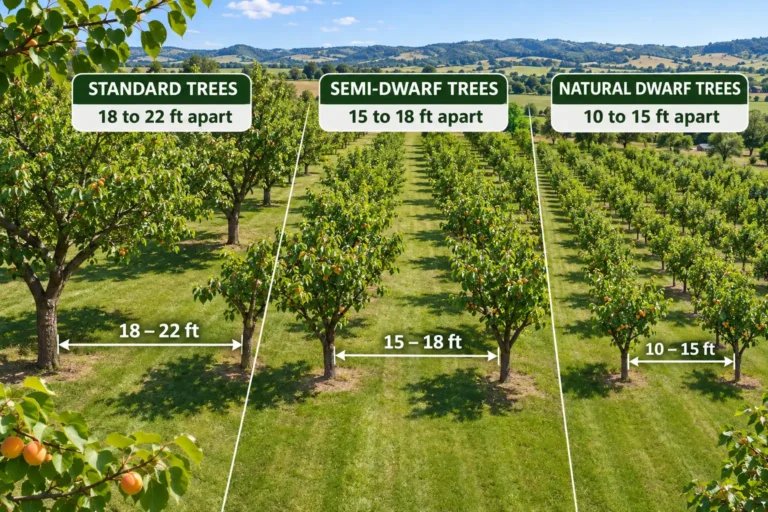
Space standard apricots about 18 to 22 feet apart, the range USU gives for Utah. University of Minnesota Extension sets at least 20 feet for its Minnesota varieties. California orchards use 20 by 20 or 22 by 22 feet, per UC ANR.
To turn spacing into a tree count, use this formula.
Trees per acre = 43,560 ÷ (in-row spacing × between-row spacing), in feet
At 20 by 20 feet, an acre holds about 108 trees (43,560 ÷ 400). At 22 by 22 feet, it holds about 90. In a yard, each tree at 20 feet needs about 400 square feet. So a 40 by 60 foot backyard (2,400 square feet) fits about six trees, before paths and buildings.
Rootstocks and What They Change
Rootstock changes soil tolerance more than bearing age. Iowa State says rootstock has little effect on early bearing outside apple and pear. UC ANR’s California overview rates common apricot rootstocks this way:
| Rootstock | Type | Wet soil | Notes from UC ANR |
|---|---|---|---|
| Citation | Peach-plum hybrid | Tolerant | Slightly dwarfing; less prone to bacterial canker |
| Marianna 2624 | Plum | Tolerant | Moderately resistant to two root rots; very prone to bacterial canker |
| Myrobalan 29C | Plum | Tolerant | Prone to bacterial canker |
| Lovell | Peach | Sensitive | Prone to armillaria and phytophthora root rots |
| Nemaguard | Peach | Sensitive | Prone to root rots and bacterial canker |
On heavy or wet ground, the plum rootstocks and Citation hold up better in UC ANR’s ratings. Ask the nursery which rootstock sits under the variety before you buy.
How Long Does It Take to Grow an Apricot Tree?
A grafted apricot tree usually bears first fruit 2 to 5 years after planting. The exact range depends on source and region. Iowa State puts apricots at 3 to 5 years for Iowa. K-State Research and Extension gives 2 to 5 years for Kansas. In California, UC ANR’s overview says most trees fruit in year 2 or 3. Substantial crops follow in year 4 or 5.
Carry that through to your own planting.
Year of first harvest = planting year + years to bearing
- Plant in spring 2027 in Iowa, and expect first fruit from 2030 to 2032.
- Plant in spring 2027 in Kansas, and expect first fruit from 2029 to 2032.
- Plant in early 2027 in California, and expect light fruit in 2029 or 2030. A substantial crop should follow by 2031 or 2032.
Frost then thins the calendar. In Utah, USU expects fruit about 3 years in 5. So the first 10 bearing seasons may bring around 6 crops. USU expects 3 to 4 bushels per tree in a good year. Two trees, then, could yield 6 to 8 bushels.

How Fast Do Apricot Trees Grow?
Young apricot trees grow about 10 to 20 inches of new shoot length a year in USU’s Utah guidance. Older trees slow to about 8 to 10 inches. University of Minnesota Extension uses similar marks in Minnesota. Young trees with 15 inches or more of growth need no fertilizer. Bearing trees should still make at least 8 inches.
Shoot growth is what extension services measure, so track it. Each fall, measure a few branch tips from last year’s bud scar to the tip. Published data on height gained per year is limited, so treat any single growth-rate figure with caution.
Final size depends on variety and pruning. In Minnesota, University of Minnesota Extension lists Moongold and Sungold at up to 15 feet. Scout and Westcot reach up to 20 feet. In Marin County, California, UC ANR suggests keeping full-size trees at 10 to 14 feet for easier picking.
Apricot Tree Growth Stages
Through the Year
Each spring, an apricot moves from bud swell to bloom, petal fall, and fruit set. UC ANR’s overview puts California bloom from early February into early March. In Minnesota, University of Minnesota Extension notes that bloom still comes very early.
USU publishes the temperatures that kill flower buds after 30 minutes at each stage.
| Apricot stage | 10% of buds killed | 90% of buds killed |
|---|---|---|
| First swell | 15°F | Not listed |
| Tip separation | 20°F | 0°F |
| First white | 24°F | 14°F |
| First bloom | 25°F | 19°F |
| Full bloom | 27°F | 22°F |
| In the shuck (petal fall) | 27°F | 24°F |
| Shuck split (post-bloom) | 28°F | 25°F |
The pattern matters most. A closed bud survives the teens, but open flowers die a few degrees below freezing. After fruit set, apricots size up through spring. Harvest comes in late June to July in Marin County (UC ANR) and July through August in Utah (USU). In Minnesota, University of Minnesota Extension lists late July to mid-August.

Over the Tree’s Life
| Stage | When | Focus |
|---|---|---|
| Planting | Year of planting | Choose scaffold branches; skip fertilizer (USU) |
| Young tree | Until first fruit | Prune lightly, since heavy cuts delay fruiting (University of Minnesota Extension) |
| First fruit | 2 to 5 years after planting (Iowa State, K-State, UC ANR) | Start thinning to 4 to 6 inches |
| Substantial crops | Year 4 or 5 in California (UC ANR) | Prune and thin every year |
| Productive life | About 20 to 30 years in UC orchard cost studies | Renew spurs and remove dead limbs |
How to Care for an Apricot Tree
Caring for an apricot tree comes down to deep watering, light feeding, and a clear circle under the canopy. Water comes first. In Utah, USU advises watering about twice a week in the first season, keeping soil moist but not soggy. Later, it shifts to about every two weeks. Over a season, that adds up to around 30 inches of water, minus significant rain.
Now carry that to one tree. One inch of water over one square foot equals about 0.62 gallons. So 30 inches over a 20 by 20 foot space comes to roughly 7,500 gallons a season (30 × 400 × 0.623).
In Minnesota, University of Minnesota Extension calls for 1 to 2 inches a week on young trees. It suggests checking the soil 4 to 8 inches down first, and it favors deep, occasional watering. USU recommends drip, soaker hoses, or hand watering at the base to keep leaves dry. For scheduling, a ring of drip emitters around young trees does the job well.
Fertilizing and Mulching an Apricot Tree
For apricot tree care for beginners, go light on fertilizer. Get a soil test first, then feed only when it or weak shoot growth calls for it. USU says to skip fertilizer in the first year after planting. It also sets no fixed schedule for home orchards.
When Utah trees need nitrogen, USU suggests 20-0-0 spread around the drip line. Trees under 5 years old get 1/2 to 1 cup, and older trees get 1 to 2 cups. If a soil test also shows low phosphorus and potassium, USU suggests a similar amount of a balanced fertilizer such as 16-16-16.
University of Minnesota Extension adds that nitrogen is usually the only nutrient Minnesota trees need. It prefers compost and advises against feeding trees with normal or vigorous growth.
Weeds compete for the same water. For the first 3 to 5 years, University of Minnesota Extension advises clearing a 3-foot radius around each tree. After that, keep grass at least 2 feet from the trunk.
Pruning and Training an Apricot Tree
Train young apricots to an open center, the most common system in UC ANR’s California overview. USU calls for 3 to 4 evenly spaced scaffolds starting 18 to 24 inches up. University of Minnesota Extension suggests 4 to 6 at the same height. In hot Utah sites, USU also suggests a modified central leader to shade fruit and limbs from sunburn.
Timing changes by region, because the main risk changes.
| Region | When to prune | Note | Source |
|---|---|---|---|
| California | July and August inland; August near the coast | Rain from fall through spring spreads Eutypa spores into fresh cuts | UC IPM |
| Utah | Late winter | Avoid fall pruning in northern Utah, which raises canker risk | USU |
| Minnesota | March or April, before buds break | Once a year, before growth starts | University of Minnesota Extension |
UC IPM’s Eutypa dieback guide for home growers explains the California rule. Summer cuts stop being vulnerable before the rains bring spores.
On established trees, USU advises removing about 25 percent of branches a year. UC ANR’s home calendar calls for about 20 percent of last year’s growth instead. Either way, keep plenty of spurs, since USU notes they fruit for up to 5 years. The basics of open-center training cuts apply to apricots too.

Thinning Apricots for Bigger Fruit
Thin apricots to one fruit every 4 to 6 inches once fruit reaches grape size. In Utah, USU times that about 4 to 6 weeks after full bloom. UC ANR uses the same spacing in California, when fruit is 1/2 to 5/8 inch across.
Thinning feels wasteful, but it pays. UC ANR says it increases fruit size and prevents limb breakage. Twist off the extras by hand, starting with small, damaged, and doubled fruit.
For example, a 6-foot branch (72 inches) thinned to 6 inches keeps about 12 fruit. At 4 inches, it keeps about 18. The same approach to thinning heavy fruit sets works on peaches and plums.

Protecting Apricot Blossoms From Frost
Frost protection starts at planting, with a late-blooming variety on a site that drains cold air. USU names Goldrich and Harglow as its latest bloomers in Utah. Even so, it warns that all apricots stay prone to spring freeze.
Next, watch the forecast against the bud temperatures above. At full bloom, USU’s table shows 27°F killing about 10 percent of buds. At 22°F, about 90 percent die. For small trees, plan your frost protection for early-blooming trees before the buds open.
If a freeze does take the flowers, the tree usually survives. University of Minnesota Extension notes that a lost bloom means no fruit that year, but probably fruit the next.
Trunks need protection too. In Minnesota, University of Minnesota Extension advises wrapping trunks in late fall against cracking. In California, UC ANR suggests painting young trunks with white interior latex paint, mixed 1:1 with water, against sunburn.
Common Apricot Pests and Diseases
Many apricot problems look alike. Your county extension office or a state plant diagnostic lab can confirm what’s affecting a tree, and many accept samples. The descriptions below are examples from extension guides, not a diagnosis.
| Problem | What it often looks like | Source |
|---|---|---|
| Brown rot | Blighted blossoms and twigs in wet bloom; fruit that rots and shrivels with brown bumps | UC ANR, University of Minnesota Extension |
| Eutypa dieback | A limb wilts and dies suddenly with leaves still attached; amber gum and dark bark near old cuts | UC IPM |
| Shot hole (Coryneum blight) | Leaf spots that drop out and leave holes; damage to buds, twigs, and fruit | UC ANR, USU |
| Bacterial canker | Amber gum on branches; can kill young trees; worse on sandy soils | UC ANR |
| Peach tree borer | Attacks the trunk; USU’s main defense is a healthy tree with undamaged bark | USU |
Several of these respond to the cultural steps above. Summer pruning in California limits Eutypa, and open-center training helps airflow against brown rot. Careful watering on heavy soil also limits root disease. Some growers use fungicides, dormant oils, or other sprays. The label decides whether a product fits apricots, how much to use, and how long to wait before harvest.
Birds are the main wildlife pest of stone fruit, according to University of Minnesota Extension, which advises netting the whole tree. Secure netting well, because loose netting can trap birds and other wildlife.
When and How to Harvest Apricots
Pick apricots when they are fully colored and slightly soft. USU describes ripe fruit turning from green to yellow, orange, red, or a mix. Twist each fruit as you pick, so you don’t tear the spur that bears next year.
Fruit also ripens unevenly across a tree. UC ANR notes that picking may take several weeks. Its California overview describes two or three picks by color, often in the cool early morning to limit bruising.
After harvest, USU says underripe fruit softens at room temperature. Ripe apricots keep 3 to 5 days in the refrigerator, so freeze, can, or dry the rest. Lower trees, as UC ANR suggests, also mean less ladder work. When you do climb, set the ladder on firm, level ground.
How Long Do Apricot Trees Live?
Commercial growers count on about 20 to 30 productive years from an apricot orchard, though published lifespan research is thin. UC Cooperative Extension cost studies from 2003 used 20 years for processing orchards in California’s San Joaquin Valley. For a Central Coast orchard in San Benito County, they used 30 years. Those are economic lives, not the age a tree dies.
Wider figures circulate too. Enumerator training slides for USDA NASS’s 2026 apricot survey say trees can live 40 to 150 years. The same slides say consistent fruiting lasts only 20 to 25 years. They cite no orchard trials, so read that as a rough guide.
What shortens useful life is clearer. UC IPM says Eutypa dieback hits older trees harder, because infections build up over years of pruning wounds. University of Minnesota Extension notes that trunk cankers can follow winter injury and slowly kill trees. USU links most apricot root disease to overwatering. Summer pruning where UC advises it, hardy varieties in cold zones, and careful watering address all three.
FAQs About Apricot Tree Growing Guide
Can you grow an apricot tree from a pit?
Yes, but the seedling won’t match its parent fruit, and little data shows how long seedlings take to bear. Grafted trees give a known variety, and Iowa State puts them at 3 to 5 years.
Why did my apricot tree bloom but not set fruit?
Frost at bloom is a common reason, since open apricot flowers die a few degrees below freezing. A missing partner for Goldrich and similar varieties is another, and your county extension office can help sort it out.
Why are my apricot leaves turning yellow?
USU Extension says Utah’s alkaline soils can cause iron chlorosis in apricots, which yellows the leaves. Other problems look similar, so a soil test and your county extension office can confirm the cause.
Can apricot trees grow in zone 4?
Some can, though USU says hardy selections in zone 4 fruit only sporadically. For zones 4 and 3, University of Minnesota Extension rates Scout and Westcot highest for hardiness among its listed varieties.
Do apricots ripen after you pick them?
Underripe apricots will soften at room temperature after picking, according to USU Extension in Utah. Even so, UC ANR advises harvesting when fruit is fully ripe, picking over several weeks as it colors.
Before You Plant
Start with your region. Check your chill hours and hardiness zone, then pick a late-blooming variety your state extension service recommends. Add a partner if that variety needs one. Give the tree full sun, deep drainage, and the spacing your extension guide sets. Then plan by the calendar, with first fruit 2 to 5 years out and some springs lost to frost.