Best Soil for Apricot Trees: Drainage, Depth, pH, and Rootstock

Apricots bloom early, root deep, and decline fast in wet ground. So the best soil for apricot trees comes down to three checks. They are drainage, rooting depth, and pH, and you can test each one before planting.
The best soil for apricot trees is deep, well-drained loam, sandy loam, or clay loam with no hardpan. Aim for a pH near 6.0 to 7.0, low salts, and drainage of 1 to 2 inches per hour.
What Soil Do Apricot Trees Need?
Apricots need soil that drains well and lets roots go deep. Texture matters less than those two things.
UC ANR’s apricot overview for California growers says apricots set larger crops and bigger fruit on deep, well-drained soils. Loamy sand, sandy loam, loam, and clay loam have all worked in California districts. Clay and clay loam still grow apricots, but they make soil moisture harder to manage. Shallow or marginal soils can grow a tree, though good yield and fruit size become hard to reach.
The same UC ANR apricot overview adds two limits. First, apricots do not tolerate high levels of salts or boron. Second, layers that block water or roots cause trouble. That list includes clay pans, hardpans, silt pans, stratified layers, and a high water table.
Penn State Extension makes the same point for Eastern orchards. Its orchard planning guide notes that stone fruit is especially sensitive to waterlogging and Phytophthora diseases. So if you can pick only one soil trait to get right, pick drainage.
How Deep Should the Soil Be for Apricots?
Plan on at least 3 feet of open, well-drained soil, and more if you can get it. The sources differ on the target.
Penn State Extension prefers an orchard soil at least 3 feet deep for Pennsylvania plantings. UC ANR’s home orchard site guide asks more for California fruit trees: soils very well drained and 4 to 9 feet deep. Both agree that a shallow soil gives a smaller, weaker tree. Treat 3 feet as the floor and 4 feet or more as the goal.
Depth also has a limit you cannot fix. UC ANR’s home orchard guide says ripping or deep plowing to 12 to 18 inches breaks up compaction before planting. However, ripping will not fix a soil that is simply shallow over rock or a hard layer.
To check depth on a home site, dig or auger a hole 3 feet down where the tree will go. Look for rock, a hard layer, gray mottled soil, or water seeping in. For a wider view first, the USDA NRCS Web Soil Survey maps soil series by parcel. UC ANR calls these USDA surveys a good starting point, but notes they may lack detail for one small site.
How to Test Drainage Before You Plant an Apricot
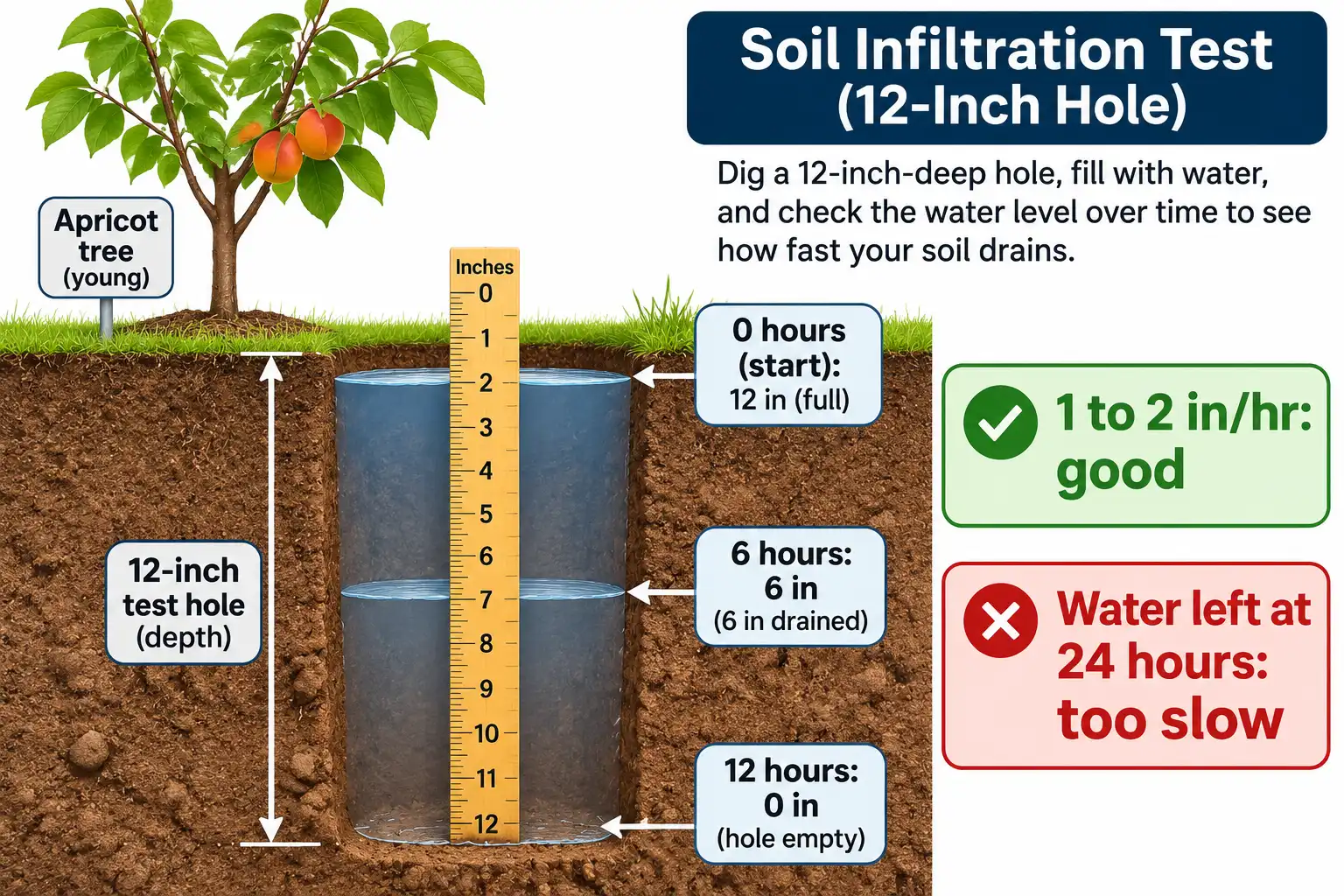
A 12-inch test hole should drain in 6 to 12 hours. If water is still standing after 24 hours, the site drains too slowly for apricot roots.
UC IPM gives this percolation test:
- Dig a hole about 12 inches deep and about as wide as a spade.
- Roughen the sides and bottom so smeared soil does not seal them.
- Fill the hole with water and soak the ground around it.
- Wait 24 hours.
- Refill the hole and time how long it takes to empty.
UC IPM’s drainage guidance calls about 1 to 2 inches per hour a good rate. That 24-hour mark matters for apricots in particular. UC IPM’s apricot guidelines say periods of 24 hours or more of saturated soil favor Phytophthora root and crown rot.
Run your own numbers:
Drain rate (inches per hour) = inches the water drops ÷ hours elapsed
For example, say the water drops 3 inches in 4 hours. That is 0.75 inch per hour, so a full 12-inch hole needs 16 hours (12 ÷ 0.75). That is slower than UC IPM’s range. In that case, plant on a mound and pick a wet-tolerant rootstock. Test in the wettest month of your year, because that is when roots sit in water longest.
What pH Do Apricot Trees Need?
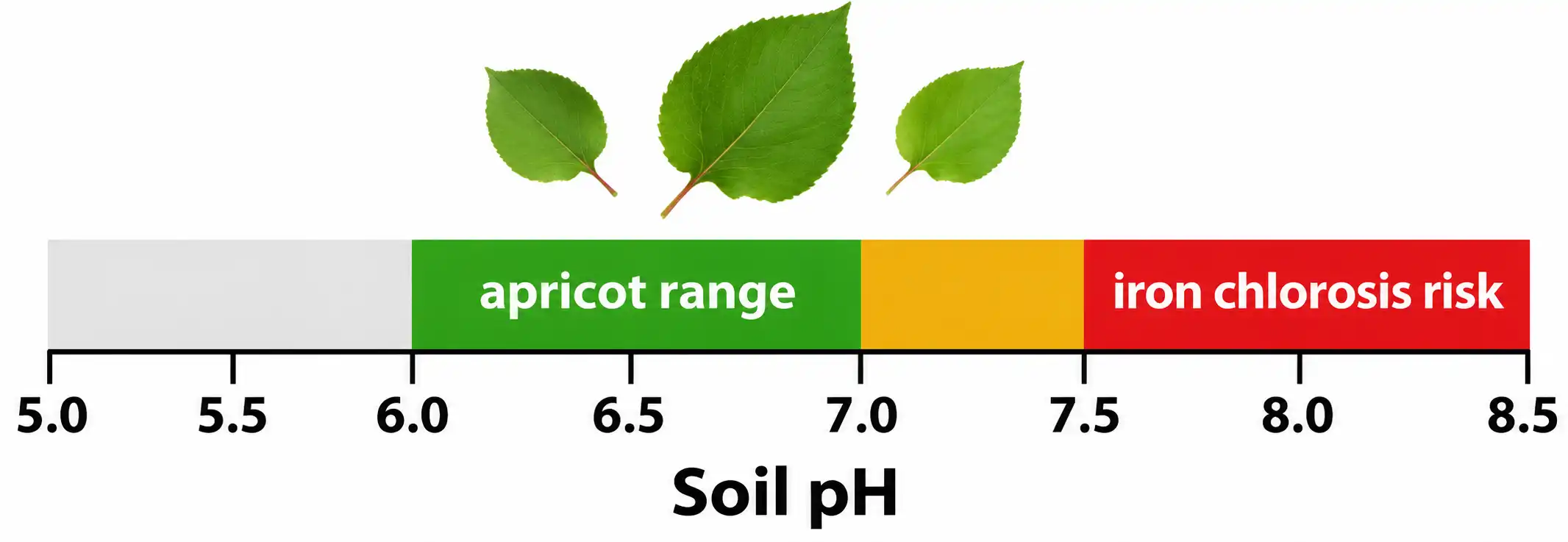
Apricots grow well in slightly acidic to neutral soil, roughly pH 6.0 to 7.0. The exact target depends on which source you follow.
Penn State Extension’s stone fruit guide for home plantings tells Pennsylvania growers to keep pH at 6.0 to 6.5. UNH Extension’s plum, cherry, and apricot fact sheet gives a wider 6.0 to 7.0 for New Hampshire. Both call for a soil test before planting. So a reading of 6.8 sits inside UNH’s range but above Penn State’s. Your county extension office can say which target fits your state.
Lime moves slowly through soil. Penn State’s orchard guide says to work it to root depth before planting. That is the one chance to fix the root zone. Its stone fruit guide also says to lime and fertilize a 10-by-10-foot area for each tree, following the test.
Carry it to your planting: 10 feet × 10 feet = 100 square feet per tree. Four apricot trees need about 400 square feet prepared. Use that area when you convert the lab’s per-area recommendation. Our guide to raising or lowering soil pH covers the materials.
Alkaline Soil and Iron Chlorosis in the West
Apricots grow in alkaline Western soils, but they yellow more easily there, especially when overwatered.
Utah State Extension’s apricot guide says apricots grow in most Utah soils if drainage is adequate. It also warns that apricots are very prone to iron chlorosis in Utah’s alkaline soils. Overwatering raises that risk sharply. Utah State notes that deep, infrequent watering and EDDHA chelated iron may help, and the product label sets the amount.
Colorado State Extension draws a hard line at pH 7.5. Above it, its iron chlorosis guide says treatment options narrow. Soil with free lime cannot practically be pushed down in pH at all.
Check for free lime before you plan to acidify:
- Put a rounded tablespoon of dry, crumbled soil in a small cup.
- Wet it with vinegar.
- Watch for fizzing. Fizzing means free lime is present.
If it fizzes, put your effort into drainage and careful watering rather than sulfur. Colorado State also links compaction in clay soils to low soil oxygen and worse chlorosis.
Yellow leaves can have many causes. Your county extension office or a plant diagnostic lab can confirm what is behind them.
What to Ask the Soil Lab For
A standard fruit tree soil test is the starting point. Add salt, boron, and nematode tests where your region calls for them.
Penn State Extension’s orchard guide has topsoil and subsoil sampled for pH, nutrient imbalances, and organic matter. Our walkthrough on collecting a soil sample shows how to pull both layers. A lab test reads far more than a home kit. This comparison of home kits and lab tests shows what each one measures.
For irrigated sites in the arid West, the UC ANR apricot overview lists more. It suggests testing soil for salinity, exchangeable sodium percentage, and boron, sodium, or chloride toxicity. It also suggests testing irrigation water for sodium adsorption ratio, chloride, boron, total salts, pH, carbonates, and bicarbonates. Apricots do not tolerate high salts or boron, so a well or canal source deserves its own test.
On sandy ground or a former orchard, test for nematodes too. UC ANR notes that sandy soils can carry high nematode numbers when the previous crop was a host. Heavy infestations stunt trees and cut yields. A nematode lab gives its own sampling instructions, so follow those.
Match the Apricot Rootstock to Your Soil
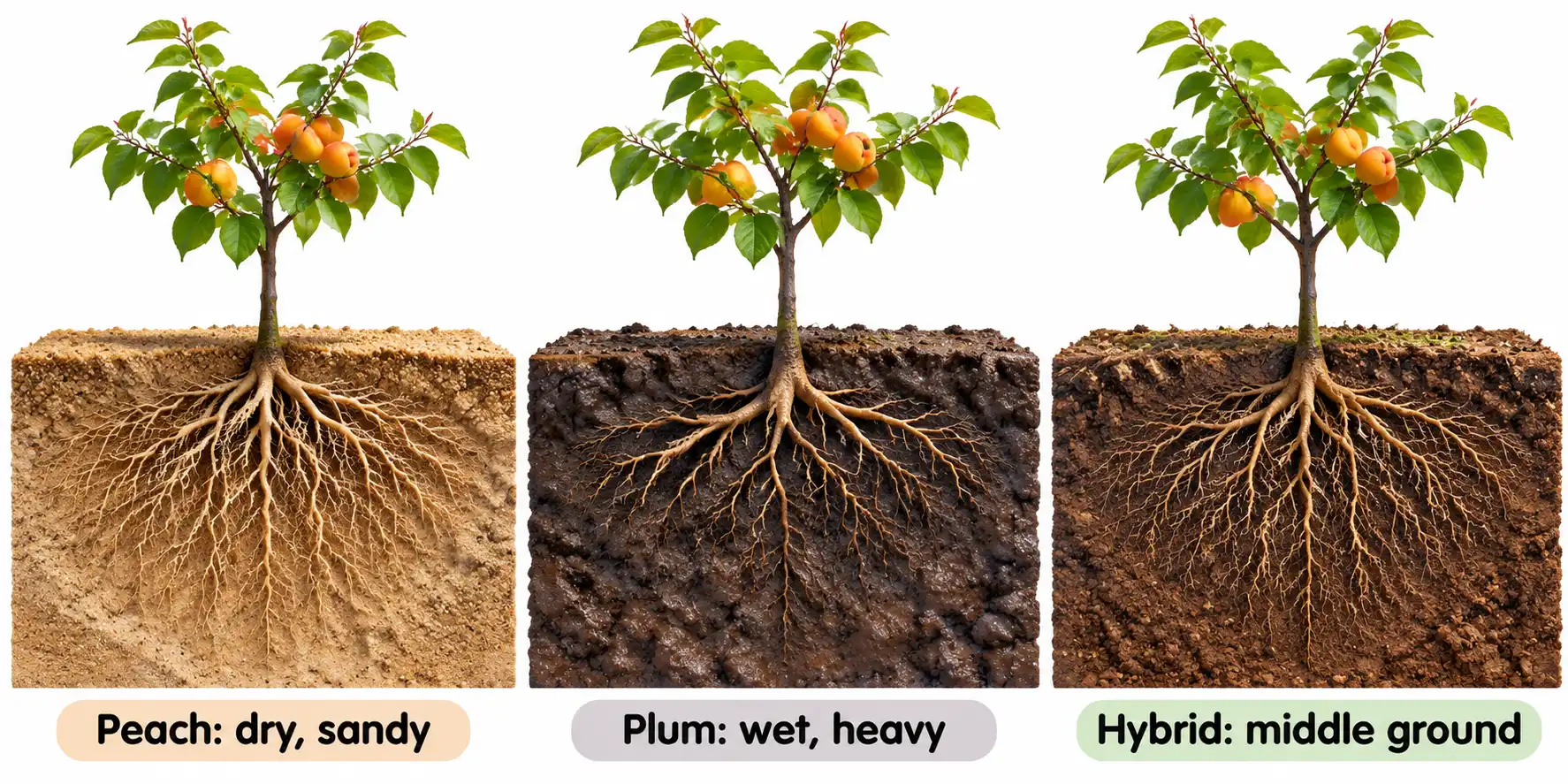
Most apricot trees are grafted, and the rootstock decides how the roots handle wet, sandy, or infested soil. Pick it with your soil test and drainage result in hand.
| Rootstock | Soil it suits (UC ANR) | Nematode response (UC IPM) | Disease notes (UC ANR, UC IPM) |
|---|---|---|---|
| Nemaguard (peach) | Well-drained, sandy soils; sensitive to wet | Resists root-knot; susceptible to ring and root lesion | Not listed as Phytophthora resistant |
| Lovell (peach) | Well-drained, sandy soils; sensitive to wet | Somewhat resists ring; susceptible to root-knot and root lesion | Not listed as Phytophthora resistant |
| Citation (hybrid) | Handles wet or dry conditions better than peach | Not rated in UC IPM’s apricot nematode guide | Less susceptible to bacterial canker |
| Marianna 2624 (plum) | Tolerates wet soil; used on Central Coast clays | Resists root-knot; susceptible to ring and root lesion | Very susceptible to bacterial canker; somewhat resists Phytophthora |
| Myrobalan 29C (plum) | Tolerates wet soil | Resists root-knot; susceptible to ring and root lesion | Susceptible to bacterial canker; somewhat resists Phytophthora |
| Apricot seedling (Royal or Blenheim) | No wet-soil rating in these guides | Nonhost for root-knot; resists root lesion; susceptible to ring | Least susceptible to bacterial canker |
The soil column comes from the UC ANR apricot overview. The nematode column comes from UC IPM’s apricot nematode guidelines, and the canker ratings from UC IPM’s rootstock canker table.
Which Apricot Rootstock Fits Clay, Sand, or Loam?
Plum rootstocks or Citation fit heavy clay, while peach rootstocks fit deep, sandy, well-drained ground.
Decision rule: On heavy clay or a site that failed the drainage test, look at Marianna 2624, Myrobalan 29C, or Citation, and still plant on a mound. Keep in mind that both plum rootstocks carry a bacterial canker risk. On deep, sandy, well-drained ground, peach rootstocks fit, but test for nematodes first. On deep loam that passes the drainage test, soil fit narrows the choice less, so let nematode results and canker history decide.
Published rootstock-by-soil data for apricots comes almost entirely from California trials. Eastern and Midwestern guides rarely rate apricot rootstocks by soil type. Treat this table as a starting point outside the West. Nursery tags usually name the rootstock. If yours does not, ask before you buy.
Sandy Soil vs. Clay Soil for Apricots
Both can grow apricots. Each fails in its own way, so manage them differently.
Sandy soil drains fast, which suits apricot roots. Still, the UC ANR apricot overview lists bacterial canker as a problem on sandy and loamy-sand soils and old gravelly creek beds. Sandy ground can also hold nematodes. It dries fast, too. UC ANR’s home orchard guide waters California fruit trees on sandy soil every 10 to 15 days.
Clay soil holds water and nutrients, but it drains slowly and packs hard. UC ANR says clay makes moisture harder to manage, and UC IPM ties saturated soil to Phytophthora. For California clay loam, UC ANR’s home orchard guide waters every 15 to 20 days, with larger applications to wet the soil deeply. Then Colorado State adds that compacted clay starves roots of oxygen.
Both intervals shorten in hot summer weather and lengthen in cool spring and fall. Outside California, set the schedule by your own rainfall and soil. Whichever soil you have, avoid heavy watering in cool seasons. UC IPM warns that spring and fall overwatering suits root rot, because trees use little water then.
How to Fix Poor Drainage Before Planting Apricots
Raise the roots above the wet layer, break up compaction, and choose a forgiving rootstock. Do all of it before the tree goes in.
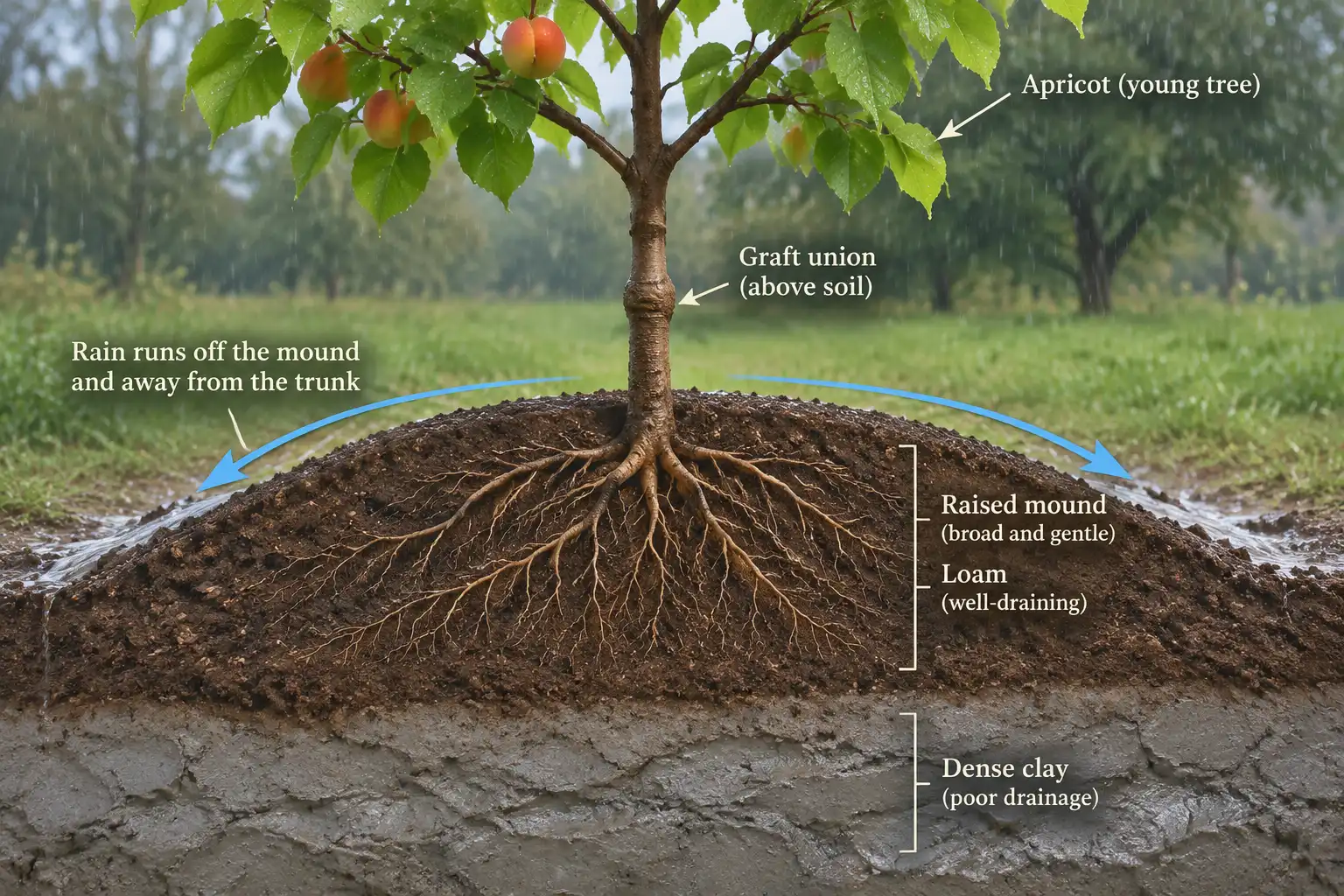
UC IPM’s apricot guidelines advise planting on a slight raised mound or berm to move water away from the crown. UC ANR’s home orchard guide says mounds and raised boxes can make up for poor drainage. For larger sites, Penn State Extension lists subsurface drainage and ridging as fixes made before planting. Our page on fixing a wet planting site covers each option.
Do not dig a big hole in clay and fill it with compost-rich soil. Water runs into the loose soil and stops at the tight clay walls. The hole then holds water like a pot with no drain. Raising the planting surface works better.
Where compaction is the problem, break it up before planting, as the depth section above describes. On a small yard site, a contractor with the right equipment can do this. Then, after planting, keep irrigation short and frequent rather than long and soggy, as UC IPM recommends.
Soil Prep Timeline for a Spring Apricot Planting
Start soil work the season before you plant. Lime, drainage fixes, and rootstock orders all take time.
- A year or more ahead (commercial blocks): Penn State Extension advises detailed soil appraisals several years before planting.
- Late summer or fall before planting: Run the drainage test, send a lab soil test, and run the vinegar test on Western soils.
- Fall: Add lime or other amendments the test calls for and work them to root depth.
- Late fall or early spring: Break compaction and build mounds or berms on slow-draining ground.
- Winter: Order trees on the rootstock that fits your soil.
- Planting day: Set the graft union above the soil line.
- First season: Water to keep the soil moist but not soggy.
Sources differ on graft height. Penn State Extension sets the union 1 to 2 inches above settled soil. Utah State Extension gives 2 to 4 inches for bare-root trees. Either keeps the union clear of wet soil. Our guide to setting a young apricot in the ground walks through planting day.
Commercial Apricot Blocks: What Changes at Scale
On a commercial site, soil varies across the block, so you test by section, not once.
The UC ANR apricot overview advises digging several backhoe pits wherever soil type seems to change. Samples come from several depths and locations. A local Cooperative Extension farm advisor or the NRCS office can help read the profile. The overview also points out that fixing soil problems before planting costs less and works better than fixing them later.
For nematodes, UC IPM’s apricot guidelines split a field into sampling blocks of no more than 5 acres. Each block shares one cropping history and soil texture.
Carry it to your block: a 20-acre site with uniform history needs at least 4 sampling blocks (20 ÷ 5). Split further wherever soil texture or past crops change.
Pre-plant soil fumigation, where nematode results call for it, is a label and applicator licensing matter. Your farm advisor and state pesticide regulators set what applies.
Troubleshooting Soil Problems in Apricot Trees
Many soil problems look alike in the canopy. Your county extension office or a state plant diagnostic lab can identify the cause, and many accept samples.
| What you see | Soil conditions sources link to it | Who confirms |
|---|---|---|
| Yellow leaves with green veins, worse in cool wet springs | Alkaline soil, overwatering, compaction (Utah State, Colorado State) | Plant diagnostic lab; soil test |
| Decline, weak growth, and branch dieback after wet spells | Saturated soil for 24 hours or more favoring Phytophthora (UC IPM); overwatering (Utah State) | Plant diagnostic lab |
| Stunted trees with low yields on sandy ground | Nematodes where a host crop grew before (UC ANR) | Nematode lab sample |
| Poor growth on irrigated Western sites | High salts or boron in soil or water (UC ANR) | Soil and water lab test |
| Small fruit and weak trees on shallow ground | Shallow soil or a hardpan (UC ANR) | Test pit or soil survey |
Use the table to decide what to test, not as a diagnosis. Several of these can occur together.
FAQs About Apricot Tree Soil
Can apricot trees grow in clay soil?
Yes, if water drains out of it. UC ANR reports clay loam has grown apricots in California, but plant on a mound and use a wet-tolerant rootstock such as Marianna 2624 or Myrobalan 29C.
Is sandy soil good for apricot trees?
Sandy soil drains well, which apricot roots need. Still, UC ANR links sandy soils to bacterial canker and nematode problems, so test for nematodes and water more often than you would on loam.
Do apricots prefer acidic or alkaline soil?
They do best in slightly acidic to neutral soil, about pH 6.0 to 7.0. They also grow in alkaline Western soils, but Utah State Extension warns that iron chlorosis is common there.
Can I lower my soil pH for an apricot tree?
Sometimes, but not if your soil holds free lime. Colorado State Extension says lowering pH is impractical in limey soil, so run the vinegar fizz test before spending money on sulfur.
Should I add compost to the planting hole?
Mix little or none into the hole itself. A pocket of loose soil inside tight clay collects water, so improve drainage across the whole planting area or plant on a mound instead.
How long after a soil test should I plant?
Test the season before you plant, ideally the late summer or fall before a spring planting. That leaves time for lime to work in, drainage fixes, and a tree order on the right rootstock.
Do dwarf apricot trees need different soil?
They need the same drainage and pH as full-size trees. UNH Extension notes dwarfing rootstocks for apricots are not readily available for home gardens, so most backyard apricots grow on full-size roots.
Before You Plant
Test drainage first, because no rootstock or amendment rescues a waterlogged site. Then get a lab soil test, fix pH and compaction before planting, and pick a rootstock that matches what you found. With the ground ready, our year-round apricot care guide picks up from planting day.