
Strawberry Farming: Matted Row vs Plasticulture by Region and Budget
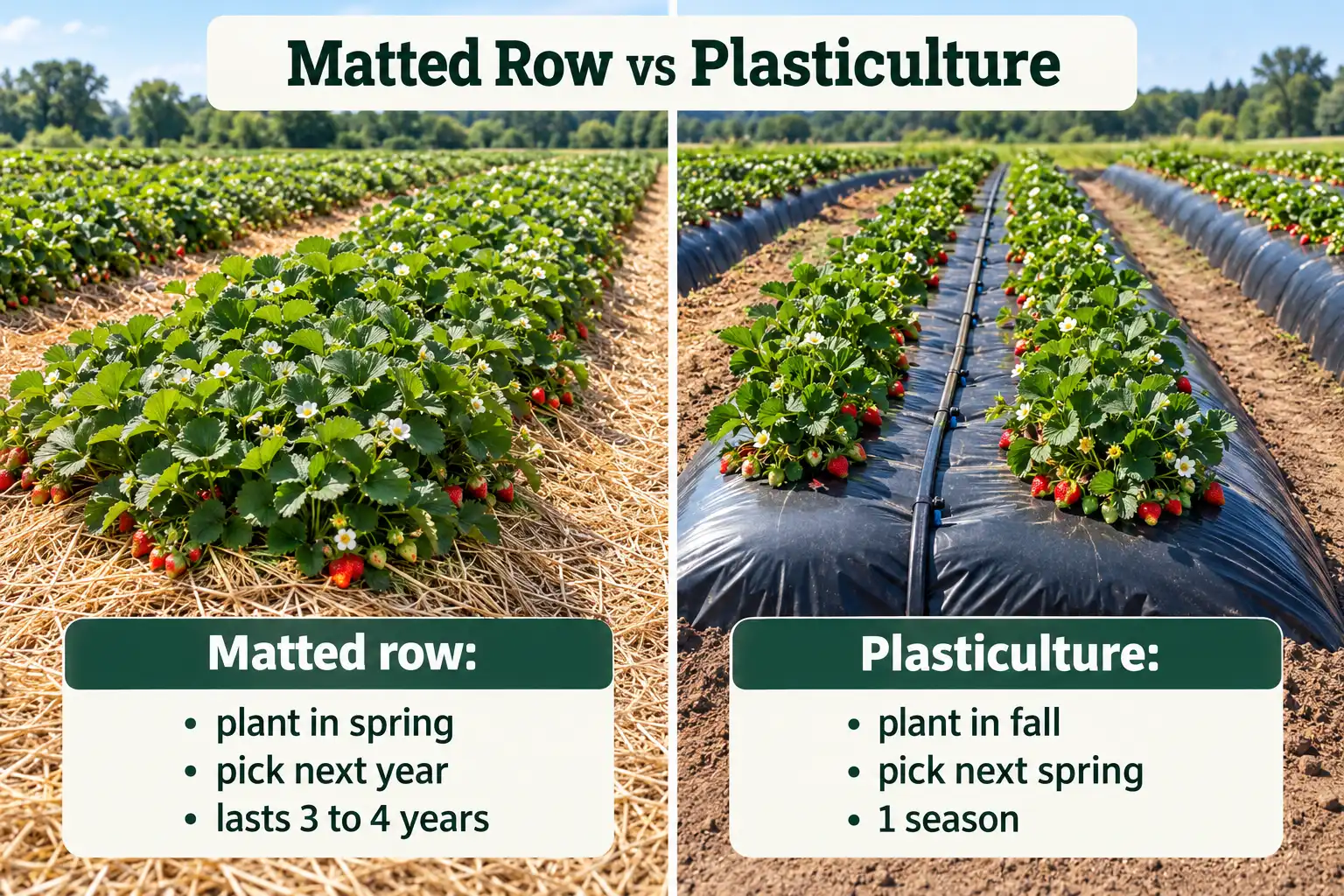
Matted row vs plasticulture is the first decision in strawberry farming. It sets your planting date, first harvest, budget, and field life. Your region and market decide most of it, and the figures below come from five land-grant extension services.
Region settles the matted row vs plasticulture choice. Plasticulture fits the warm South, where fall-planted strawberries fruit the next spring. Matted row fits cold northern states, costs less to establish, and bears again each year after renovation.
Matted Row vs Plasticulture at a Glance
The two systems differ in plant type, calendar, plant count, and cost. Each figure below belongs to the state its source studied, so check it against your county extension guide.
| Factor | Matted row | Plasticulture | Source |
|---|---|---|---|
| Strawberry type | June-bearing, kept as a perennial | Chandler or Camarosa in Georgia; day-neutral varieties in Minnesota | UGA Extension, University of Minnesota Extension |
| Planting time | March or April in Illinois | September 15 to November 1 in middle and south Georgia | Illinois Extension, UGA Extension |
| First harvest | The year after planting | The spring after planting in Georgia | UGA Extension |
| Field life | 3 to 4 years in Minnesota | One season, then replanted | University of Minnesota Extension, UGA Extension |
| Plants per acre | 4,000 to 9,000 in Minnesota | About 17,500 in North Carolina, on 12-inch double rows and 5-foot beds | University of Minnesota Extension, NC State Extension |
| Yield | Up to 7,000 lb per acre in Minnesota | 1 to 1.5 lb per plant in North Carolina | University of Minnesota Extension, NC State Extension |
| Weeds | A major challenge | Minimal under plastic | University of Minnesota Extension |
| Cost before first harvest, 2019 | About $4,000 per acre in Kentucky | $10,000 to $15,000 per acre in Kentucky | University of Kentucky |
Plasticulture yield per acre depends on plant count. NC State Extension’s regional yield table multiplies it out for North Carolina. At 17,500 plants, 1 to 1.5 pounds per plant gives about 17,500 to 26,250 pounds per acre.
How a Matted Row Strawberry Planting Works
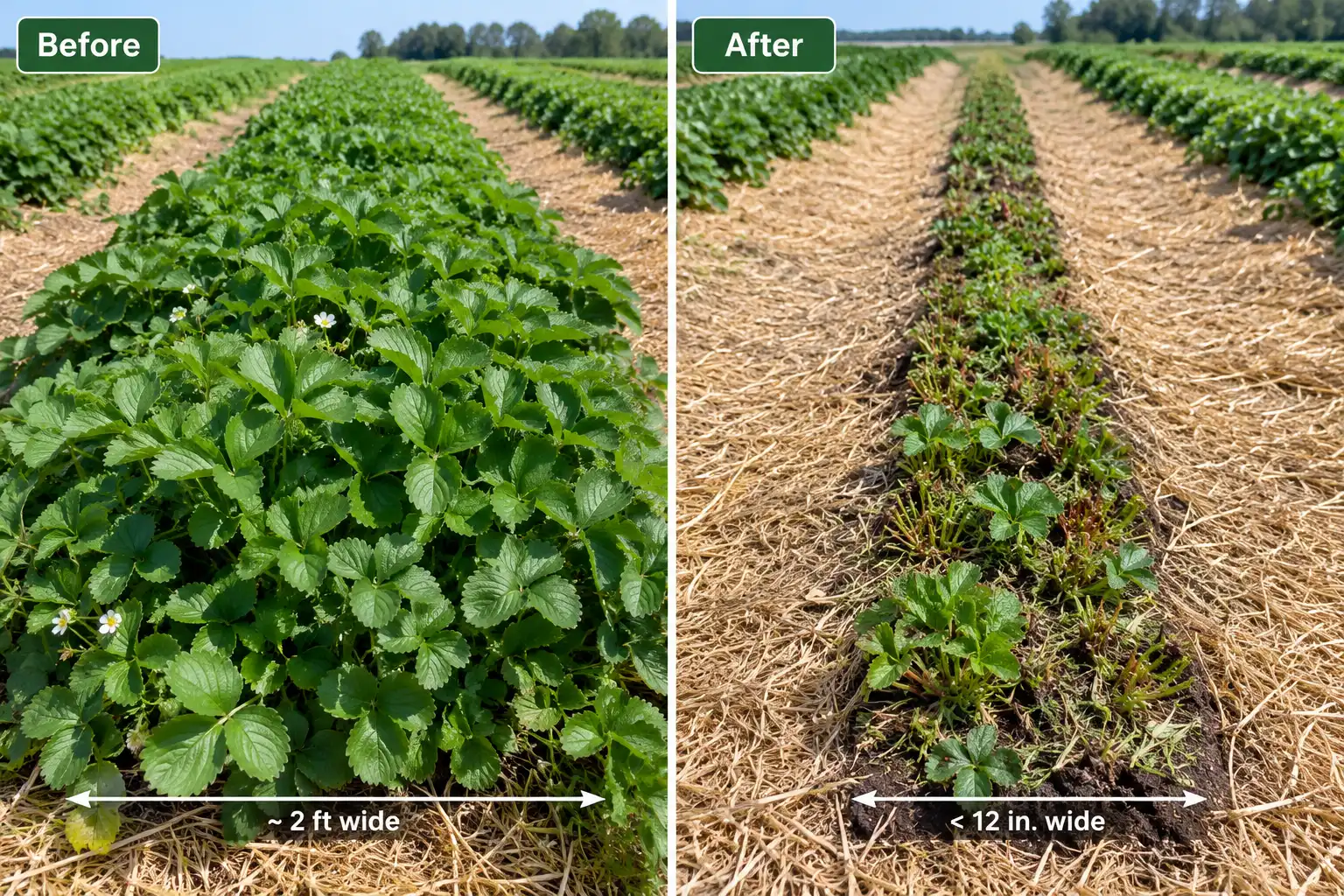
A matted row starts with widely spaced mother plants. Their runners fill the row during the first summer. Illinois Extension’s strawberry growing guide sets June-bearing plants 18 to 30 inches apart, in rows 3 to 4 feet apart. Then daughter plants root freely into a mat no wider than 2 feet.
Planting comes early. Illinois Extension recommends March or April in Illinois, so plants settle in before summer heat. Next, pinch off every flower stem that first season. Illinois Extension explains that fruit in year one slows root and runner growth and shrinks the next crop. As a result, the first harvest comes the year after planting.
Winter cover protects the crowns in the North. Illinois Extension spreads clean wheat straw 3 to 4 inches deep after several fall frosts, before temperatures drop below 20°F. In Illinois, that window usually falls between mid-November and mid-December. Then, in spring, move part of the straw into the aisles once the soil holds at 40°F for 3 or 4 days.
Renovation After Each Harvest
Renovation is the yearly reset that keeps a matted row bearing. Start as soon as picking ends. First, Illinois Extension mows the leaves about 1 inch above the crowns. Next, it narrows the rows to 6 to 12 inches wide by tilling or hoeing. New runners then refill the row and carry next year’s crop.
Timing matters here. Illinois Extension advises against mowing at all if you can’t finish renovation within 7 to 10 days of harvest. Also, University of Minnesota Extension’s production system comparison notes that June-bearing plants yield best in their second, third, and fourth years. After that, UGA Extension’s home strawberry circular suggests a new bed on different ground with new certified plants, since disease and nematodes build up in old beds.
How Strawberry Plasticulture Works
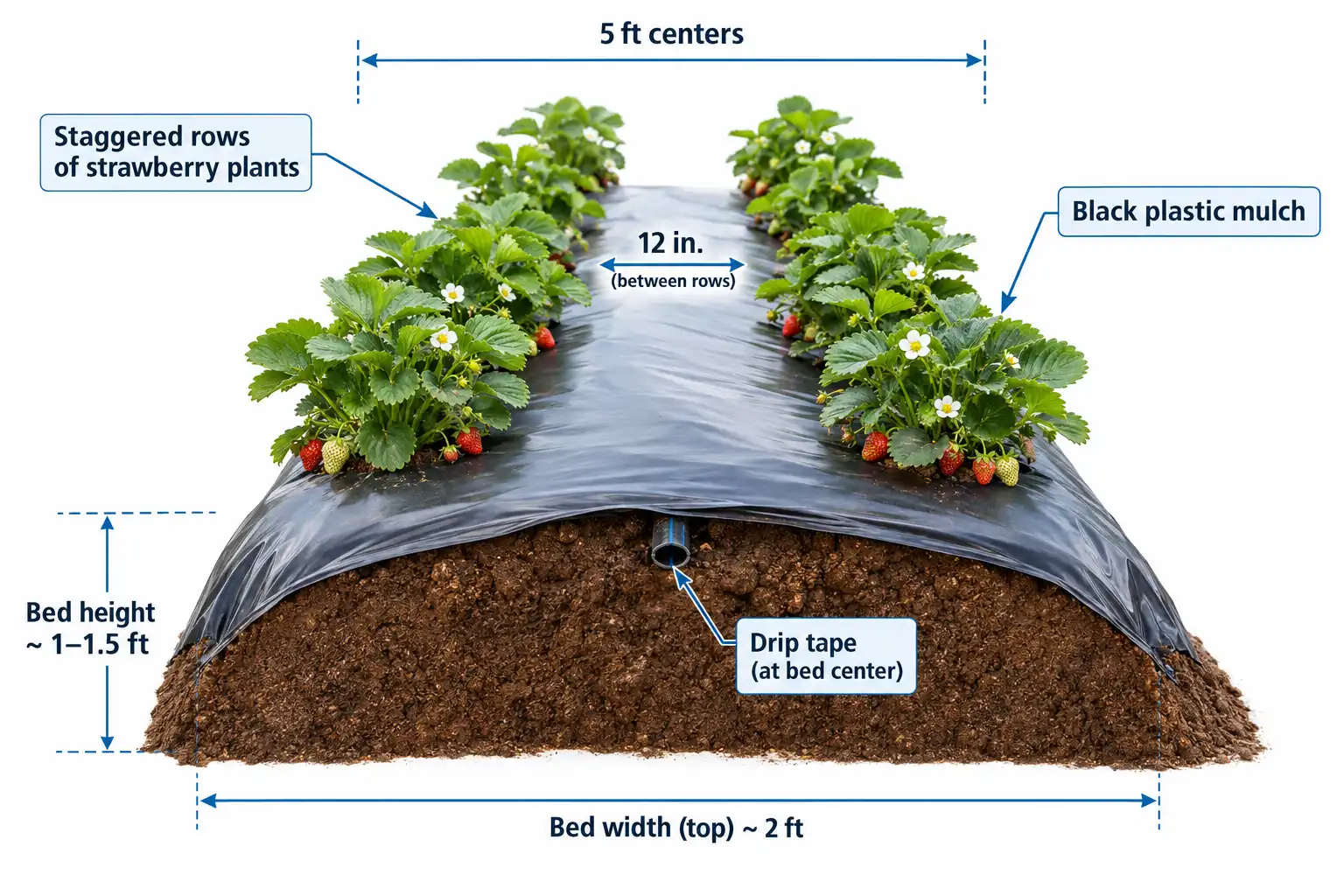
Plasticulture grows strawberries as a one-season crop on raised beds under plastic mulch. NC State Extension spaces the beds on 5-foot centers, with two staggered rows 12 inches apart. Meanwhile, UGA Extension runs a drip tube under the plastic, so the bed gets water without wetting fruit or leaves. Plan the drip line layout under the mulch before the plastic goes down, because the tape is out of reach afterward.
In the Southeast, plants go in during fall and fruit the next spring. UGA Extension sets plants from September 15 to November 1 in middle and south Georgia, and early October usually works best. After harvest, growers usually destroy the planting. NC State Extension’s production schedule treats plasticulture as a year-round job. It starts with plant orders and testing the soil in early summer. Then it ends with pulling the plastic and plowing under the plants the following summer.
Plant type changes the workload. NC State Extension’s planting guidance finds plug plants cause fewer transplant problems than fresh-dug plants. By contrast, fresh dugs need intense overhead sprinkling for 1 to 2 weeks before they take hold.
Plasticulture in Cold Northern States
Northern growers use plastic for a different crop. University of Minnesota Extension grows day-neutral strawberries on plastic as annuals, planted in early spring. In Minnesota, they fruit from mid-July through early October of the planting year. Growers also strip the runners, because runners pull energy away from fruit.
So plasticulture covers two opposite calendars. In Georgia, it means fall-planted Chandler beds that fruit in spring. In Minnesota, it means spring-planted day-neutral beds that pick up after the June crop ends. The June-bearing and day-neutral strawberry types each need their own system, so match the plant to the plan.
Which System Fits Your Region
Climate makes most of the matted row vs plasticulture decision before cost does. Three broad zones show the pattern.
The warm South. Plasticulture is the default. UGA Extension says anthracnose often destroys matted row plantings in middle and south Georgia during their first summer, before they fruit. NC State Extension recommends plasticulture in every region of North Carolina, including the mountains. Still, mountain beds yield about 1 to 1.2 pounds per plant, against 1.5 pounds in the Piedmont and Coastal Plain. NC State Extension ties that gap to the shorter fall and colder winters.
The transition zone. Both systems work here. UGA Extension says matted rows do well in north Georgia. Likewise, the University of Kentucky’s 2019 strawberry budget reports success with both matted row and annual plasticulture in Kentucky.
The cold North. Matted row leads for June-bearing strawberries. Illinois Extension calls it the most popular method in Illinois, and University of Minnesota Extension grows June-bearers on straw. However, plastic still has a role there for day-neutral varieties and a late-summer crop.
Matching the System to Your Market
Your sales plan matters almost as much as climate. NC State Extension notes that many North Carolina growers now use 14-inch spacing, because inexperienced pickers miss berries in the row middles. On 5-foot beds, that trades 2,500 plants per acre (17,500 down to 15,000) for easier picking. If you run a pick-your-own patch, plan for that trade from the start.
Season length matters too. University of Minnesota Extension puts the June-bearing harvest at 3 to 5 weeks, from late June to mid-July in Minnesota. By contrast, it rates day-neutral fruit on plastic at high market value, because the system supports extended-season and organic production.
If you sell the berries, check whether the FDA’s Produce Safety Rule covers your farm before the first harvest. Farm stands and u-pick fields also follow state and local rules, so ask your state department of agriculture.
Plants, Yield, and Cost for Your Planting
Extension figures come per acre or per plant. Carry them to your own ground before you order plants.
Plants Per Acre
For plasticulture, start with feet of bed. On 5-foot bed centers, an acre holds 43,560 ÷ 5 = 8,712 feet of bed. Two rows at 12-inch spacing put two plants on every foot, so 8,712 × 2 = 17,424 plants. That matches NC State Extension’s figure of about 17,500 plants per acre in North Carolina. At 14-inch spacing, the count drops to about 14,900, close to NC State’s 15,000.
For a matted row, divide an acre by the space each mother plant gets:
Plants per acre = 43,560 ÷ (in-row spacing in feet × row spacing in feet)
With Illinois Extension’s spacing range, that gives:
- 18 inches × 3 feet: 43,560 ÷ 4.5 = 9,680 plants
- 24 inches × 4 feet: 43,560 ÷ 8 = 5,445 plants
- 30 inches × 4 feet: 43,560 ÷ 10 = 4,356 plants
That range lines up with University of Minnesota Extension’s 4,000 to 9,000 plants per acre.
Yield on a Quarter Acre
A quarter acre is 10,890 square feet. Here is what the published yields mean at that size:
- Plasticulture, North Carolina: 10,890 ÷ 5 = 2,178 feet of bed, or about 4,356 plants. At NC State Extension’s 1 to 1.5 pounds per plant, expect about 4,360 to 6,530 pounds.
- Matted row, Minnesota: University of Minnesota Extension’s figure of up to 7,000 pounds per acre works out to about 1,750 pounds.
- Matted row, Kentucky: the University of Kentucky budget models 5,500 to 9,000 pounds per acre, or about 1,375 to 2,250 pounds.
Sources disagree on matted row yield. Region is the likely driver, so use the figure published for your state rather than an average.
Cost Before the First Harvest
The University of Kentucky’s 2019 budget puts matted row establishment at about $4,000 per acre, spread over a four-year planting life. In the same budget, plasticulture runs $10,000 to $15,000 per acre, counting setup and growing costs before harvest. On a quarter acre, that comes to about $1,000 for matted row against $2,500 to $3,750 for plasticulture, in 2019 dollars.
However, the bigger plastic bill buys bigger yields. The University of Kentucky reports that plasticulture’s annual returns compete with matted row’s annualized returns. It also expects a matted row to repay its setup cost by the second fruiting year. Prices have changed since 2019, so price plants, plastic, and drip tape at current rates before you commit.
Planting to Harvest Timeline by System
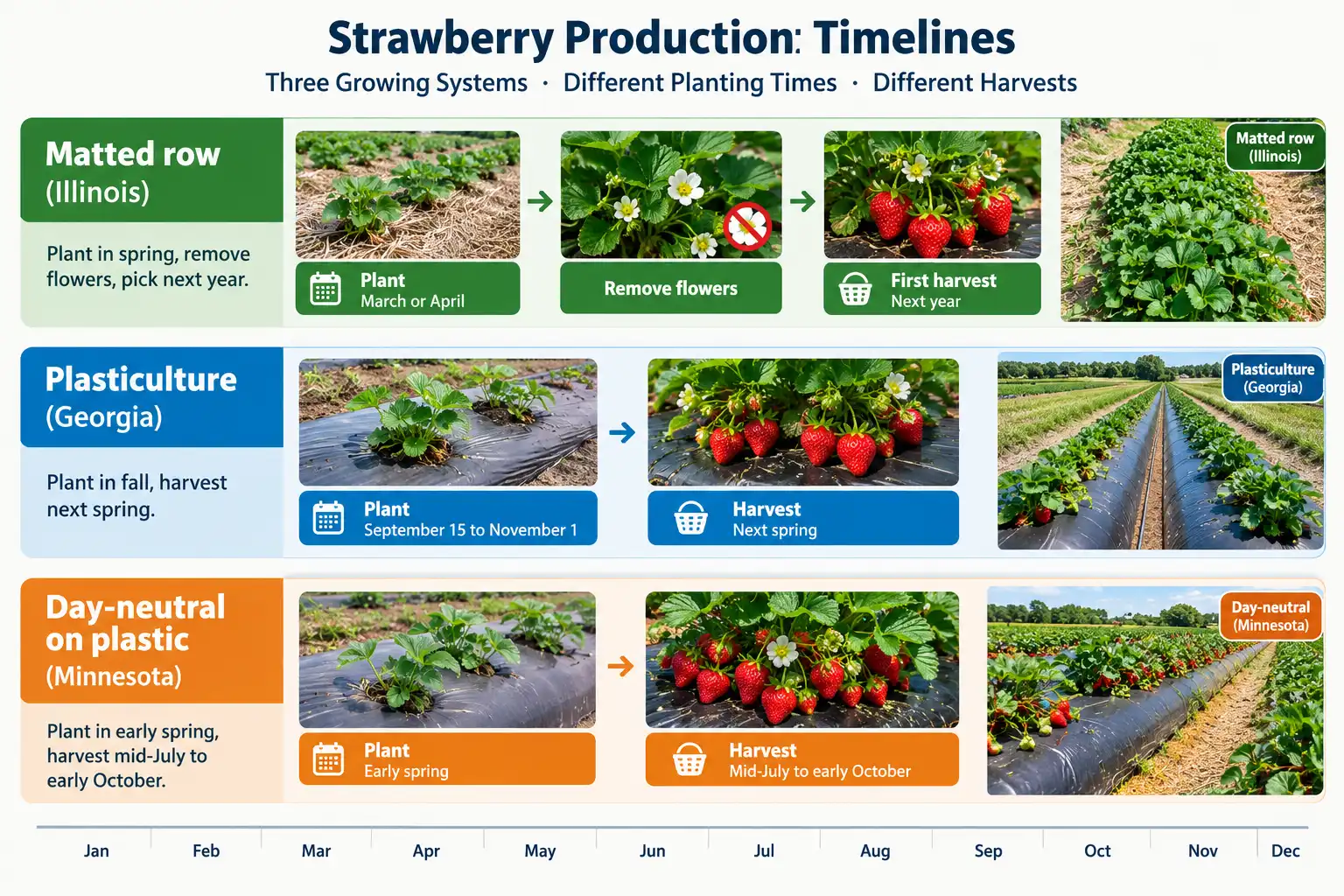
A Georgia plasticulture bed and an Illinois matted row both give their first berries in the year after planting. However, the plastic bed goes in about six months later. The table uses 2027 as an example planting year, with dates from Illinois Extension, UGA Extension, and University of Minnesota Extension for those states.
| Stage | Matted row, Illinois | Plasticulture, middle and south Georgia | Day-neutral on plastic, Minnesota |
|---|---|---|---|
| Plant | March or April 2027 | September 15 to November 1, 2027 | Early spring 2027 |
| First season | Remove flowers; runners fill the row | Plants overwinter in the bed | Remove runners; plants flower and fruit |
| First harvest | 2028 season | Spring 2028 | Mid-July to early October 2027 |
| After harvest | Renovate, then pick again in 2029 and 2030 | Remove plants and plastic | Remove plants |
| Replant | New bed on fresh ground after 3 to 4 years | Fall 2028 | Spring 2028 |
That six-month gap shapes cash flow. The University of Kentucky notes that a matted row earns nothing in its first year. A plastic bed, by contrast, holds the ground for one season and then frees it for another crop.
Where Each System Goes Wrong
Most failures trace back to weeds, timing, or plant choice.
Matted Row Failure Points
- Weeds in year one. University of Minnesota Extension calls weeds a major challenge in matted rows. UGA Extension advises preparing the bed a year ahead, so weeds can’t set seed.
- Late renovation. Rows left uncut grow too dense for good production. Renovate right after harvest, inside Illinois Extension’s 7 to 10 day window.
- Fruit in the first year. Letting new plants fruit weakens them and shrinks the next crop, Illinois Extension notes.
- Southern heat and disease. Anthracnose often wipes out matted rows in middle and south Georgia, according to UGA Extension.
Plasticulture Failure Points
- Late plant orders. NC State Extension starts the plasticulture year with plant orders in early summer, months before fall planting.
- Dry transplants. NC State Extension starts overhead irrigation within 30 to 45 minutes of setting fresh dugs. Then it keeps sprinkling for 1 to 2 weeks.
- The wrong variety. In Georgia, UGA Extension rates Chandler and Camarosa as by far the best for the annual hill system. Other varieties give mediocre to fair results.
- Holding beds a second year. UGA Extension warns that branched crowns left into a second year produce many very small berries.
Frost and Disease in Both Systems
Open blossoms are the weak point in spring. Illinois Extension says spunbond row covers used for protecting blossoms from spring frost hold strawberries safe down to about 23 to 25°F. It also starts sprinkler protection when the temperature at plant level reaches 34°F.
Spots, wilting, and collapsing plants have many possible causes. Your county extension office or a state plant diagnostic lab can identify the problem, and many accept samples. If a fungicide becomes necessary, the product label sets the rate, the timing, and the wait before harvest.
FAQs About Matted Row vs Plasticulture
Can June-bearing strawberries grow on plasticulture beds?
Yes, in the warm South, where UGA Extension grows Chandler and Camarosa on plastic as a fall-planted annual. In cold climates, University of Minnesota Extension keeps June-bearers on straw matted rows instead.
Can you keep a plasticulture bed for a second year?
Sometimes, if the planting stays free of anthracnose, UGA Extension says it can carry on as a matted row. However, branched crowns left into year two give many very small berries unless you clip them in late fall.
How many strawberry plants do you need per acre?
For plasticulture on 5-foot beds with 12-inch double rows, NC State Extension puts it at about 17,500 plants. For June-bearing matted rows, University of Minnesota Extension lists 4,000 to 9,000 plants, depending on spacing.
Which system works best for a backyard strawberry patch?
Outside the warm South, matted row suits most home gardens because it needs no plastic or drip tape. In north Georgia, UGA Extension says an 8-by-30-foot bed started with 30 plants feeds a family of four.
Why do southern growers avoid matted row strawberries?
Disease is the main reason, according to UGA Extension. Anthracnose often destroys matted row plantings in middle and south Georgia during their first summer, before they produce any fruit at all.
Does plasticulture need drip irrigation?
Yes, drip tape runs under the plastic, and UGA Extension lays it before the mulch goes down. Fresh-dug transplants also need overhead sprinkling for 1 to 2 weeks to establish, per NC State Extension.
Before You Plant
Start with your region, then your market, then your budget. In the warm South, plan on fall-planted plastic beds. In the cold North, a matted row of June-bearers costs less to start and bears for several seasons. Day-neutrals on plastic can then stretch the harvest into fall. Between those zones, both systems work, so let your sales plan decide. Whichever you choose, order plants by early summer for fall planting, and ask your county extension office which varieties suit your area.