
Organic Fruit Certification: How the 36-Month Transition Works

Organic fruit certification starts with a waiting period set by federal rule. Here is how the 36-month clock works for tree fruit and berries, how to date your first organic harvest, and what you can sell and recover along the way.
Under USDA rules, organic fruit certification requires 36 months with no prohibited substances on the land before the harvest you sell as organic. The clock starts on the date of the last prohibited application, not on the planting date.
What the 36-Month Rule Requires
The rule sets three conditions for every field that will grow organic fruit. Under 7 CFR 205.202, the land must:
- Follow the organic practice standards for soil, planting stock, rotation, and pest control.
- Go 3 years with no prohibited substances before the harvest you sell as organic.
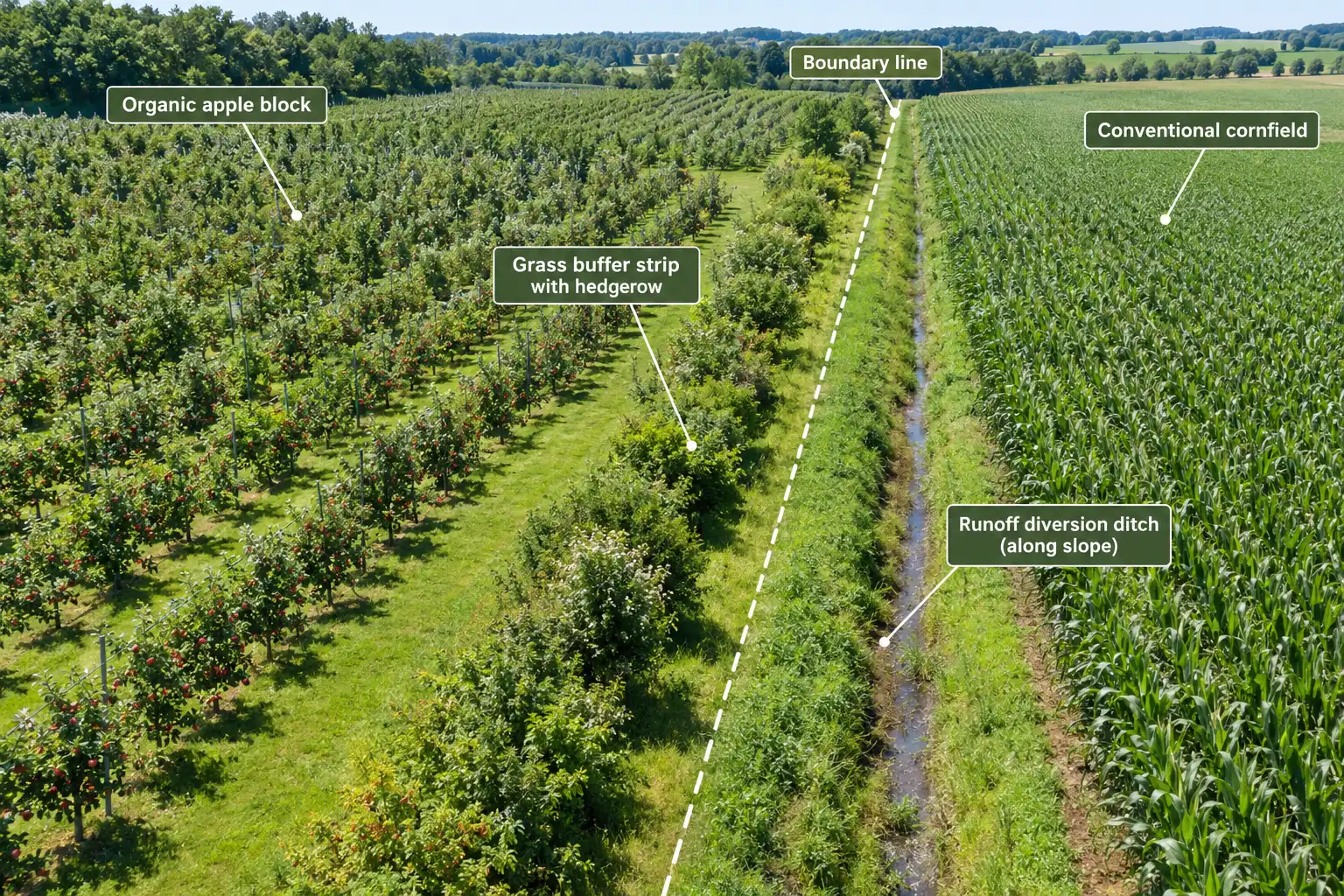
- Keep clear boundaries and buffer zones against drift and runoff from neighboring land.
The USDA AMS guide for farmers transitioning to organic explains that prohibited substances include most synthetic fertilizers, herbicides, and pesticides. Still, the National List cuts both ways. It allows a few synthetic materials and bans a few natural ones.
So the 36 months is not a rest period. You farm to organic standards the whole time, yet you sell at conventional prices. That is why planning starts before the last conventional input. Every other part of the standards for growing organic fruit builds on this land rule.
When Does the 36-Month Clock Start?
The clock starts on the date of the last prohibited application. The day you plant and the day you apply for certification don’t change it. USDA AMS advises documenting that date, and signing any affidavits your certifier requires, as early as possible.
Where your land starts out shapes the timeline:
- Bearing conventional orchard: the count begins after the last conventional spray or synthetic fertilizer. So fruit from roughly the next three seasons sells as conventional.
- Crop field or hay ground becoming an orchard: the count begins after the last herbicide or synthetic fertilizer. Often, that happens before any trees go in.
- Pasture, woodland, or idle ground: if records show no prohibited substance in the past 36 months, the land may qualify at the first harvest. Your certifier decides from the land history you document.
One slip resets the count. Because the rule needs 3 clean years before harvest, a single prohibited application starts a new 36 months from that date.
Hidden inputs cause some of those slips. USDA AMS names treated seed, synthetic wetting agents, and prohibited fiber pots as common culprits. In an orchard, that means checking cover crop seed, irrigation additives, and potting mixes before use.
How to Date Your First Organic Harvest
Add 36 months to the date of the last prohibited application. The result is the earliest date the land rule allows an organic harvest.
First organic harvest = date of last prohibited application + 36 months
For example, say a hay field got its last herbicide on June 1, 2026. Then any fruit picked after June 1, 2029 meets the land rule.
Next, add the trees. Illinois Extension’s fruit tree table, written for Illinois plantings, gives years from planting to first fruit. We use it because it splits apples by rootstock. Here is what it means for trees planted on that field in spring 2027:
| Fruit and tree type | Years to first fruit (Illinois Extension) | First fruit if planted spring 2027 | Inside the 36-month clock? |
|---|---|---|---|
| Dwarf apple | 2 to 4 | 2029 to 2031 | Only fruit picked by June 1, 2029 |
| Semi-dwarf apple | 3 to 4 | 2030 to 2031 | No |
| Standard apple | 4 to 6 | 2031 to 2033 | No |
| Standard peach | 2 to 3 | 2029 to 2030 | Only fruit picked by June 1, 2029 |
| Standard sweet cherry | 4 to 7 | 2031 to 2034 | No |
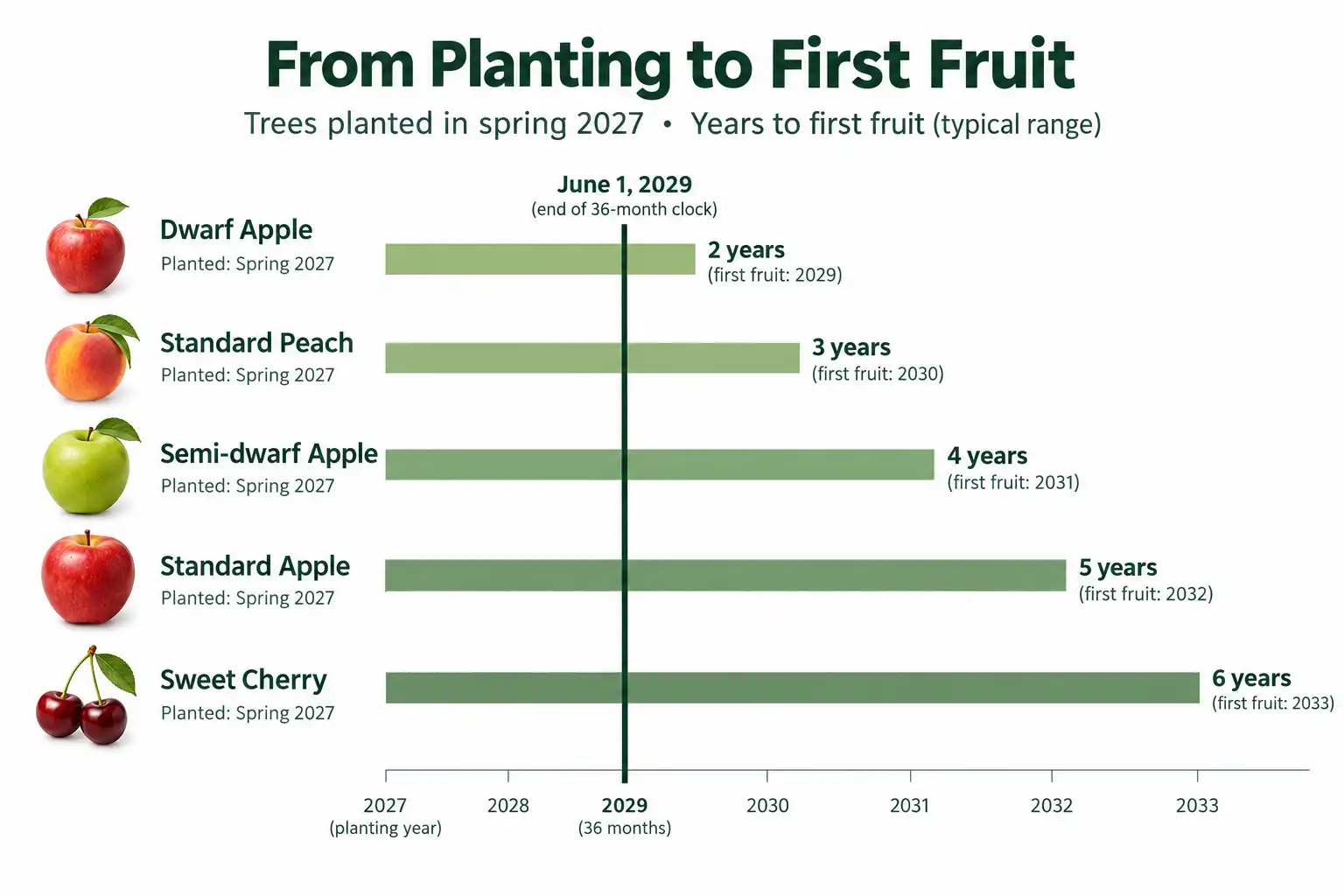
So for a new planting, the clock mostly runs during years with no fruit at all. Only fruit picked on or before June 1, 2029 would fall inside it. Bearing ages also shift with region and variety, so check your own state’s extension figures before you set dates.
Bearing orchards carry the real cost. They farm organically for three seasons while selling every crop at conventional prices.
Nursery Trees and the 12-Month Rule
Nonorganic nursery trees are allowed, but their fruit waits 12 months under organic management before it can sell as organic. The USDA AMS seeds and planting stock standard sets the order:
- Use organic planting stock when it is commercially available.
- If it isn’t, search for organic sources and document that search.
- Then plant untreated, non-GMO stock and manage it organically for at least 12 months before the first organic harvest.
AMS applies the 12-month rule to tree fruits, blueberries, caneberries, strawberries, and grapes. But where growers manage strawberries or caneberries as annuals, the annual planting stock rules apply instead.
Treated stock is the other trap. Stock treated with a prohibited substance is off limits, except for treatments that federal or state phytosanitary rules require. AMS gives strawberry crowns as an example, since some need a fungicide before shipping between states.
For most tree fruit, the 12 months passes long before first fruit. It binds harder on plants that can fruit soon after planting, such as day-neutral strawberries. So ask your certifier how it applies before you order plants.

Pest and Disease Plans for the Transition
Build the organic pest plan before the clock starts, because the rules expect more than a change of sprays. USDA AMS explains that 7 CFR 205.206 requires a mix of practices, not reliance on allowed pesticides alone.
Fire blight shows why this matters for apples and pears. USDA let the allowance for streptomycin and tetracycline in organic apples and pears expire on October 21, 2014. It then removed both listings in a 2015 Federal Register rule. As a result, organic apple and pear blocks have no antibiotic option for fire blight.
Inputs need checking too. Most certifiers accept products on the OMRI or WSDA lists, but AMS advises confirming with your own certifier. Also, organic-allowed products are still pesticides. The label sets every rate, interval, and pollinator protection direction, and the label is the law.
Organic blocks rely on a different set of pest control options allowed in organic orchards, so learn them before the clock starts. Your county extension office or a certified crop adviser can help fit a plan to your fruit and region.
Shared equipment counts as well. If one sprayer serves both organic and conventional blocks, AMS says you need a plan showing how you clean it before it touches organic trees.
Soil Fertility and Buffer Zones
Start with a soil test, then plan fertility around organic inputs. USDA AMS recommends a nutrient plan for the transition, soil tests as needed, and cover crops or green manures suited to your soils. A baseline soil test also helps you justify amendments, such as micronutrients, to your certifier later.
Synthetic fertilizers stop on day one of the transition. From then on, building fertility without synthetic fertilizer relies on compost, cover crops, and allowed amendments.
Buffers Between Your Orchard and the Neighbors
The rule requires distinct boundaries and buffer zones, such as runoff diversions, wherever organic land meets conventional land. However, it names no fixed width. Instead, your certifier reviews whether your buffer fits your site. Ask early how it treats fruit from trees inside the buffer.
Records, Trellis Posts, and Paperwork
Keep records from the first day of transition, because the inspector will audit them. USDA AMS says certified operations must keep records for 5 years. They must be detailed enough to trace every input, field task, harvest, and sale.
- Dates and products for every application, block by block
- Purchases of seed, plants, and nursery stock, with notes on your organic search
- Harvest and sales records, kept apart for organic and conventional fruit
- Receipts for every input
Treated wood needs attention in trellised plantings. Under 7 CFR 205.206, new or replacement posts that touch soil can’t use arsenate or other prohibited wood treatments. You must also disclose posts already in place on your application. So list them before you rebuild a grape, bramble, or apple trellis.
Selling Fruit During the Transition
Until the 36 months pass and a certifier approves you, fruit from transitioning land sells as conventional. WSDA’s transitional certification page puts it plainly: you farm organically during transition, but you can’t label, sell, or represent the crop as organic.
Some states offer a middle step. Washington, for example, runs a state transitional certification program through WSDA. Even so, its certified transitional growers still cannot represent their crops as organic.
The Small-Farm Exemption
Very small sellers can skip certification, but not the 36 months. The USDA AMS certification fact sheet sets the line at $5,000 or less in gross organic sales per year. Exempt growers must:
- Follow every other organic rule, including the land rule
- Keep records for at least three years
- Skip the USDA organic seal and the words “certified organic”
- Avoid selling fruit as an organic ingredient for another business’s certified product
- Register with the California Department of Food and Agriculture, if the farm is in California
That fourth point matters for fruit. For example, selling berries to a certified jam maker as organic ingredients takes your own certificate.
Food safety rules apply on top of all this. Growers who sell fruit may also fall under the FDA Produce Safety Rule, which organic status does not replace. So check the current rules for food safety on fruit farms before your first sale.
Applying for Certification on Time
Apply months before the first organic harvest, because a certifier must inspect the crop before you pick it. USDA AMS describes four stages: application, initial review, on-site inspection, and final review. Your application forms also become your organic system plan, which 7 CFR 205.201 requires.
- Choose a certifier. Any USDA-accredited certifier that works in your area can certify you, so compare fees, service, and deadlines.
- Get its forms early. Reading them during transition shows which records and practices it will expect.
- Submit ahead of harvest. In Washington, WSDA recommends applying at least 3½ months before the expected harvest.
- Prepare for the inspection. Have field maps, input records, and buffer details ready.
- Renew every year. Certification continues through an updated plan and a yearly inspection.
Run the math with your own harvest date. Say you expect the first organic peaches on August 15, 2029. Then WSDA’s guideline puts your application in by May 1, 2029. Other certifiers set their own deadlines, so confirm yours early.
Inspectors walk the blocks and trace your records. So learn what a certification inspection covers well before the visit.
What Transition Costs and Where USDA Helps
Certification fees vary by certifier, so ask each one for its fee schedule. Then look at two USDA programs that can offset part of the cost.
FSA Cost Share, Once You’re Certified
The Farm Service Agency’s Organic Certification Cost Share Program repays 75 percent of eligible certification costs, up to $750 per scope. That covers program years 2025 and 2026, and applications for both years are due December 31, 2026. However, only certified operations qualify, so transition years alone don’t earn a payment.
Here is the math for a crops scope in 2026:
| Your certifier’s bill | 75 percent of the bill | Your reimbursement |
|---|---|---|
| $600 | $450 | $450 |
| $1,000 | $750 | $750 |
| $1,400 | $1,050 | $750 (cap) |
NRCS Help During the Transition
NRCS offers the Organic Transition Initiative through EQIP. Every contract includes Organic Management, conservation practice 823, and can add cover crops, field borders, and nutrient management. The NRCS Organic Transition Initiative fact sheet adds that it may repay foregone income when yields dip during transition. Apply at your local NRCS office, because each state sets its own ranking dates.
FAQs About Transitioning to Organic Fruit
Can I sell fruit as organic during the 36-month transition?
No, fruit from transitioning land sells as conventional until 36 months pass and a certifier approves you. Exempt small farms skip certification, but their land still has to clear the same 36 months.
Does the clock start when I plant my fruit trees?
No, it starts on the date of the last prohibited substance applied to the land. Planting date does not matter, so trees can go in during the transition and grow while the clock runs.
Can land that was never sprayed skip the transition?
Yes, land with no prohibited substances in the past 36 months can qualify right away. Your certifier will ask for land history records or signed affidavits that show the last application date.
Do I need certified organic nursery trees?
Only when organic stock of your chosen variety is commercially available. If it isn’t, document your search, plant untreated non-GMO stock, and manage it organically for at least 12 months.
Does one prohibited spray restart the clock?
Yes, for every field or orchard block it touched. One prohibited application starts a new 36-month count from that date, so clear each input, even a wetting agent, with your certifier first.
Can a small farm sell organic fruit without certification?
Yes, if gross organic sales stay at $5,000 or less a year. You must still follow organic rules and keep records for three years, but you cannot use the USDA organic seal.
Key Points for Your Planting
Date the clock from the last prohibited application, then add 36 months. For a new orchard, plant early so the clock runs through the years before first fruit. For a bearing orchard, plan on three seasons of conventional sales and talk to NRCS before you start. After that, apply well ahead of the first organic pick and claim the FSA cost share once certified.