
Citrus Tree Care and HLB Quarantine Rules: What US Growers Can Move
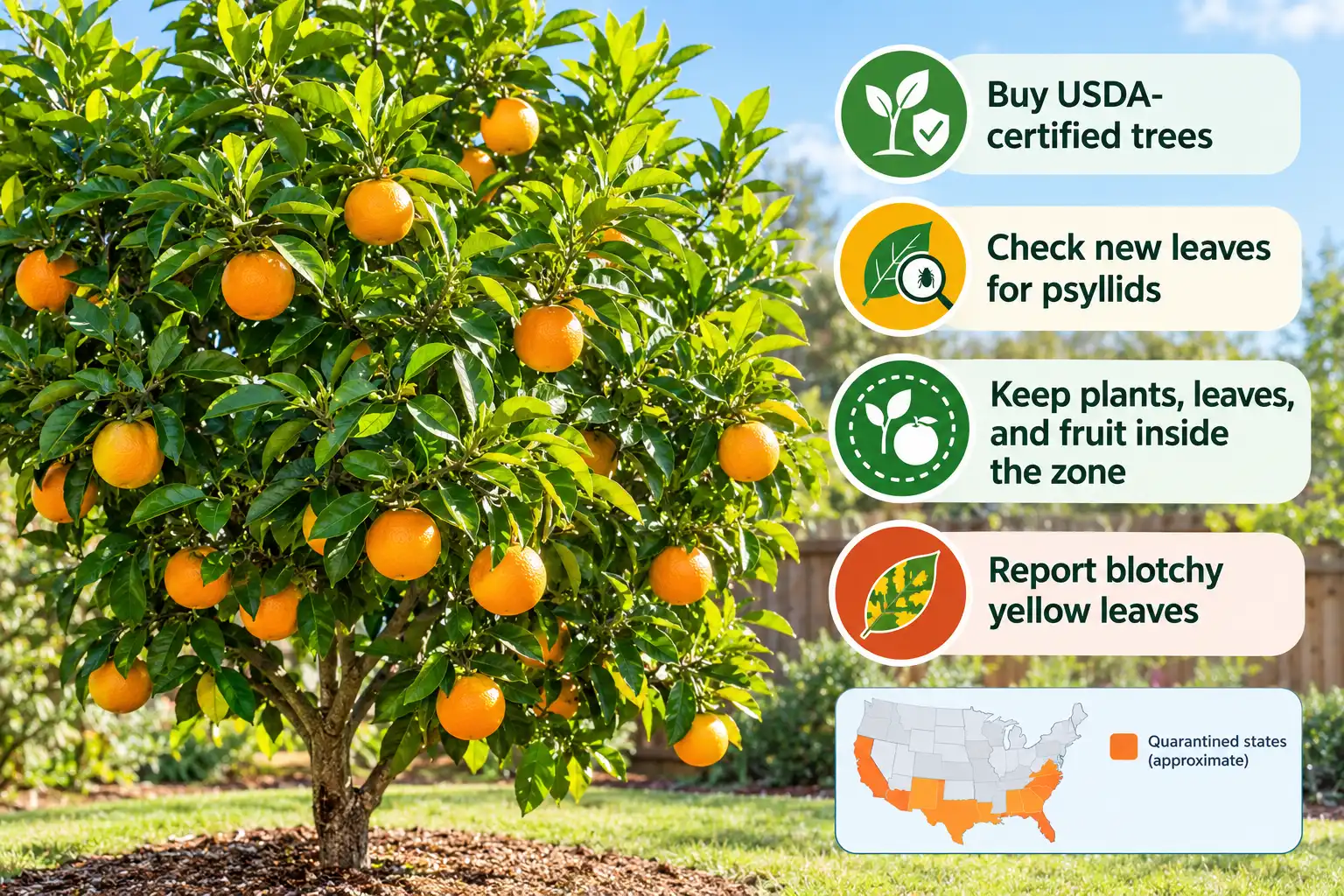
HLB quarantine rules now cover citrus in all or part of nine states, Puerto Rico, and the US Virgin Islands. Here is what you can move, how to buy a legal tree, and how to keep it bearing.
Under HLB quarantine rules, citrus plants, leaves, and homegrown fruit stay inside the quarantine area. Buy only USDA-certified trees, check new leaves for Asian citrus psyllid, and report blotchy yellow leaves to state plant officials.
What HLB Does to a Citrus Tree
HLB, also called citrus greening, is a bacterial disease with no cure. The APHIS citrus greening page says most infected trees die within a few years. Meanwhile, the bacteria travel in the Asian citrus psyllid, a gnat-sized insect that feeds on new leaves.
Timing is what makes HLB so hard to contain. UC IPM notes that symptoms may not show for 2 or more years after infection. But psyllids can spread bacteria from that tree within a few weeks. So a healthy-looking tree can still carry HLB, and moving it can spread the disease to a new county.
That gap explains the quarantines. Officials restrict plants, leaves, and fruit by location, because nobody can judge infection by eye.
Florida shows the cost. The USDA NASS Citrus Fruits 2025 Summary counted 144,900 bearing citrus acres in Florida for 2025-26. Two seasons earlier, in 2023-24, it counted 249,800 acres. Hurricanes also damaged groves in those years. Even so, APHIS reports greening throughout Florida and says the disease has devastated millions of acres of citrus.
Where HLB Quarantine Rules Apply in October 2026
APHIS reports citrus greening in these areas as of its October 14, 2026 update:
- Entire state or territory: Florida, Georgia, Mississippi, Puerto Rico, and the US Virgin Islands
- Parts of the state: Alabama, Arizona, California, Louisiana, South Carolina, and Texas
The list keeps growing. In February 2026, APHIS set Arizona’s first HLB quarantine, about 9 square miles around Nogales in Santa Cruz County. Then in August 2026, CDFA opened a quarantine around Calexico after the first HLB find in Imperial County.
California also has quarantines in parts of Los Angeles, Orange, Riverside, San Bernardino, San Diego, and Ventura counties. CDFA says crews have removed more than 10,700 infected trees from those areas since 2012. Each new confirmed tree triggers a mandatory five-mile quarantine radius, so boundaries can shift from one month to the next.
The HLB zone is not the only line to watch. UC IPM notes that California’s psyllid quarantines cover more ground than its HLB zones, with their own rules. CDFA also runs separate quarantines for sweet orange scab and citrus yellow vein clearing virus.
Before you buy, prune, or share fruit, look up your address on the APHIS citrus quarantine map. California residents can also check CDFA’s HLB quarantine maps, last updated October 8, 2026.
What You Can and Cannot Move Out of a Quarantine Area
Citrus plants and plant parts stay inside the quarantine line. APHIS asks residents not to move branches, green waste, or dead trees out of a quarantined area. It also says not to mail or carry homegrown citrus fruit or plants out of one.
| Item | Rule in an HLB quarantine area |
|---|---|
| Citrus trees and nursery stock | Cannot leave the area. Commercial nurseries move stock only under strict APHIS protocols. |
| Leaves, prunings, green waste, dead trees | Cannot leave the area. |
| Homegrown citrus fruit | Do not mail or carry it out. In California, it stays on the property where it grew, though you can eat or process it there. |
| Commercially cleaned and packed fruit | Can move under the quarantine’s provisions. |
| Curry leaf, orange jasmine, box orange | Psyllid hosts, so they cannot leave the area either. |
APHIS sets the federal rules under 7 CFR 301.76. On top of that, CDFA adds California’s tighter fruit rule in its August 2026 Imperial County notice. UC IPM lists the ornamental relatives that host the psyllid, and the same limits cover them.
Grafting carries risk too. UC IPM reports that California’s first HLB tree most likely came from an illegally grafted, infected bud. So never trade budwood or cuttings with neighbors, and never bring them across state lines.
Prunings need the same care. Keep leaves and branches inside the quarantine area, and ask your county agricultural office how to dispose of them locally.
How to Buy a Citrus Tree Legally
Buy only USDA-certified citrus plants. APHIS lists this among its main prevention steps, and it rules out swap meets, roadside sellers, and gifts from friends. Before you pay, ask the nursery whether the tree is certified and where it grew.
Then weigh the commitment honestly. UF/IFAS warns Florida residents that HLB demands costly inputs, time, and steady attention. Even with that effort, some trees catch the disease early and never produce edible fruit. UF/IFAS also notes that home citrus trees are unlikely to live for many decades, as they once did. Part-time residents face a harder job, because their trees may sit untended for months.
California guidance runs along the same lines in hard-hit areas. UC IPM advises against planting new citrus in neighborhoods where HLB is becoming widespread. Likewise, CDFA suggests removing any tree you no longer plan to tend, so it can’t harbor the pest or disease.
Site, Spacing, and Planting
Plant citrus in full sun on ground that drains fast. UF/IFAS says citrus tolerates light shade but bears more in full sun. Mississippi State Extension adds that citrus can’t tolerate wet feet, and standing water can kill it. In Florida, UF/IFAS says container-grown trees can go in the ground in any month.
Follow these steps for a container-grown tree:
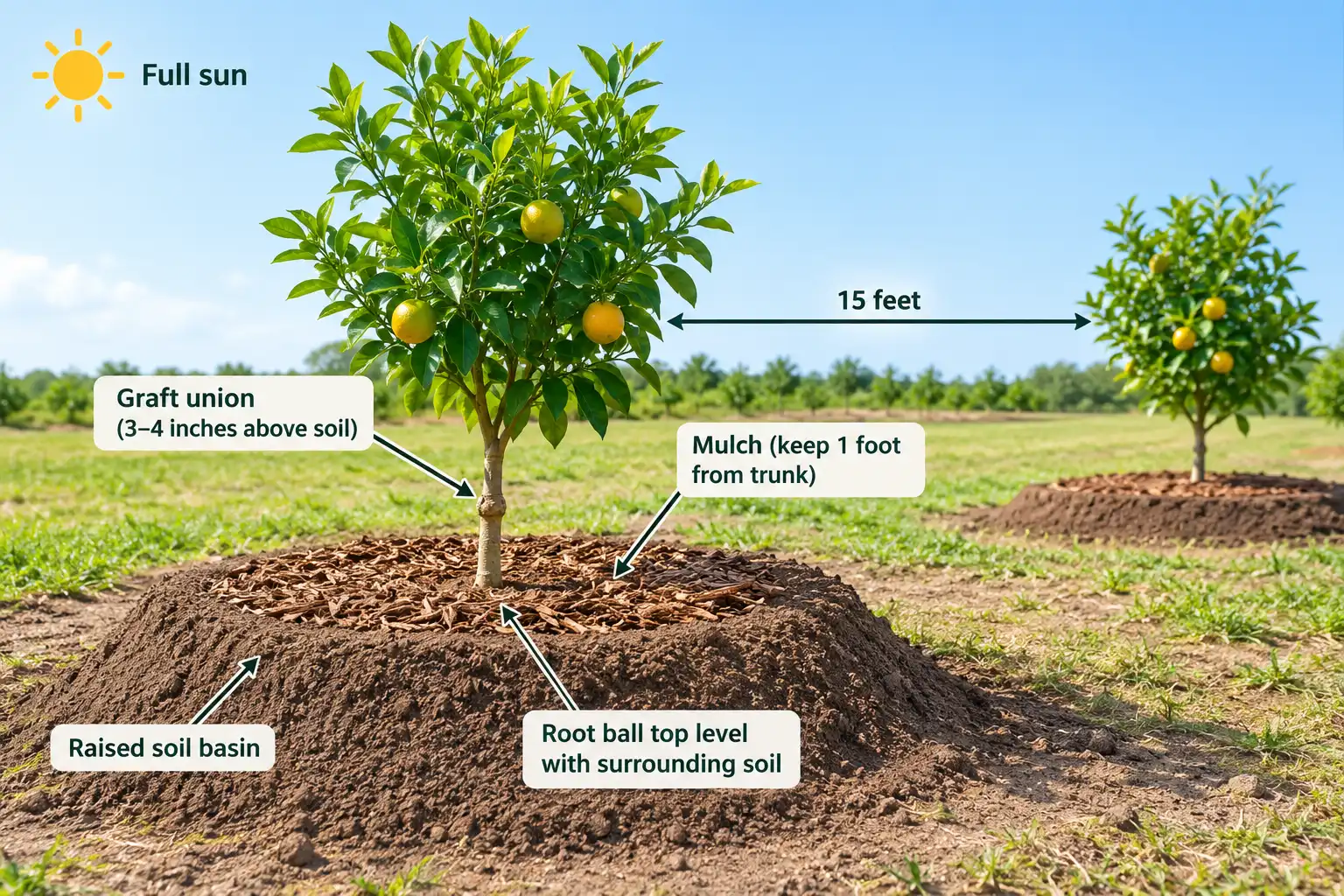
- Space trees at least 15 feet apart. UF/IFAS gives that minimum for Florida home plantings, because well-fed citrus grows into a large tree. Keep clear of septic tanks and drain fields too.
- Loosen the outer potting mix. UF/IFAS advises removing some soil from the root mass, so outer roots grow straight into native soil.
- Set the tree at its container soil line. Planting deeper buries the trunk and can put the graft union below ground.
- Build a basin that holds 5 to 10 gallons. Then fill it right away to soak the root zone.
- Keep mulch and weeds a foot off the trunk. UF/IFAS links weeds at the trunk to foot rot, a soil fungus that can kill trees.
- Remove rootstock suckers. Shoots from below the graft are the rootstock variety and won’t bear desirable fruit.
To size a Florida planting at UF/IFAS spacing, divide your area by 225 square feet (15 x 15) per tree. For example, an open yard section of 30 by 45 feet fits about 6 citrus trees (1,350 / 225). Swap in your own measurements. UF/IFAS covers the rest in Citrus Culture in the Home Landscape.
How Much Water Does a Young Citrus Tree Need?
For the first month, UF/IFAS advises filling a new citrus tree’s basin twice a week in Florida home plantings. Where a hose can’t reach, that means about 8 to 10 gallons per watering.
Here is that figure carried through to a small planting:
- Waterings in the first 4 weeks: 2 per week x 4 weeks = 8
- Water per tree: 8 x 8 to 10 gallons = 64 to 80 gallons
- Three new trees: about 192 to 240 gallons for the month
After the first month, water less often. Still, UF/IFAS says to refill the basin whenever new growth wilts in mid-afternoon. As roots spread each year, the tree needs less irrigation, though dry spells still call for water.
Timing also matters on the Gulf Coast. Mississippi State Extension notes that drought during bloom stops fruit set, and drought later causes fruit drop. However, soggy ground is just as risky, so never let water stand around the trunk.
How to Fertilize Citrus by Tree Age
Start with a soil test through your county extension office. Then feed small, split doses of nitrogen that rise each year. UF/IFAS puts the best soil pH for Florida home citrus at 5.5 to 6.5.
UC IPM and UF/IFAS print different amounts, so both appear below. Each guide fits its own state’s soils and climate, so follow the one closer to your region.
| Year after planting | UC IPM, California (actual nitrogen per tree per year) | UF/IFAS, Florida (actual nitrogen per tree per year) |
|---|---|---|
| 1 | 1 tablespoon of nitrogen fertilizer, 3 times | 0.15 to 0.30 lb, in 6 feedings |
| 2 | 0.25 lb | 0.30 to 0.60 lb, in 5 feedings |
| 3 | 0.5 lb | 0.45 to 0.90 lb, in 4 feedings |
| 4 | 0.75 lb | 0.80 to 1.0 lb, in 3 feedings |
| 5 and later | 1 lb | 1.1 to 1.4 lb, in 3 feedings |
Timing differs too. In California, UC IPM’s citrus fertilizing guide puts the first feeding in January or February, just before bloom. Later feedings follow in May and possibly June. The guide also warns that late-season feeding can delay color and roughen the rind. In Florida, UF/IFAS spaces first-year feedings about 6 weeks apart from February through October.
Overfeeding adds an HLB risk. UC IPM notes that excess nitrogen pushes extra new growth, and new growth is exactly where psyllids lay eggs. Container and dwarf citrus also need less fertilizer, according to UC IPM.
How Cold Can Citrus Trees Handle?
Kumquats and fully dormant satsumas handle the most cold, while lemons and limes handle the least. Mississippi State Extension, writing for Gulf Coast growers, lists the lowest temperature each tree survives without damage:
| Citrus type | Lowest temperature without tree damage (°F) |
|---|---|
| Kumquat | 16 to 17 |
| Satsuma mandarin, fully dormant | 18 |
| Other mandarins | 22 to 23 |
| Sweet orange | 23 to 24 |
| Grapefruit | 23 to 24 |
| Lemon | 26 to 27 |
| Lime | 28 |
Those numbers protect the tree, not the crop. The same guide says the tree usually takes 3 to 4 degrees more cold than its fruit. Duration counts too. For navel oranges, injury takes 3 to 4 hours at 27 to 28°F. For small lemons, just 30 to 60 minutes at 29°F does damage.
A hard freeze can also kill a tree back to the graft. Then the rootstock regrows and bears seedy, sour fruit.
So plan freeze protection for fruit trees before the first cold front. Keep frost cloth and tree covers on hand too. Where winters regularly drop below your type’s number, a container citrus tree that moves indoors is the safer choice. Mississippi State Extension says full protection from cold injury takes a greenhouse or sunroom.
When Will a New Citrus Tree Bear Fruit?
In Florida, UF/IFAS says a 1-year-old citrus tree usually needs 3 or 4 years after planting to produce quality fruit. So a tree planted in spring 2027 should give its first good crop in 2030 or 2031. That timeline assumes the tree stays free of HLB.
Seedlings take far longer. Mississippi State Extension puts seed-to-fruit time for field citrus at 7 to 8 years. Even then, the fruit may be poor. That is why nurseries sell grafted trees.
Independent data on newer home varieties is thin. So treat a tag promising fruit in the first year as the nursery’s own claim, not a tested result.
How to Check New Growth for Asian Citrus Psyllid
Check the soft new leaves, called flush, every time they appear, using a hand lens. If you find an insect you can’t name, your county extension office or state agriculture department can identify it.
The UC IPM pest note on psyllids and HLB says mature citrus flushes mostly in spring and fall. Young trees and lemons, however, flush year-round in warm weather, so they need the most frequent checks.
Look for these signs:
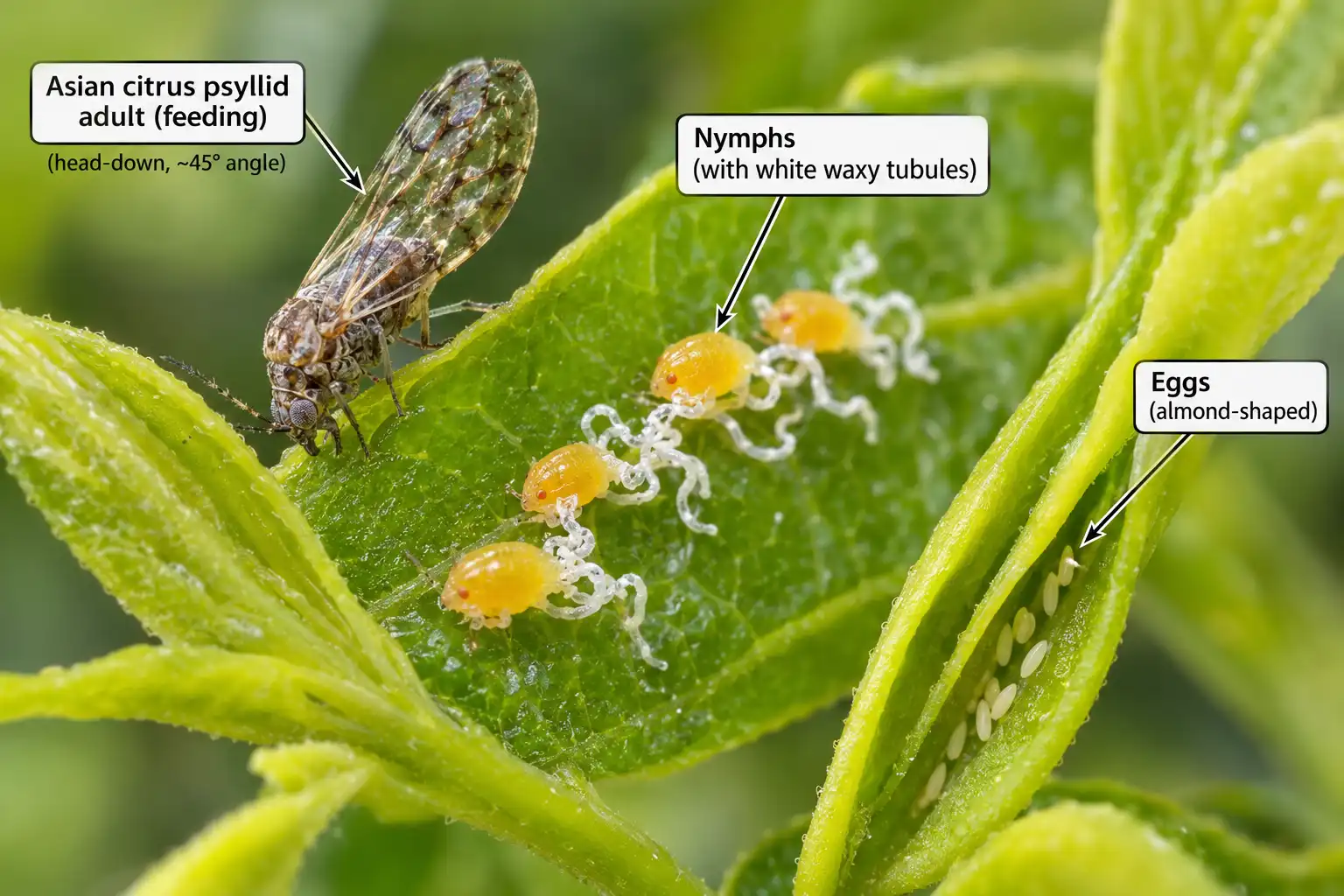
- Adults: 1/6 to 1/8 inch long, with mottled brown wings. They feed head-down, with the body tilted at about 45 degrees.
- Nymphs: flat and yellow to orange, trailing white waxy tubules shaped like a curly tube with a bulb on the end.
- Eggs: tiny, yellow-orange, and almond-shaped, tucked into leaf folds.
- Damage: twisted new leaves that mature with a notch, plus sticky honeydew and sooty mold.
Aphids, citrus leafminer, and citrus thrips also twist new leaves. So compare what you find with other fruit tree insect pests. Also control ants near the tree, because UC IPM explains that ants protect psyllids from predators and parasitic wasps.
Some products carry labels for psyllids on home citrus. The label sets the product, the amount, and the timing. UC IPM warns that broad-spectrum sprays and systemic insecticides harm honey bees, so never apply them while trees bloom. In California, report psyllids found in a new area to the CDFA hotline at 1-800-491-1899.
HLB Signs to Report, Not Diagnose
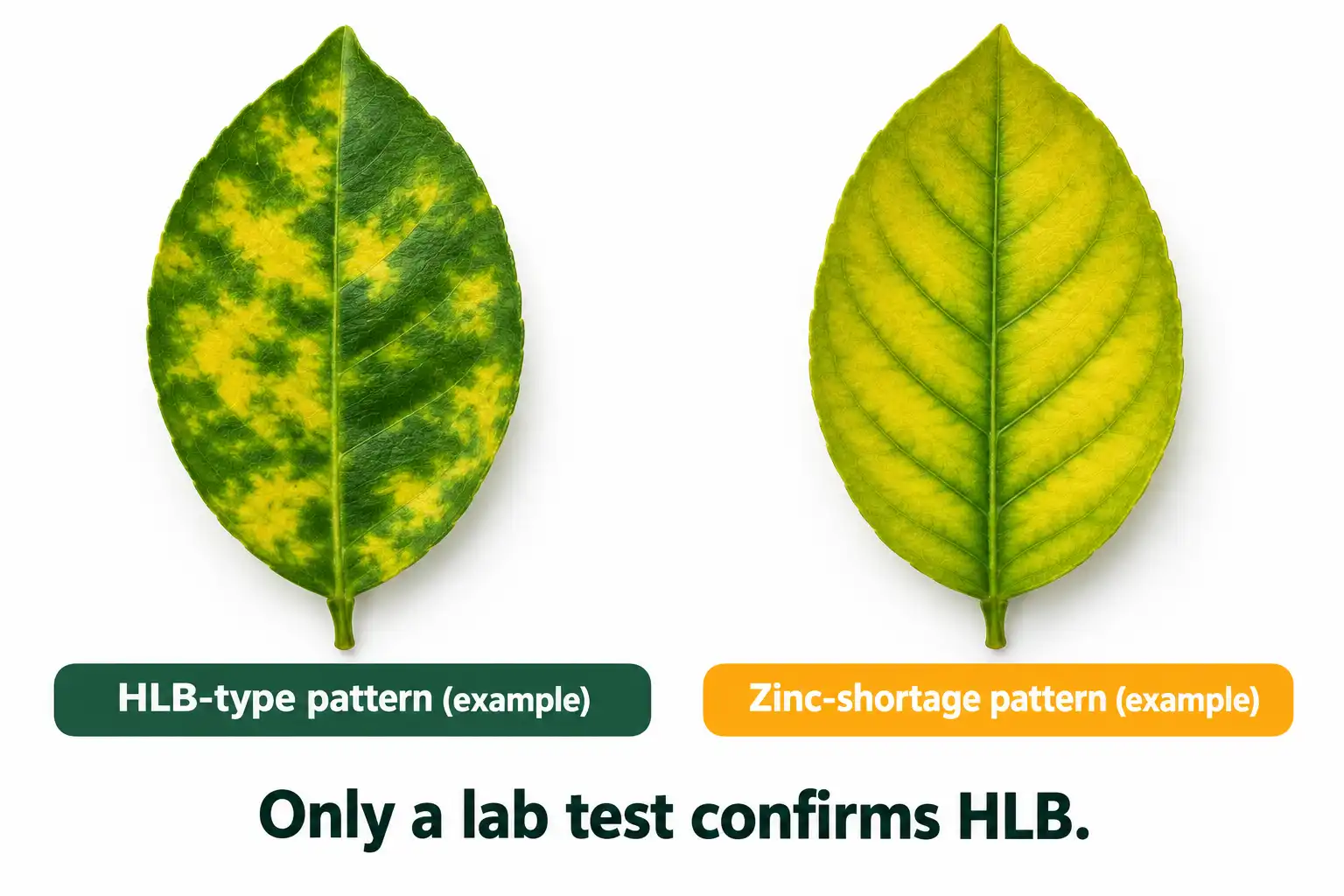
Only a lab test confirms HLB, so report a suspect tree instead of judging it yourself. In California, call CDFA at 1-800-491-1899. Elsewhere, APHIS directs reports to your State Plant Health Director. Your county extension office can also help rule out other causes.
APHIS and UC IPM describe these warning signs:
- Leaves: blotchy yellow mottling that looks different on each side of the midvein. By contrast, zinc and other nutrient shortages usually yellow both sides evenly.
- Shoots: yellowing on a single limb or one sector of the canopy.
- Fruit: small, lopsided, and partly green, with a bitter taste and dark aborted seeds. It also tends to drop early.
- Whole tree: twig dieback and sparse, small leaves that point upward.
None of these signs proves HLB on its own. Nutrient shortages and other stresses can look alike, which is why the lab test matters.
If a test comes back positive in California, CDFA removes the tree. It then surveys all citrus within 250 meters, treats nearby citrus for psyllids, and sets the five-mile quarantine described above.
Common Mistakes That Spread HLB or Weaken Trees
These habits either move HLB to new trees or leave a tree weaker:
- Sharing fruit with leaves attached. UC IPM notes that stems and leaves can harbor psyllids, and homegrown fruit can’t leave a quarantine area anyway.
- Grafting from a neighbor’s tree. UC IPM ties California’s first HLB case to an illegally grafted bud.
- Buying an uncertified tree. A bargain tree can carry HLB for 2 years or more before symptoms show.
- Overfeeding nitrogen. Extra flush gives psyllids more places to lay eggs.
- Pruning hard every year. UF/IFAS says mature citrus needs little canopy pruning, and unneeded cuts often reduce the crop.
- Crowding the trunk. UF/IFAS links weeds at the trunk to foot rot and keeps mulch at least a foot away.
- Ignoring rootstock suckers. UF/IFAS says they interfere with tree growth and never bear desirable fruit.
- Leaving a neglected tree in place. An untended tree can host psyllids for the whole block, which is why CDFA suggests removing it.
FAQs About Citrus Greening Quarantine
Can I give homegrown citrus to a neighbor in a quarantine area?
Not outside the quarantine line, and in California not even off your property. Under CDFA rules, fruit that isn’t commercially packed stays where it grew, though you can eat or juice it there.
Is fruit from an HLB-infected tree safe to eat?
Yes, APHIS says HLB poses no health threat to people or animals. Infected trees still bear small, lopsided fruit that often tastes bitter and may stay partly green at the bottom.
Can an HLB-infected citrus tree be saved?
No, APHIS says citrus greening has no treatment or cure, and infected trees eventually die. Removing a confirmed tree takes a disease source away from nearby citrus, which is why CDFA removes infected trees promptly.
What happens if HLB turns up on my street in California?
CDFA removes the infected tree and surveys all citrus within 250 meters. It also treats nearby citrus for psyllids and sets a mandatory five-mile quarantine that limits moving citrus fruit and plants.
Should I remove a healthy-looking citrus tree?
Sometimes, since UC IPM suggests that Californians in areas where HLB is spreading consider removing citrus before it tests positive. CDFA also suggests removing any tree you no longer plan to tend.
Which citrus handles the most cold?
Kumquats handle the most cold, surviving 16 to 17°F without damage in Mississippi State Extension’s table for Gulf Coast growers. Fully dormant satsuma mandarins come next at 18°F, while limes tolerate only 28°F.
Do citrus quarantines cover curry leaf plants?
Yes, UC IPM lists curry leaf, orange jasmine, and box orange as Asian citrus psyllid hosts. Like citrus trees, these host plants can’t leave a quarantine area, even as cuttings or gifts.
Key Points for Your Planting
Look up your address on the APHIS and state quarantine maps before you buy, prune, or share fruit. Boundaries shift every few months. Next, choose among citrus types for home growers by cold tolerance, and buy only a certified tree. After planting at the container soil line, feed in small doses guided by a soil test. Finally, check every flush for psyllids. Call your state hotline about blotchy, one-sided yellowing rather than waiting to be sure.